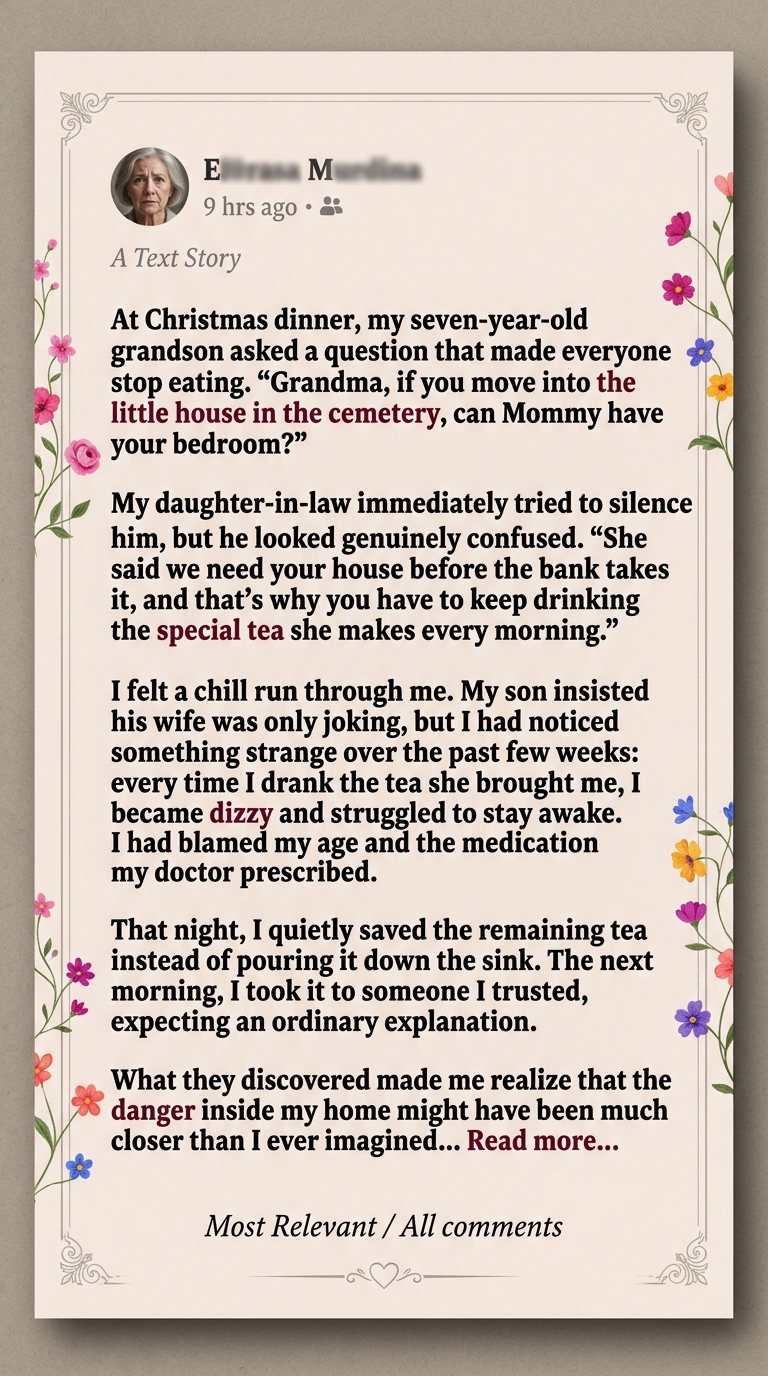
The question came from my seven-year-old grandson just as I was reaching for the cranberry sauce.
“Grandma, when you move into the little house in the cemetery, can Mommy have your bedroom?”
My fork stopped halfway to my mouth.
Around the dining table, conversations faded. My daughter-in-law, Vanessa, went pale. She quickly reached across the table and touched my grandson’s shoulder.
“Ethan, sweetheart, that’s not something we talk about at dinner.”
But Ethan pulled away, genuinely confused.
“Why not? You told Daddy we need Grandma’s house before the bank takes it. You said she has to keep drinking the special tea every morning so she can go live with Grandpa.”
My late husband, Robert, had been buried three years earlier. I had never heard of a little house in the cemetery, and I certainly had no intention of joining him anytime soon.
I slowly lowered my fork.
“What special tea are you talking about, darling?”
Vanessa laughed nervously.
“He’s been watching too many cartoons. You know how children invent things.”
Ethan shook his head.
“It’s the tea you make Grandma every morning. You said it makes her sleepy, and then Mommy can have the big bedroom.”
My son, Daniel, immediately stood up.
“That’s enough, Ethan. Go sit in the living room.”
The boy looked at me apologetically before leaving. Vanessa began clearing plates, avoiding my eyes. Daniel insisted that his wife was only making harmless jokes about the house.
I smiled and pretended to accept his explanation.
But something inside me had changed.
For nearly six weeks, Vanessa had been bringing me a cup of herbal tea every morning. She said it would help me sleep better, improve my circulation, and calm the nerves that had bothered me since Robert’s death.
At first, I appreciated her kindness.
Then I began feeling strangely weak.
Some mornings, my hands trembled so badly that I struggled to hold a spoon. Other days, I would sit in my favorite armchair after breakfast and wake up hours later, confused about how I had fallen asleep.
I had blamed my age and the medication my doctor prescribed for my blood pressure.
Vanessa always seemed to have an explanation.
“You’re doing too much, Margaret.”
“You need to rest more.”
“It’s normal at your age.”
I had believed her because she was my son’s wife, the mother of my grandson, and someone I had welcomed into my home.
That night, I couldn’t sleep.
I kept thinking about Ethan’s words.
Before going to bed, I found the remaining tea in the refrigerator. Vanessa had prepared it earlier that afternoon and poured it into a glass container. I transferred a small amount into a clean bottle, sealed it, and placed it inside my handbag.
The next morning, I told Vanessa I was feeling better and didn’t need tea.
She frowned.
“Are you sure? You’ve been sleeping so much better since I started making it.”
“I think I should ask my doctor before adding anything else to my routine.”
Her expression changed for just a second.
Then she smiled.
“Of course. Whatever you think is best.”
I didn’t tell her where I was going.
Instead, I drove to see Dr. Samuel Price, my physician of nearly twenty years. I explained what had been happening and handed him the bottle.
He listened without interrupting.
“Have you taken any other supplements or herbal products recently?” he asked.
“Only the tea my daughter-in-law prepares.”
He looked at the bottle.
“Don’t drink any more of it until we know what’s inside. I’ll arrange for a toxicology screening, and I want you to bring me a complete list of your medications.”
His seriousness frightened me more than I wanted to admit.
Two days later, he called.
“Margaret, I need you to come to my office. Bring someone you trust if possible.”
I went alone.
Dr. Price closed the office door before speaking.
“The laboratory detected a sedating medication in the sample. It isn’t an ingredient that belongs in ordinary herbal tea, and it isn’t one of your prescribed medications.”
My stomach tightened.
“Could it explain why I’ve been so dizzy?”
“Yes. It could explain the excessive sleepiness, confusion, and some of the weakness you’ve described. I can’t determine how much you consumed or whether there are other substances involved, but you need to stop drinking it immediately.”
I stared at the bottle on his desk.
“Are you telling me someone has been drugging me?”
“I’m telling you that someone has been giving you a drink containing a medication you weren’t prescribed. Given the circumstances you’ve described, I strongly recommend reporting this.”
I left his office with a copy of the laboratory findings and drove directly to the police station.
Detective Laura Bennett listened carefully as I explained the Christmas dinner conversation, the tea, and the strange symptoms.
She didn’t dismiss my concerns because the person involved was family.
Instead, she asked detailed questions.
Who prepared the tea? Where was it stored? Did Vanessa have access to my medication? Had anyone discussed selling my house?
I answered as honestly as I could.
Then I mentioned something I hadn’t thought important before.
Three weeks earlier, Vanessa had asked me to sign several papers. She claimed they were routine documents related to updating my homeowner’s insurance.
I had refused because I hadn’t had time to read them.
Detective Bennett wrote something down.
“Do you still have those papers?”
“I believe they’re in my study.”
She asked me not to confront Vanessa and arranged for an officer to accompany me home. I was also advised not to consume any food or drink prepared by her until the investigation was complete.
When I returned, Vanessa was in the kitchen.
She looked at my handbag.
“Where have you been?”
“Seeing my doctor.”
“About what?”
“My dizziness.”
She immediately began wiping the counter.
“What did he say?”
“He wants me to stop drinking the tea.”
Her hand paused.
“That’s ridiculous. It’s only chamomile and lavender.”
“Then there shouldn’t be any problem with having it tested.”
For a moment, neither of us spoke.
Then she forced a smile.
“You’re letting your imagination run away with you.”
I went upstairs without answering.
The following afternoon, Detective Bennett returned with another officer. They collected the remaining tea, the container, and the papers from my study.
The documents Vanessa had given me were not insurance forms.
They were draft applications to refinance my house and authorize a new joint account. My name appeared on several pages, but the signatures were incomplete. One document included a proposed arrangement that would have given Daniel and Vanessa authority over certain financial decisions if I became medically incapacitated.
I had never agreed to anything like that.
The detective explained that the papers alone did not prove a crime, but they were important evidence.
Then she asked whether Vanessa had ever mentioned taking me to a doctor for a memory assessment.
I remembered that she had.
Several times, she had suggested I was becoming forgetful and might need someone to manage my affairs.
I had thought she was simply worried about me.
Now I understood why she had been so interested in my health.
The investigation took another week. During that time, I stayed with my longtime friend Helen while the police examined the evidence. Daniel called repeatedly, sounding confused and increasingly angry.
He insisted that Vanessa would never hurt me.
When I finally agreed to meet him, he arrived alone.
“Mom, the police have questioned Vanessa for hours,” he said. “They think she put something in your tea.”
“They have laboratory results, Daniel.”
“She says she never knew anything was in it.”
“Then who prepared it?”
“She says she bought an herbal mixture from someone at a wellness shop.”
I studied my son’s face.
“Did she tell you I was supposed to die?”
His expression crumpled.
“No. Of course not.”
“Then why did Ethan say she wanted my room after I moved into the cemetery?”
Daniel rubbed his forehead.
“She told me she was worried about your finances. She said the house was too expensive for you to maintain and that you might eventually need assisted living. We talked about moving into your home because it would be easier for everyone.”
“Did you agree to that?”
“I thought we were discussing possibilities. I didn’t know she had made plans.”
I wanted to believe him, but I couldn’t ignore the fact that he had dismissed his own son’s warning at Christmas.
“Daniel, you heard Ethan. You watched me become weaker every morning. Why didn’t you ask questions?”
He looked down.
“Because I trusted her. And because I wanted to believe everything was fine.”
His answer hurt more than an argument would have.
A few days later, Detective Bennett called with an update.
The tea contained a prescription sedative that had not been prescribed to me. Investigators traced the medication to a prescription issued to Vanessa several months earlier. The pharmacy records showed that she had collected it herself.
More importantly, messages recovered from her phone revealed that she had discussed making me appear increasingly confused and incapable of living independently.
She had also searched for information about obtaining control over an elderly relative’s finances.
The most disturbing messages were between Vanessa and a man she had met through a debt-relief service. She had borrowed money to cover several failed business investments and was facing foreclosure on the house she and Daniel owned.
She believed my property could solve her problems.
But there was something else.
Vanessa had repeatedly complained that I would never agree to sell my house while I was healthy and thinking clearly. In one message, she wrote that if I became unable to manage my affairs, Daniel could be persuaded to move into my home and take control of the situation.
She had not written that she wanted me dead.
She had written that she wanted me weakened, confused, and dependent enough that nobody would question her decisions.
The police arrested her after obtaining the necessary evidence.
Daniel was devastated.
For several days, he barely spoke. He kept saying he should have noticed something, that he should have protected me, that he had failed both his mother and his son.
I told him that his failure to question Vanessa had consequences, but I wasn’t going to pretend he had deliberately helped her.
He had to face what he had ignored.
Vanessa eventually pleaded guilty to charges related to administering an unauthorized sedative and attempting to exploit my financial vulnerability. She was sentenced to prison and ordered to undergo treatment as part of her rehabilitation.
The court also prohibited her from contacting me except through approved arrangements concerning Ethan.
The hardest part came afterward.
Ethan had heard adults arguing and had begun blaming himself for what happened.
One afternoon, Daniel brought him to visit me.
The boy sat beside me on the sofa, twisting the sleeve of his sweater.
“Grandma, are you mad at me?”
I put my arm around him.
“Why would I be mad at you?”
“Because I told everyone about the tea.”
I gently lifted his chin.
“You did exactly the right thing. You told the truth when something didn’t feel right. You may have helped save my life.”
His eyes filled with tears.
“I didn’t want you to go to the cemetery.”
I hugged him tightly.
“I’m not going anywhere, sweetheart.”
Daniel sat across from us, wiping his eyes.
“I should have listened to him,” he whispered.
“Yes,” I said. “You should have.”
He didn’t argue.
Over the next several months, I recovered physically. My doctor adjusted my medication and monitored my health until the dizziness and excessive sleepiness disappeared. I also changed the locks, updated my financial accounts, and made my own decisions about the house.
I did not sell it.
Instead, I converted the downstairs study into a small room where Ethan could draw, read, and play whenever he visited. Daniel began coming over every Sunday, not because he expected to inherit anything, but because he finally understood that being family meant showing up and paying attention.
Our relationship did not return to what it had been before Christmas. Trust takes longer to rebuild than it takes to destroy. I made that clear, and Daniel accepted it.
As for Ethan, he never asked about the little house in the cemetery again.
One spring afternoon, while we planted flowers in the garden, he looked up at me.
“Grandma, are you going to drink tea again?”
I smiled.
“Of course. But from now on, I’ll make it myself.”
He considered that answer carefully, then nodded.
I watched him return to his little watering can and felt a gratitude deeper than words.
For weeks, I had believed my body was simply growing old. I had mistaken careful manipulation for kindness and accepted explanations that should have raised questions.
But a seven-year-old boy had noticed what the adults had chosen not to see.
He hadn’t understood the medicine, the money, or the documents. He had only repeated what he had heard.
And that had been enough to expose the danger.
I still think about that Christmas dinner sometimes. Not because of the silence that followed Ethan’s question, but because of the moment before it, when everyone was eating and laughing while I unknowingly drank something that was making me disappear a little more each day.
I learned that night that danger does not always arrive with threats or angry voices.
Sometimes it comes in a warm cup, offered with a smile, by someone who knows exactly where you keep the sugar.