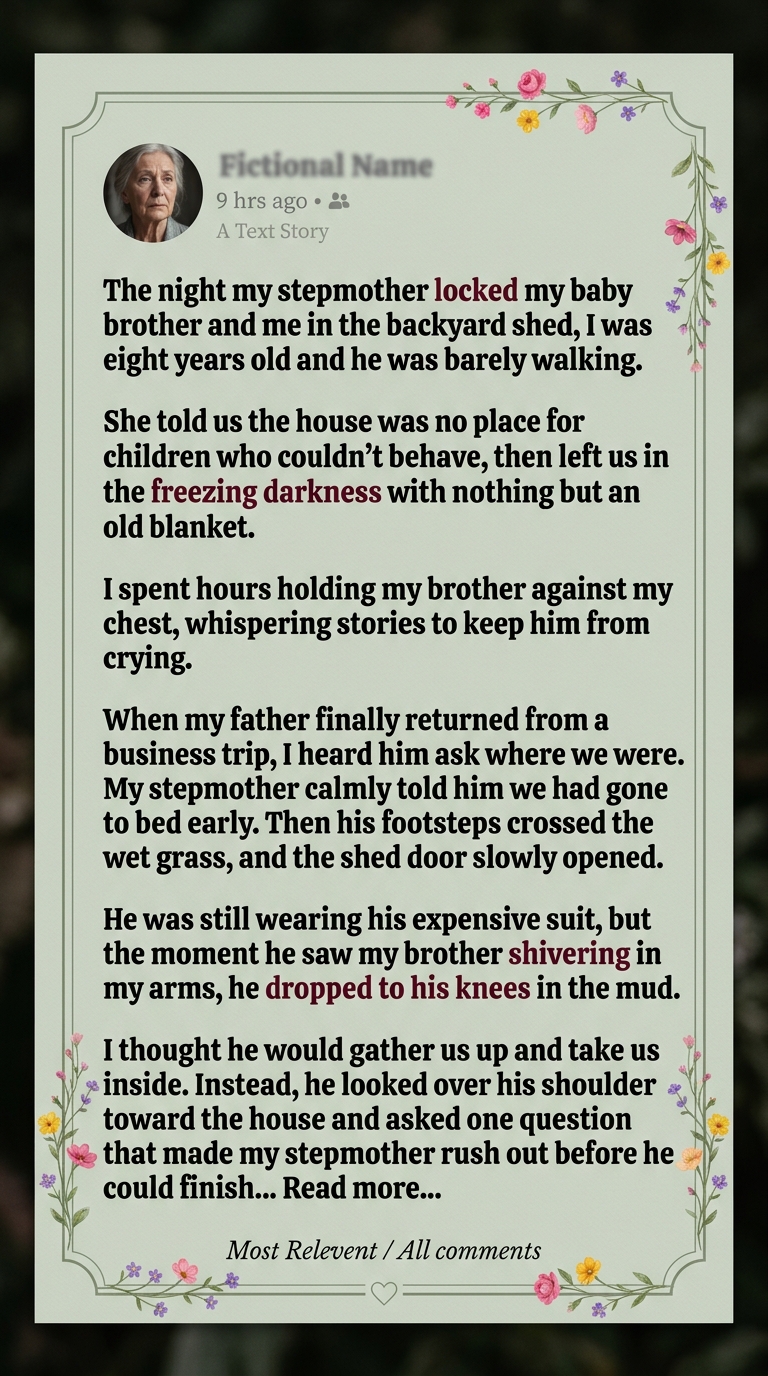
I was eight years old the night my stepmother locked my baby brother and me in the backyard shed. My brother, Oliver, was only fourteen months old. He was still learning to walk, and whenever he became frightened, he reached for me with both hands.
That evening, my stepmother, Patricia, had been angry because Oliver spilled a bowl of cereal on the kitchen floor. I tried to clean it up, but she said I had made the mess worse by letting him play near the table.
“You two are impossible,” she snapped. “This house is no place for children who refuse to behave.”
Before I understood what she meant, she grabbed our coats, pushed us through the back door, and led us across the garden.
The shed stood behind the garage. It smelled of damp wood, old paint, and gasoline. Patricia threw an old blanket onto the floor and pointed at it.
“Stay here until you learn to behave.”
I begged her not to leave Oliver outside. She ignored me, shut the door, and turned the key.
At first, I thought she would return after a few minutes. But the sky darkened, rain began tapping against the roof, and the temperature dropped. Oliver started crying. I wrapped the blanket around him and held him against my chest.
“It’s just a game,” I whispered. “We’re camping. Remember the stories Dad tells us about explorers?”
Oliver didn’t understand all my words, but he recognized my voice. Eventually, his crying softened into little hiccups.
I told him stories about a brave rabbit who crossed a snowy forest to find his family. I invented mountains, talking birds, and a castle made of warm bread. I kept talking because whenever I stopped, he began shivering harder.
My father, Richard, was supposed to return from a business trip that evening. I had no idea whether Patricia had remembered.
I only knew that I wanted him to come home.
Inside the house, Patricia continued her evening as if nothing had happened. I could see the kitchen light through a narrow gap beneath the shed door. Once, I heard the television. Later, I heard a car pull into the driveway.
Then came my father’s voice.
“Patricia? Where are the children?”
“They went to bed early,” she replied. “It was a difficult evening.”
There was a pause.
“Both of them?”
“Yes. Oliver was tired, and Emma was being difficult. I put them upstairs.”
I wanted to scream, but Oliver had finally fallen asleep against me. I was afraid that if I moved, he would wake up crying.
Then I heard my father’s footsteps crossing the wet grass.
The shed door rattled.
A key turned in the lock, and the door slowly opened.
My father stood outside in his expensive gray suit, holding his car keys. His expression changed the moment he saw us.
He dropped to his knees in the mud.
“Emma? Oliver?”
I clutched my brother tighter.
“Daddy, I tried to keep him warm.”
My father reached toward us, then stopped when he saw Oliver’s blue-tinged lips and trembling hands.
He took off his jacket, wrapped it around both of us, and lifted Oliver into his arms.
Then he looked over his shoulder toward the house.
“Patricia,” he called, his voice suddenly quiet. “How many times have you done this?”
Before he could say anything else, the back door flew open.
Patricia rushed into the garden.
“What are you doing out here?” she demanded. “They were supposed to be asleep!”
My father turned toward her.
“That wasn’t what I asked.”
She glanced at the shed, then at us.
“Richard, you’re misunderstanding. Emma was misbehaving, and I needed to teach her that there are consequences.”
“In a freezing shed?”
“They weren’t going to be out here all night.”
My father looked at his watch.
“It is nearly midnight.”
Patricia folded her arms.
“You weren’t here. You don’t know what it’s like managing two children alone.”
My father didn’t raise his voice.
“I’m asking you how many times you’ve locked them out here.”
She looked away.
That small movement told him more than her explanation.
He carried Oliver toward the house while I followed, wrapped in his jacket. Patricia hurried behind us, insisting that she had done nothing serious.
Inside, my father called his driver, who had accompanied him home from the airport, and asked him to bring a thermometer and warm blankets from the car. Then he called our pediatrician.
Oliver was examined that night. Fortunately, he had not suffered lasting harm, but the doctor warned that prolonged exposure to the cold could have been dangerous, especially for a child so young.
I was taken upstairs, given warm clothes, and settled beside my brother.
I thought everything would be over by morning.
But I had misunderstood my father’s question.
He wasn’t asking because he wanted to punish Patricia for one terrible evening. He was asking because he had already noticed things that didn’t make sense.
For months, he had received messages from Patricia claiming that I was becoming increasingly aggressive toward Oliver. She said I refused to help with him, deliberately disturbed his sleep, and sometimes frightened him.
My father had never seen that behavior himself. He had asked Patricia to arrange a meeting with our family doctor, but she always found a reason to postpone it.
He had also noticed that Oliver cried whenever Patricia approached him after being left alone with her. He had dismissed it as ordinary toddler behavior because she repeatedly assured him that everything was fine.
Now he knew he had been wrong.
The following morning, my father asked me to sit with him in the living room while Oliver played nearby.
“Emma, I need you to tell me the truth,” he said. “Has Patricia ever locked you outside before?”
I stared at my hands.
“Sometimes.”
His face tightened.
“How many times?”
“I don’t know. A lot.”
“Did she ever hurt Oliver?”
I shook my head, then hesitated.
“She gets angry when he cries. Sometimes she puts him in his room and tells me not to go in, even when he calls for me.”
My father leaned forward.
“Has she ever told you not to tell me?”
I nodded.
“She said you were busy and that if I complained, you might send Oliver away because he was too much trouble.”
My father closed his eyes.
That was when I finally began to cry.
“I didn’t want you to send him away, Daddy. He’s only little. He needs me.”
My father pulled me into his arms.
“Listen to me. You are both my children. Neither of you is going anywhere because you need care. And you should never have been made responsible for protecting your brother from an adult.”
He apologized for not noticing sooner. I had never heard my father apologize like that before.
Later that day, he arranged for a child welfare specialist to speak with us. A doctor examined both children, and an investigator interviewed my father and Patricia separately.
At first, Patricia insisted that I had exaggerated everything. She claimed the shed had been used as a harmless punishment and that the children had been outside for only a few minutes.
But the investigator discovered that the shed door could only be locked from the outside. A neighbor also remembered hearing a child crying in the garden on several previous evenings. When asked about it, Patricia had told the neighbor that we were playing outside.
The most damaging evidence came from a message Patricia had sent to a friend the previous month.
She had written that she was tired of raising children who weren’t hers and that she intended to make my father understand that our presence was ruining their marriage.
My father read the message twice.
He had married Patricia two years after my biological mother died. At first, she had been attentive and pleasant. But once my father began traveling more frequently for his company, her behavior changed. She resented the time he spent with us and increasingly treated our needs as inconveniences.
She had never wanted to become our mother. My father had believed she could still be a good adult in our lives.
That belief had cost us more than he understood.
Patricia left the house while the investigation continued. She was not permitted to be alone with us, and my father began divorce proceedings. The child welfare authorities arranged support for both children and monitored our living situation until they were satisfied that we were safe.
My father also changed his work schedule. He hired a qualified caregiver to help during the hours he had to be away, but he made it clear that the responsibility for raising us belonged to him.
For the first few weeks, I refused to sleep in my bedroom. I kept asking whether the doors were locked and whether Oliver was still beside me.
My father never told me to stop being afraid.
Instead, he placed a small night-light in our room and left the hallway light on. Every night, he came to check on us before going to bed.
One evening, he found me sitting beside Oliver’s crib, holding the same old blanket from the shed.
“Do you still think about that night?” he asked.
I nodded.
“Sometimes I dream that the door won’t open.”
He sat beside me.
“I can’t change what happened, Emma. But I can make sure you never have to face something like that alone again.”
I looked at him.
“Why didn’t you know she was doing it?”
He took a long breath.
“Because I trusted someone I should have questioned. I listened to her explanations instead of paying attention to what you were trying to tell me. That was my mistake, not yours.”
It was the answer I needed, even though it couldn’t erase the memory.
Months passed. Oliver grew stronger and began running through the garden, laughing whenever I chased him. I returned to school without constantly worrying about what would happen at home.
My father kept his promise. He attended school meetings, learned how to manage Oliver’s bedtime routine, and stopped treating business travel as an unavoidable excuse for missing family life.
The divorce was finalized the following year. Patricia was held accountable through the legal process, and she was not allowed to resume unsupervised contact with us.
Years later, when Oliver was old enough to understand what had happened, he asked why I always insisted that he keep a warm blanket in his bedroom.
I told him it was because everyone deserved to feel safe and warm, especially at home.
He thought about that for a moment.
Then he smiled and said, “Like when Dad found us?”
I nodded.
“Exactly like that.”
I never forgot the sight of my father kneeling in the mud that night. For a long time, I remembered only the fear on his face when he saw us in the shed.
Eventually, I understood something else.
He had opened that door expecting to find two sleeping children inside the house. Instead, he found the truth he had been too trusting to see.
And the question he asked Patricia was not really about how many times she had locked us outside.
It was the moment he finally understood that protecting his children required more than loving them.
It required believing them, paying attention, and having the courage to act when someone they trusted had caused them harm.