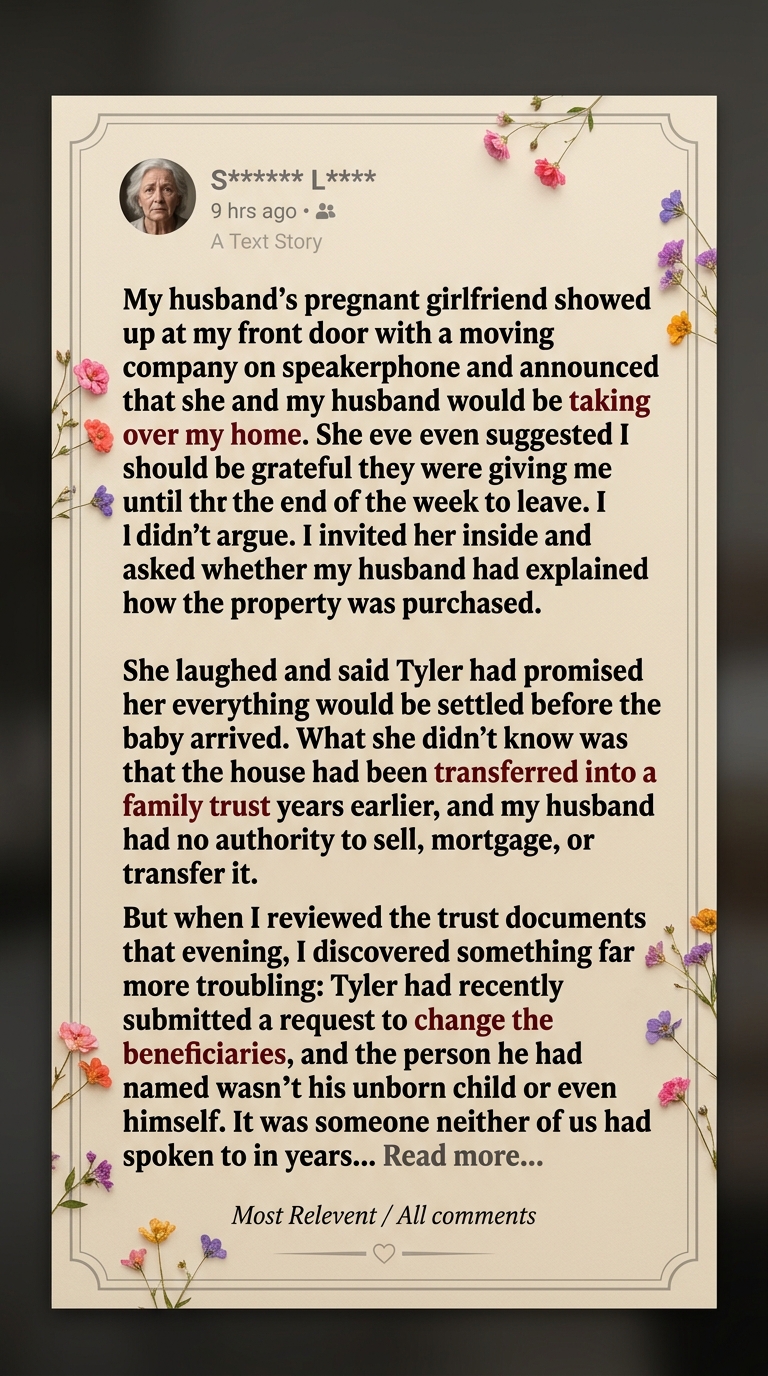
The first time my husband’s girlfriend came to my front door, she didn’t come alone.
A moving company was waiting outside with a truck, two employees, and a list of furniture they had apparently been instructed to remove. The woman standing beside them was wearing a cream-colored maternity dress, one hand resting on her stomach and the other holding her phone.
“I’m Chloe,” she announced, as though I had somehow forgotten the name of the woman my husband had been seeing for nearly eight months. “Tyler said you’d be difficult about this, so I thought it would be better to handle everything in person.”
I stared at her.
“Handle what?”
She glanced at the movers.
“We’re moving in. Tyler and I have a baby coming, and he says this house is the best place for us to start our family. He’s giving you until Friday to collect your things.”
She said it with the confidence of someone announcing that a restaurant reservation had been changed.
I looked past her at the moving truck.
“Did Tyler tell you that I own this house?”
Chloe laughed.
“He told me everything. We’ve already discussed the arrangements. You’re getting a generous amount of time to leave, considering how long you’ve been living here.”
I stepped aside and opened the door wider.
“Come inside. I think there are a few things he forgot to explain.”
She smiled triumphantly and walked into the living room.
I offered her water. She declined, then began pointing toward the furniture.
“That sofa can go. Tyler wants something more modern. The dining table too. And we’ll need the upstairs bedroom for the baby.”
I listened without interrupting.
Then I asked, “Has Tyler explained how this property was purchased?”
Chloe rolled her eyes.
“He said it was his before you got married.”
“That isn’t what I asked.”
“He said his family helped him buy it. Whatever arrangement you two had before, he’s taking care of it now.”
I nodded slowly.
“Interesting.”
Chloe checked her phone.
“Can we finish this? I have a doctor’s appointment.”
“Of course. I’ll speak with Tyler.”
She gave me a satisfied smile, then walked back outside and told the movers to wait for further instructions.
I closed the door.
My hands were shaking, but not because I was afraid of losing the house.
I was afraid of what my husband might have done to get Chloe to believe he could simply hand it over.
Tyler and I had been married for nine years. We had moved into the house shortly after our wedding, and he had always described it as our family home. He handled most of the household maintenance, while I managed the finances and kept the records.
What he rarely mentioned was that the property had never belonged to either of us personally.
My grandmother, Eleanor, had purchased it decades earlier. After her death, she left it in the care of a family trust established to protect the property for future generations. I was the primary beneficiary, and my mother had been appointed trustee until she retired. After that, a professional trustee took over.
The arrangement was deliberately restrictive.
No beneficiary could sell, mortgage, or transfer the property without the trustee’s approval. Tyler had been allowed to live there as my spouse, but he had never owned it.
I called the trustee, Mr. Bennett, and explained what had happened.
He became unusually quiet when I mentioned the moving company.
“Please don’t let anyone remove anything,” he said. “I need to review the trust records immediately.”
“Why?”
“Because your husband submitted a beneficiary amendment request three weeks ago.”
My stomach tightened.
“What kind of amendment?”
“He requested that the trust’s future interest be redirected to a third party.”
“Who?”
There was a pause.
“Your half-brother, Daniel.”
I sat down.
Daniel and I hadn’t spoken in eleven years.
He was my mother’s son from her first marriage. When I was young, he had been the person I admired most. He taught me to ride a bicycle, helped me with mathematics, and once spent an entire night sitting outside my bedroom because I was afraid of a thunderstorm.
Then, when I was twenty-one, he disappeared from our family.
The official explanation was that he had taken money from our grandmother’s estate and left after a furious argument. My mother refused to discuss him. I had sent letters for several years, but none received a response.
Eventually, I stopped trying.
Now my husband had apparently named him as the person who should inherit the house.
“Why would Tyler do that?” I whispered.
“That’s what we need to establish,” Mr. Bennett replied. “The request hasn’t been approved. In fact, there are problems with the documentation.”
“What problems?”
“The signature on the supporting declaration appears to have been copied from an older document. We are investigating its origin.”
I felt cold.
“Are you saying Tyler forged my signature?”
“I’m saying we cannot accept the amendment as valid. Please don’t confront him until we have secured the records.”
I ended the call and sat in the living room for a long time.
My husband had been cheating on me, apparently promising another woman my home, and attempting to alter a family trust.
But why Daniel?
That evening, Tyler came home carrying a takeout bag.
He found me sitting at the dining table with the trust documents spread in front of me.
His expression changed immediately.
“What’s all this?”
“Chloe visited today.”
He placed the bag on the counter.
“She wasn’t supposed to come here without telling me.”
“She brought a moving company.”
Tyler rubbed his forehead.
“She’s pregnant. She’s emotional. You know how these things are.”
“Do I?”
He sighed.
“Look, this marriage has been over for a while. We need to stop pretending otherwise. Chloe and I are having a child. We need the house.”
I looked directly at him.
“You don’t own the house.”
His expression hardened.
“We’ve lived here for nine years.”
“That doesn’t make you the owner.”
“My grandmother helped us buy it.”
“My grandmother bought it before we were married. The trust documents are right here.”
He glanced at the papers, then looked away.
“Those arrangements were supposed to be temporary.”
“They weren’t.”
He pulled out a chair.
“Listen, I was trying to make things easier. You can have money for an apartment. Chloe and I can take over the house, and everyone moves on.”
“You offered my house to your girlfriend?”
“Our house,” he snapped.
“No. The trust owns it. I have the beneficial interest. You have permission to live here because you’re my husband.”
He stared at me.
Then his eyes settled on the amendment request.
“Where did you get that?”
“From Mr. Bennett.”
Tyler’s face drained of color.
I tapped the page.
“Why did you name Daniel as the new beneficiary?”
He leaned back.
For several seconds, he said nothing.
Then he answered, “Because Daniel deserves it.”
I almost laughed.
“After eleven years of silence?”
“You don’t understand what happened.”
“Then explain it.”
Tyler looked toward the window.
“Your grandmother didn’t throw Daniel out because he stole money. He was trying to protect her.”
I felt my chest tighten.
“What are you talking about?”
“Your mother told everyone Daniel had taken money from the estate. But he discovered that she had been transferring funds into accounts controlled by her second husband. When he confronted her, she accused him of theft first.”
I shook my head.
“That makes no sense. My mother would never—”
“Your grandmother believed him. That’s why she changed the trust before she died. She made sure the house couldn’t be taken or sold by anyone in the family.”
I stared at him.
“Why didn’t Daniel tell me?”
“He tried. Your mother intercepted his letters. She told him that if he contacted you again, she’d make sure you lost everything your grandmother had left you.”
My throat tightened.
“And you know this how?”
Tyler finally looked at me.
“Because I met him.”
The room seemed to tilt.
“When?”
“About six months ago.”
“Why?”
Tyler hesitated.
“Your mother died last year, and Daniel came back to settle some old matters. He contacted me because he thought I might be willing to help him recover the money your mother had taken.”
I remembered my mother’s funeral. Tyler had claimed he couldn’t attend because of a business meeting.
“You met my brother while I was grieving our mother?”
“Yes.”
“And you never told me?”
“I thought I could resolve everything first.”
“By changing the trust?”
He rubbed his face.
“Daniel said he had evidence that the trust should have been arranged differently. He believed the house was supposed to be his.”
I looked down at the amendment.
“Did he ask you to put his name here?”
Tyler didn’t answer.
That was answer enough.
I called Mr. Bennett the next morning and requested an in-person meeting. He arranged for an independent trust attorney, Ms. Collins, to attend.
When I arrived, Daniel was already sitting in the conference room.
He looked older than I remembered. His hair had turned gray at the temples, and there were deep lines around his eyes. But I recognized the way he held his hands together when he was nervous.
For several seconds, neither of us spoke.
Then he stood.
“I’m sorry,” he said.
I wanted to hug him.
I also wanted to ask why he had let me spend eleven years believing he had stolen from our grandmother.
Instead, I asked the question that mattered.
“Did you ask Tyler to put your name on the trust?”
Daniel shook his head immediately.
“No. I told him the opposite. I asked him to stop interfering.”
Mr. Bennett opened a folder.
“Daniel contacted our office before the amendment request was submitted. He wanted to know whether he had any rights under the original trust. We explained that he did not have a present ownership interest and that only the designated trustee could consider any amendment.”
Daniel looked at me.
“I never wanted your house. I wanted the records your grandmother left behind.”
Ms. Collins placed a second folder on the table.
Inside were copies of bank statements, old correspondence, and several handwritten notes.
Daniel explained that after our grandmother became seriously ill, our mother had gained access to some of her financial accounts. She used the money to support her second husband’s failing business and later transferred part of the estate into accounts that were never properly reported.
Daniel discovered the transfers while helping our grandmother organize her paperwork.
He confronted our mother, who accused him of stealing the money himself. She then told the family that he had disappeared because he was guilty.
Our grandmother knew the truth.
She couldn’t recover everything before she died, but she had arranged for the trust records to be preserved independently. She also left instructions that Daniel should receive a copy of the financial investigation if he ever returned and requested it.
He had spent years trying to obtain those records.
“Why didn’t you come to me?” I asked.
Daniel’s eyes filled.
“I did. Several times. Your mother told me you wanted nothing to do with me. Then I received a letter in your handwriting saying you believed her.”
I felt sick.
“I never wrote that.”
“I know that now.”
Ms. Collins turned a page.
The letter Daniel had received was dated eleven years earlier. The signature looked like mine, but I knew immediately that I hadn’t written it.
My mother had forged it.
I pressed my fingers against my forehead.
All those years, I had believed my brother abandoned me.
He had believed I rejected him.
And our mother had made sure neither of us knew the truth.
But there was still one question.
“Why did Tyler submit the amendment?”
Daniel looked toward the window.
“He said he wanted to make things right.”
“That doesn’t explain it.”
Ms. Collins answered.
“Your husband had been contacting Daniel about the old financial records. Tyler believed the trust might be vulnerable if he could establish that Daniel was the rightful heir. He submitted an amendment naming Daniel as beneficiary, but the request included a declaration supposedly signed by you.”
I looked at Tyler, who had been waiting outside the conference room.
“He told you he wanted to help Daniel,” I said.
Daniel nodded.
“But I never agreed to receive the property. I wanted the records examined so the money your grandmother lost could be accounted for. Tyler kept asking about the house.”
Mr. Bennett added that the amendment had been rejected before any change could take effect. The copied signature had triggered a review, and the trustee had preserved the original records.
I finally understood.
Tyler had used Daniel’s return as an opportunity to create a false appearance of consent. By naming Daniel, he hoped to make the transfer look like a family decision rather than an attempt to gain control of property he did not own.
Whether he intended to benefit from a later sale or simply believed he could pressure me into leaving, he had no authority to make that decision.
And Chloe had been told the house was already hers.
When Tyler entered the room, Daniel stood.
“You told me you were helping me,” Daniel said.
Tyler looked uncomfortable.
“I was trying to give you what you deserved.”
“No,” Daniel replied. “You were using my name to get something you wanted.”
Tyler turned toward me.
“Can we talk privately?”
“No.”
His expression hardened.
“You’re really going to throw away nine years of marriage over paperwork?”
I stared at him.
“You brought another woman to my front door and told her she could move into my home. You tried to change a family trust using my signature. And you hid my brother’s return from me.”
He opened his mouth.
I continued.
“You didn’t make one mistake. You made a series of decisions, and every one of them required you to lie.”
He looked toward Daniel.
Then he looked at the attorney.
Finally, he lowered his eyes.
The trust’s attorney sent Tyler a formal notice that same afternoon, confirming that his residential permission would end following the separation and that he had no authority to arrange a sale, mortgage, or transfer. The trustee also referred the suspected signature fraud for an independent review.
Chloe called me twice that evening.
I didn’t answer.
She sent a message saying Tyler had told her I was trying to steal the house from their unborn child.
I replied with one sentence:
“Your baby deserves an honest father, and you deserve the truth about the promises he made.”
I didn’t hear from her again.
The divorce took several months. Tyler eventually moved into a rented apartment. The trust remained intact, and the trustee strengthened its verification procedures so no future beneficiary change could be submitted without independent confirmation.
The financial investigation also uncovered enough evidence to establish that Daniel’s accusations against our mother had been true. The missing estate funds had been diverted through several accounts connected to her former husband’s business. There was no practical way to recover everything, but the records finally cleared Daniel’s name.
More importantly, he and I began speaking again.
Our first few conversations were awkward. Eleven years of misunderstanding couldn’t disappear in a week. Sometimes we argued about memories. Sometimes we sat quietly because neither of us knew what to say.
One afternoon, Daniel brought me a small wooden box.
Inside were the letters he had written over the years.
Some were addressed to me. Others were addressed to our grandmother. He had kept copies of everything, including the letter he had received supposedly from me.
At the bottom was a photograph of the two of us as children, sitting on the steps of our grandmother’s house.
I began to cry.
“I thought you had forgotten me,” I whispered.
Daniel sat beside me.
“I never forgot you. I just thought you had stopped wanting me around.”
I reached for his hand.
“I’m sorry.”
“So am I.”
We sat there for a long time.
A few months later, the baby was born. I heard about it through a mutual acquaintance. I hoped the child would grow up surrounded by honesty and kindness, regardless of what happened between Tyler and me.
I never tried to punish an innocent child for the choices of adults.
But I also never reconsidered my decision.
The house remained where my grandmother had intended it to remain—not as a prize, not as a bargaining chip, and not as something a husband could promise to another woman.
It was a piece of our family’s history, protected by someone who had understood that love without safeguards could leave the people she cared about vulnerable.
The greatest surprise wasn’t that Tyler had no right to give away my home.
It was discovering that the brother I had mourned for eleven years had never abandoned me at all.
And the person who had truly divided our family was someone we had both trusted without question.