The Christmas Tradition My Mother Lost
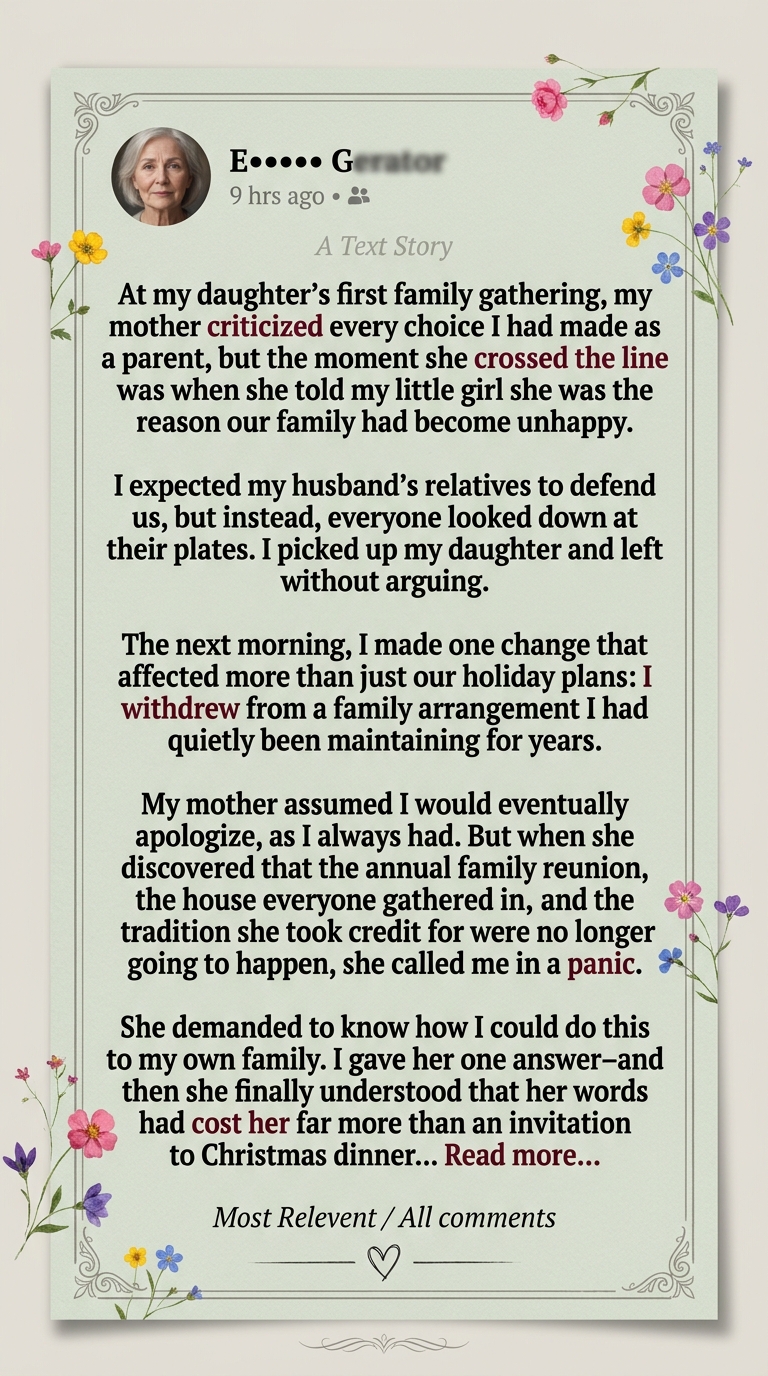
My daughter was four years old when my mother told her she was the reason our family had become unhappy.
It happened during her first Christmas gathering with my husband’s extended family. We had traveled nearly three hours to attend, and I had spent the entire morning making sure Lily was comfortable. She was shy around large groups, especially people she didn’t know well, so I had packed her favorite stuffed rabbit, snacks, and a small coloring book.
I wanted her first holiday with the family to be happy.
Instead, it became the day I finally stopped protecting my mother from the consequences of her own behavior.
My mother, Patricia, had never approved of the way I raised Lily. She believed children should be quiet, obedient, and grateful for whatever adults gave them. She considered gentle parenting an excuse for bad behavior and thought that comforting a crying child only encouraged weakness.
I had heard her opinions for years.
She criticized Lily’s clothes, complained when I let her choose her own breakfast, and regularly compared her to my sister’s children.
At first, I tried to ignore it.
My husband, Mark, usually told me not to take her comments personally. His relatives were equally uncomfortable around my mother, but nobody wanted to challenge her. She had a talent for turning every disagreement into an accusation that someone was disrespecting her.
That Christmas afternoon, she was particularly determined to make an impression.
When Lily spilled a little juice near the dining table, my mother sighed loudly.
“Honestly, Claire, she’s old enough to know better.”
“She’s four, Mom. It was an accident.”
“That’s what you always say. You never teach her to be careful.”
I wiped the juice with a napkin and helped Lily back into her chair.
My mother continued.
“She gets away with everything. No wonder she behaves like this.”
Mark’s aunt tried to change the subject, asking Lily whether she liked her new doll. Lily smiled shyly and nodded.
For a few minutes, the conversation moved elsewhere.
Then my mother noticed Lily refusing a serving of vegetables.
“Don’t be difficult,” she said. “Your mother already lets you do whatever you want.”
Lily looked at me.
“Can I have some potatoes instead?”
“Of course, sweetheart.”
My mother put down her fork.
“See? This is exactly the problem. You give her everything she asks for.”
I felt my patience thinning.
“Mom, please. We’re here to enjoy Christmas. Can we stop criticizing every little thing she does?”
She looked around the table as if I had insulted her.
“I’m only trying to help. Someone has to teach that child some manners.”
I thought that would be the end of it.
I was wrong.
A little later, Lily accidentally knocked over her glass while reaching for her rabbit. The glass landed on its side, spilling water across the tablecloth.
Before I could even reach for a napkin, my mother snapped.
“Look at what you’ve done!”
Lily froze.
“I’m sorry,” she whispered.
My mother shook her head.
“Your mother never taught you to be careful. Everyone has to rearrange their lives around you.”
I stood up.
“That’s enough.”
But my mother wasn’t finished.
She leaned toward Lily and said, in a voice loud enough for everyone to hear, “Do you know why this family isn’t happy anymore? It’s because everything has to revolve around you. Your mother has made you the center of everyone’s life, and now nobody can enjoy anything.”
Lily’s lower lip began to tremble.
She looked at me with frightened eyes.
“Mommy, did I make everyone unhappy?”
Something inside me went completely still.
I looked around the table.
Mark’s uncle stared at his plate. His aunt suddenly became very interested in pouring more water. My husband looked uncomfortable but said nothing.
Nobody defended my daughter.
I didn’t shout. I didn’t insult my mother. I simply walked around the table, picked Lily up, and collected her little rabbit.
“We’re leaving,” I said.
My mother scoffed.
“Oh, don’t start another scene.”
I looked directly at her.
“You’ve already made one.”
Then I walked out.
Mark followed us after a moment, carrying our coats and the bag I had left near the entrance. He didn’t say much during the drive home.
When we finally arrived, Lily was asleep in the back seat.
Mark glanced at me.
“I should have said something.”
“Yes,” I replied.
He nodded.
“I know.”
I didn’t want an argument that night. I carried Lily upstairs, changed her into her pajamas, and tucked her into bed.
Before falling asleep, she asked one question.
“Mommy, if I wasn’t there, would Grandma be happy?”
I sat beside her and held her hand.
“No, sweetheart. You are not responsible for making grown-ups happy. You didn’t do anything wrong.”
She nodded, but I could tell she was still hurt.
After she fell asleep, I went downstairs and opened the folder where I kept the records for our family’s annual Christmas gathering.
For eleven years, I had been quietly maintaining an arrangement that made the entire holiday possible.
The large house where everyone gathered belonged to my late grandfather. After he died, the property passed to me and my younger brother, Daniel, through a family settlement. Daniel had moved abroad several years earlier, and I had purchased his share.
My mother had been the one who organized the gatherings there long before I became the owner. She had always described the house as the heart of the family.
Everyone assumed she still controlled it.
In reality, I had been paying the property taxes, insurance, repairs, utilities, and maintenance costs. I also arranged the cleaning before and after every reunion and covered the expenses whenever relatives stayed there.
I had never complained.
My mother enjoyed telling people that she had preserved the family tradition. I let her take the credit because I thought keeping everyone together was worth more than recognition.
But after what happened to Lily, I finally understood that I had been maintaining more than a holiday arrangement.
I had been financing a place where my own child could be made to feel unwelcome.
The following morning, I called the property manager.
I instructed him to cancel the cleaning and catering arrangements for the upcoming family reunion. I also told him that the house would no longer be available for family gatherings unless I personally approved the occasion.
Then I contacted the relatives who had already been invited and explained that the Christmas reunion would not take place at the house.
I didn’t tell them they couldn’t see one another. I simply made it clear that I would no longer organize or pay for an event that had become an excuse for people to mistreat my daughter.
Finally, I called my mother.
“I’m not hosting the reunion this year,” I told her.
There was a brief silence.
“What do you mean?”
“The house won’t be available.”
She laughed.
“You’re upset about yesterday. You’ll get over it.”
“This isn’t just about yesterday. I’m done paying for everything and pretending your behavior is acceptable.”
“Oh, Claire. Don’t be ridiculous. Everyone makes mistakes.”
“Calling a four-year-old the reason a family is unhappy isn’t a mistake. It’s cruel.”
My mother sighed.
“You’re too sensitive. Your daughter needs to learn that the world won’t revolve around her.”
“She’s four. She needs adults to make her feel safe.”
“Well, if you insist on raising her that way, that’s your decision. But don’t punish the entire family.”
“I’m not punishing anyone. I’m no longer funding the arrangement.”
She hung up.
For the next few weeks, I received several messages from relatives asking what had happened. Some were genuinely concerned. Others were irritated because they had already planned their travel around the reunion.
I explained the situation without exaggerating.
A few people apologized for remaining silent at the table.
Mark’s aunt, Helen, called me one evening.
“I should have spoken up,” she admitted. “I saw Lily’s face, and I knew your mother had gone too far. I was afraid of making things worse.”
“I understand that it was uncomfortable,” I said. “But Lily needed someone to tell her she hadn’t done anything wrong.”
Helen was quiet.
“You’re right.”
She later sent Lily a small Christmas package with a handwritten note saying she hoped they could have a happier visit another time.
My mother, however, remained convinced that I would eventually change my mind.
She continued telling relatives that I was being dramatic and that the house would be ready once I calmed down.
Then, in early December, she discovered that I had made another decision.
The house needed significant roof repairs. I had postponed them twice because the annual reunion always seemed to come first. With no gathering planned, I finally scheduled the work and arranged for the property to be closed to visitors while the contractors completed it.
My mother learned about the closure when she called the property manager to arrange a delivery.
She called me immediately.
“Why is the house closed?”
“Because the roof is being repaired.”
“You can’t do that now! The reunion is only three weeks away.”
“There is no reunion.”
“Claire, people have already made plans. Your cousins are coming. Your aunt has booked a flight.”
“They can stay somewhere else.”
“What about the Christmas dinner? The decorations? The children’s gifts? Everything we do there?”
I took a breath.
“Mom, those arrangements were always mine to maintain. You organized the invitations, but I paid for the property, the repairs, the utilities, and the event expenses.”
She was silent.
I continued.
“I never needed you to thank me. I was happy to help because I believed we were creating something meaningful for the family. But I’m not going to keep providing the setting for you to humiliate my daughter.”
Her voice rose.
“You’re destroying a tradition that belonged to this family long before you were born!”
“No. I’m ending my financial support for it. The family can create another tradition somewhere else.”
She sounded genuinely panicked now.
“Where are we supposed to go? Everyone expects us to gather at the house!”
“Then someone else can organize it.”
“How can you do this to your own mother?”
I looked toward the living room, where Lily was sitting on the floor, arranging her stuffed animals around a little toy Christmas tree.
I thought about her frightened question after the gathering.
Then I answered.
“You told my daughter she was the reason our family was unhappy. I won’t spend another year paying for a place where she has to earn the right to feel loved.”
My mother didn’t respond.
For the first time in my life, she had no immediate argument.
A week later, Mark and I organized a small Christmas dinner at our own home.
We invited Helen, her husband, and two of Mark’s cousins who had reached out to apologize. Nobody was required to bring expensive gifts or contribute money. We prepared simple food, played music, and let the children decorate cookies.
Lily spent most of the evening laughing with Helen.
At one point, she brought out her stuffed rabbit and announced that it needed a Christmas present too.
Everyone laughed.
It was the kind of moment I had wanted from the beginning.
My mother didn’t attend.
She sent a message on Christmas Eve saying that she hoped I was happy with the damage I had caused. I didn’t reply.
Several days later, she called again.
This time, she didn’t ask about the house.
“Could I see Lily?” she asked.
I considered the question.
“Do you want to see her because you miss her, or because you want things to go back to the way they were?”
“She’s my granddaughter.”
“Then you need to treat her like one.”
My mother sighed.
“I don’t know what you expect me to say.”
“You don’t have to say anything perfect. But you do need to apologize to her. Not to me. To her.”
She didn’t answer immediately.
Finally, she said, “I’ll think about it.”
I told her that was her choice and ended the call.
A month later, she came to our house with a small picture book for Lily.
She looked uncomfortable standing at the doorway.
“Is she home?”
“She’s in the living room.”
My mother walked inside and sat beside her granddaughter.
For a moment, she simply watched Lily turning pages.
Then she said, awkwardly, “Grandma said something very unkind at Christmas. You didn’t make the family unhappy. I shouldn’t have said that.”
Lily looked at her.
“Are you still angry with me?”
My mother’s face changed.
“No, sweetheart. I’m not angry with you.”
Lily considered that answer, then returned to her book.
It wasn’t a perfect reconciliation. My mother didn’t suddenly become a different person, and I didn’t immediately restore the old arrangements.
The house remained closed for the repairs, and I made no promises about future gatherings. If the family wanted another reunion, they would have to organize and fund it themselves.
But something important had changed.
I no longer confused keeping a tradition alive with keeping everyone happy.
The house had once been the center of our family’s Christmas celebrations. My mother believed that made her the person in charge.
She had forgotten that a tradition was only meaningful when the people inside it treated one another with love.
And I had finally learned that I could honor my family without sacrificing my daughter’s sense of belonging.
The following Christmas, we gathered in a rented community hall. Everyone contributed something, and nobody had to carry the entire expense alone.
My mother attended.
She was quieter than usual, and when Lily asked her to join a game, she did.
I watched them from across the room.
The old house was still standing, its roof repaired and its rooms waiting for whatever purpose I chose to give them next.
But for the first time, I didn’t feel responsible for filling it with people.
I had already found the most important part of Christmas.
A place where my daughter never had to wonder whether she was wanted.