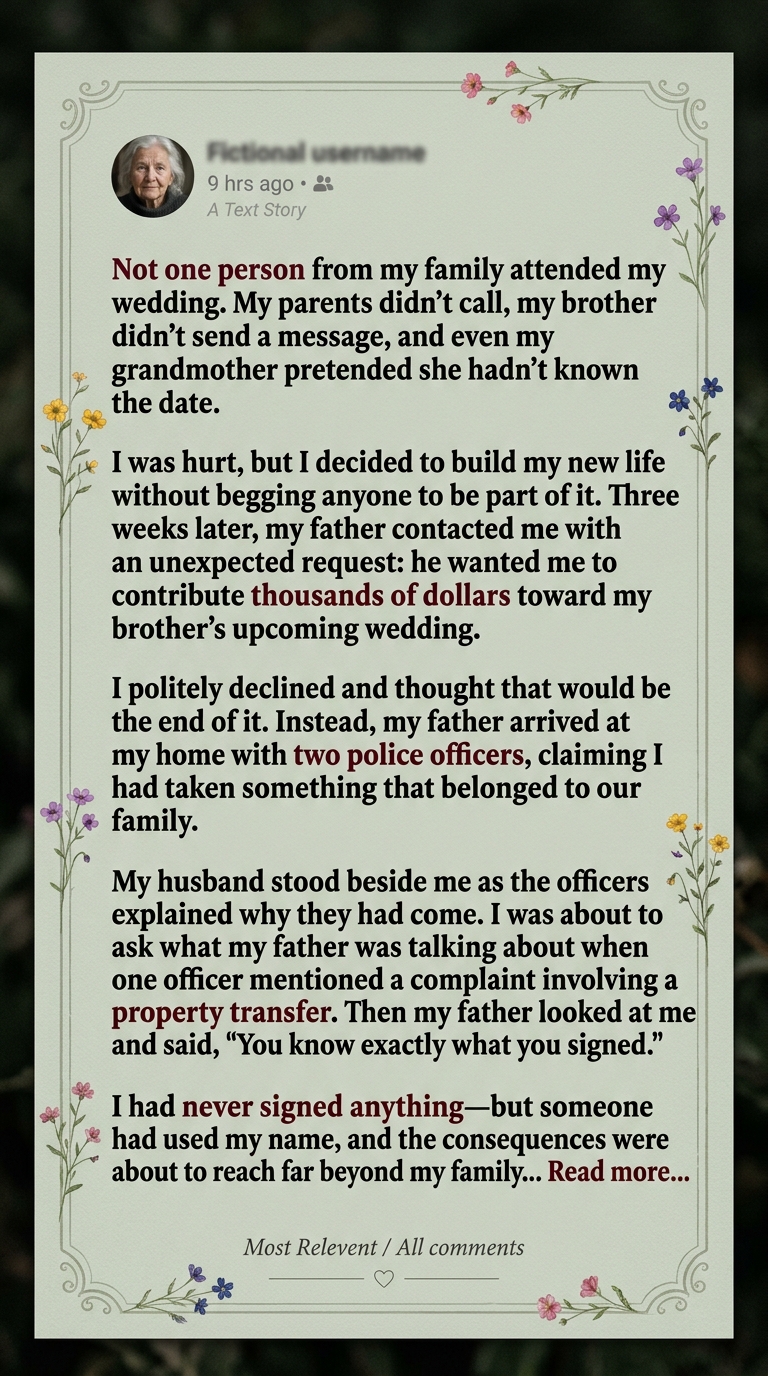
My wedding photographs filled the living room, but there was one detail I couldn’t stop noticing whenever I looked at them.
Not a single person from my family appeared in any of them.
My parents hadn’t attended. My older brother hadn’t sent a message. Even my grandmother, who had promised for years that she would never miss my wedding, had suddenly become unreachable.
I had married Daniel on a bright Saturday afternoon in a small garden overlooking the river. There were only twenty-six guests, most of them friends, colleagues, and members of his family. His mother helped me adjust my veil. His sister held my bouquet while I signed the marriage certificate. His father gave a speech that made everyone laugh and then cry.
It was a beautiful day.
It was also the day I finally understood that I could not keep waiting for my family to love me in the way I had always hoped they would.
My parents had never approved of Daniel. They considered him ordinary because he didn’t come from a wealthy family and worked as a maintenance supervisor for a regional hospital. My father, Richard, had wanted me to marry someone with a more impressive career and a family that could offer business connections.
When I refused to end the relationship, my parents stopped inviting me to family dinners. My brother, Matthew, followed their lead. My grandmother occasionally called, but whenever I mentioned Daniel, she changed the subject.
Eventually, I stopped trying to persuade them.
Three weeks after the wedding, my father called.
I almost didn’t answer.
“Claire,” he said, sounding as though nothing unusual had happened. “Your brother’s wedding is coming up. We need everyone to contribute.”
I waited.
“Matthew has found a wonderful venue, but the deposits and arrangements are more expensive than expected. Your mother and I thought you could contribute eight thousand dollars.”
I thought I had misheard him.
“Eight thousand?”
“Yes. You’re married now. Daniel has a good job. Surely you can help your brother.”
I looked across the kitchen. Daniel was preparing dinner, completely unaware of the conversation.
“Dad, you didn’t attend my wedding. You didn’t even call me. Why would you expect me to pay for Matthew’s?”
His voice hardened.
“Don’t turn this into a competition. He’s your brother.”
“I’m not competing with him. I’m simply not paying for a wedding I wasn’t invited to help plan.”
“You owe this family more than you seem to understand.”
I felt the familiar pressure in my chest, the feeling that no matter how reasonable I was, my father would always find a way to make me feel guilty.
“I won’t be contributing,” I said. “Please don’t ask again.”
He hung up.
I assumed that was the end of it.
I was wrong.
Five days later, someone knocked on our front door just after nine in the morning.
Daniel answered.
I heard a man’s voice identify himself as a police officer. When I stepped into the hallway, I saw my father standing behind two uniformed officers. He looked angry, but there was something else in his expression—an almost satisfied certainty.
“Claire,” he said. “You know why we’re here.”
I stared at him.
“No, I don’t.”
One of the officers introduced himself as Officer Lewis. His colleague, Officer Grant, asked whether I was Claire Morgan and whether I had recently signed documents transferring an interest in a family property.
My stomach tightened.
“What property?”
Officer Lewis explained that my father had filed a complaint alleging that I had participated in an unauthorized property transfer. A document bearing my signature had been submitted as part of an application to transfer ownership of a house belonging to my late grandmother.
My grandmother’s house.
I hadn’t been inside it for nearly a year.
“I haven’t signed anything,” I said.
My father stepped forward.
“Don’t lie. You know exactly what you signed.”
Daniel moved beside me.
“She said she hasn’t signed anything. Could you explain what document you’re referring to?”
Officer Lewis opened a folder.
“The complaint concerns a property on Willow Street. The transfer paperwork includes a signature attributed to Claire Morgan, along with a statement indicating that she agreed to relinquish her interest in the property.”
I felt as though the floor had shifted beneath me.
“My grandmother’s house is on Willow Street,” I said. “But I never agreed to give it away.”
My father gave a dismissive laugh.
“Your grandmother wanted the house to remain in the family. You were told about the arrangements.”
“I was told nothing.”
Officer Grant asked my father to let him finish.
“We’re not here to determine guilt at the doorstep. We need to establish whether the signature is genuine and understand how the documents were submitted.”
Daniel invited the officers inside.
My father followed without waiting for permission.
He looked around our living room, where the wedding photographs were displayed on a shelf.
“All this,” he muttered. “You can afford a wedding and a new house, but you can’t help your own brother.”
Daniel ignored him.
Officer Lewis placed copies of the documents on our dining table.
The first page was a property-transfer authorization. The second was a declaration stating that I had willingly surrendered any claim connected to my grandmother’s estate.
At the bottom of both pages was a signature that looked remarkably similar to mine.
I leaned closer.
It was convincing, but something about it bothered me.
I had a habit of writing the letter C with a small opening at the top. My signature always included it, even when I signed quickly.
The signature on the documents had a completely closed C.
“That’s not my signature,” I said.
My father folded his arms.
“Of course you’ll say that now.”
Officer Lewis looked at the papers again.
“Did you ever give anyone permission to sign on your behalf?”
“No.”
“Did you provide anyone with copies of your identification?”
I hesitated.
Then I remembered.
About four months earlier, my father had called and said my grandmother needed updated family information for her estate records. He asked me to send him a scan of my identification and a copy of my birth certificate.
I had been reluctant, but he said the family solicitor needed them to confirm the relationship between my grandmother and her grandchildren.
I had sent the documents.
“That’s how they got my information,” I said.
My father looked away.
Daniel noticed.
“Richard, why did you need her identification?”
“For family paperwork.”
“What paperwork?”
My father didn’t answer.
Officer Grant asked him to explain when the property-transfer application had been submitted.
He gave a date.
I immediately recognized it.
It was the same weekend as my wedding.
For a moment, I couldn’t speak.
While Daniel and I were exchanging vows, someone had been submitting paperwork that supposedly transferred my rights in my grandmother’s home.
Officer Lewis asked whether I knew the current status of the property.
I shook my head.
“My grandmother still lives there, doesn’t she?”
My father hesitated.
Then he said, “She’s staying with your brother for a while.”
“Why?”
“She’s getting older. Matthew has been helping her.”
That was the first time I had heard of it.
My grandmother was eighty-two. She had always lived independently, and she had never mentioned moving in with Matthew.
I asked for her phone number.
My father immediately objected.
“She’s resting. Don’t involve her in this.”
That answer frightened me more than anything else.
Daniel looked at the officers.
“Could we speak with the grandmother directly? If she’s the owner, surely her account matters.”
Officer Lewis agreed that her statement would be important.
He explained that the complaint was still being assessed and that the officers would need to establish whether the transfer documents had been authorized. They asked me to preserve any messages involving my father, Matthew, or the property.
Before leaving, Officer Lewis gave me a reference number.
My father remained behind.
When the officers reached the front gate, he turned toward me.
“You’ve made this much more difficult than it needed to be.”
I stared at him.
“You brought the police to my home because I wouldn’t give you money?”
“This has nothing to do with Matthew’s wedding.”
“Then why did you ask me for eight thousand dollars five days before this happened?”
He didn’t answer.
Daniel stepped between us.
“I think you should leave.”
My father looked at him with open contempt.
“Stay out of family matters.”
Daniel’s reply was calm.
“Claire is my family. And someone has used her identity to transfer property without her consent. That is very much my business.”
My father finally left.
As soon as the door closed, I sat down.
I wasn’t thinking about the money anymore. I was thinking about my grandmother, the woman who had once taught me to bake bread and who had promised that I would always have a place in her home.
Why hadn’t she attended my wedding?
Why had she stopped answering my calls?
And why was my father so determined to keep me from speaking to her?
That afternoon, I searched through my old messages.
Three months earlier, my grandmother had sent me a photograph of the garden behind her house. She had written, The roses are finally blooming. I wish you could come and see them.
I had replied that I would visit soon.
A week later, I called her, but my father answered her phone. He said she was tired and would call me back.
She never did.
I showed Daniel the message.
“We need to see her,” he said.
The following morning, we drove to Matthew’s house.
My brother answered the door wearing a shirt and trousers, as if he had been expecting someone.
When he saw me, his expression tightened.
“What are you doing here?”
“I want to see Grandma.”
“She’s not feeling well.”
“Then let me speak to her.”
He stepped outside and closed the door behind him.
“Claire, this isn’t a good time.”
“Why did you submit documents using my signature?”
His eyes moved briefly toward Daniel.
“I didn’t.”
“Then who did?”
Matthew rubbed his forehead.
“Look, Dad said you were being difficult. He told me you had already agreed to give up your interest in the house.”
“I never agreed to anything.”
“That’s what he told me.”
“Did you submit the transfer?”
He looked away.
That was answer enough.
“Matthew, did you use my identification?”
He didn’t respond immediately.
Then he said, “Dad handled the paperwork. I only helped with the application.”
“What application?”
He glanced toward the house again.
“Grandma’s house is too expensive to maintain. Dad thought it would be better if we transferred it before she needed more care.”
“Transferred it to whom?”
Matthew’s silence lasted several seconds.
Then he admitted that he and our father had arranged to sell the house to a property investor. The buyer had offered a substantial deposit, and Matthew had already used part of the money to pay wedding expenses.
I stared at him.
“You sold Grandma’s home?”
“We were going to move her somewhere smaller.”
“Did she agree?”
Matthew looked uncomfortable.
“She doesn’t understand these things anymore.”
I felt anger rise in my chest.
“She was perfectly capable of discussing her house when I last saw her.”
“Things have changed.”
“Then let me speak to her.”
He refused.
Daniel stepped forward.
“Matthew, if your grandmother is safe and knows what’s happening, there should be no reason to keep her from Claire.”
My brother’s face reddened.
“You’re not part of this family.”
Daniel didn’t raise his voice.
“That doesn’t give you the right to use her name.”
Matthew finally opened the door.
I followed him inside.
My grandmother was sitting in a chair near the living-room window, wrapped in a pale blue cardigan. She looked thinner than I remembered, but her eyes brightened when she saw me.
“Claire?”
I hurried toward her and knelt beside the chair.
“Grandma, why didn’t you come to my wedding?”
She reached for my hand.
“Your father told me you didn’t want me there.”
I froze.
“What?”
“He said you had decided to have a small wedding without family. He told me you were upset with me and didn’t want any of us attending.”
I felt tears fill my eyes.
“I called you. I sent you the invitation.”
She looked confused.
“I never received it.”
I turned toward Matthew.
He was standing near the doorway, looking at the floor.
My grandmother gently squeezed my fingers.
“I was waiting for you to call me, sweetheart. I thought perhaps you needed time.”
I couldn’t hold back my tears.
“I thought you had forgotten me.”
She shook her head.
“How could I forget you?”
For several minutes, we simply held each other.
Then I asked her about the property documents.
Her expression changed.
“Your father said there were some papers I needed to sign,” she said. “He brought them to the house when Matthew was here. I told him I didn’t want to sell anything.”
“Did you sign them?”
“No. I told him the house was not for sale.”
She looked toward the hallway.
“After that, he became angry. He said I was being unreasonable and that the family needed the money.”
I asked whether she knew that a document had been submitted claiming I had surrendered my interest.
She shook her head.
“I don’t know anything about that.”
My grandmother explained that she had made a will several years earlier. She had divided her estate equally between her three grandchildren: me, Matthew, and our cousin Sophie. She had also appointed an independent estate administrator to ensure that no one could pressure her into changing her wishes.
I had never known about the arrangement.
“Why didn’t you tell me?” I asked.
She smiled sadly.
“Because I didn’t want you to think I loved you because of what I might leave you. I wanted you to build your own life.”
She had given each grandchild a copy of the will when it was signed, but mine had been sent to my parents’ old address while I was living in another city. I had never received it.
The house was still legally hers. The transfer application had been submitted using documents that falsely represented my consent and implied that my grandmother had authorized the sale.
My father and Matthew had tried to make the transaction appear legitimate by using my identification and presenting me as someone who had willingly surrendered her position in the family arrangement.
But there was another problem.
My grandmother had kept a separate record of every meeting concerning her property. She had written down when my father visited, what he said, and which documents he brought. She had also kept a copy of a letter from the proposed buyer explaining that the sale could proceed once the necessary family declarations were completed.
The letter was dated two weeks before my wedding.
My grandmother had written across the top in her own handwriting:
I have not agreed to sell my home.
She asked me to take it to the estate administrator.
I promised I would.
Before we left, she held my face between her hands.
“Your father told me you had become selfish,” she whispered. “But I think he was afraid you would discover what he was doing.”
I kissed her forehead.
“I wish you had called me.”
“I know, sweetheart. I should have found a way.”
We left knowing that the matter was far from over.
The next week, I met with the estate administrator, a retired accountant named Helen Brooks. She reviewed the documents and immediately identified inconsistencies in the transfer application.
The declaration bearing my signature had been witnessed by someone who claimed to have watched me sign it.
I had never met that person.
The address listed for the signing was a small office used by a property brokerage connected to the proposed buyer. Records showed that my father had visited the office twice before the application was submitted.
Helen also confirmed that my grandmother had never authorized a sale or appointed my father to act on her behalf.
The transfer was formally challenged, and the proposed buyer was notified that the transaction was disputed. The police continued their investigation into the use of my identity and the false declaration.
A few days later, Matthew called.
He sounded exhausted.
“Claire, we need to talk.”
“About what?”
“About the house.”
I waited.
“The buyer has withdrawn. Dad says we’re going to lose the deposit.”
I closed my eyes.
“That’s not my problem.”
“Some of that money has already been spent.”
“Then you shouldn’t have spent money that didn’t belong to you.”
He became angry.
“You know what this means for my wedding?”
I almost couldn’t believe what I was hearing.
“You were willing to sell Grandma’s home without her permission. You used my identity. You lied to her about my wedding. And now you’re worried about your wedding?”
He was silent.
Then he said something I had never expected.
“I didn’t think Dad would actually go through with it.”
“Did you know he was using my signature?”
He hesitated.
“I knew the paperwork wasn’t right.”
The admission hurt, but it also confirmed what I had suspected.
“You knew enough to stop it.”
“I was already committed. I had paid deposits.”
“Then you made a choice.”
He hung up.
The police later interviewed both my father and Matthew. The investigation established that my signature had been copied from an older document and inserted into the property declaration. Matthew had helped submit the paperwork, while my father had arranged the meetings with the brokerage and provided my personal information.
The proposed buyer had not known that my grandmother opposed the sale, but the transaction was canceled once the false declaration was discovered.
My father and Matthew faced serious consequences for their roles. They were required to cooperate with the investigation, and the matter proceeded through the appropriate legal process. The family could no longer pretend that the property dispute was simply a misunderstanding.
My father tried calling me several times.
I didn’t answer.
Eventually, he sent a message.
I was trying to do what was best for everyone. You have made this family look terrible.
I read it twice before deleting it.
Not once had he asked whether I was frightened when the police arrived. Not once had he asked how I felt discovering that my own brother had helped use my identity.
His concern was still the family’s reputation.
Matthew’s wedding was postponed. He and his fiancée eventually decided to have a smaller ceremony after sorting out their financial situation. I wasn’t invited, and I didn’t ask to be.
My grandmother returned to her own home after a short stay with a relative. Daniel and I began visiting her every Sunday. We repaired the garden gate, replaced a leaking kitchen tap, and helped her organize the house so she could continue living independently.
One afternoon, while we were sitting beneath the rose trellis, she handed me a small photograph.
It showed the two of us when I was six years old. I was holding a wooden toy horse, and she was laughing at something outside the frame.
“I want you to have this,” she said.
I smiled.
“Why?”
“Because I want you to remember that you were loved long before anyone started measuring you by what you could give them.”
I held the photograph carefully.
For years, I had believed that being part of a family meant accepting whatever treatment came with the relationship. I thought I had to keep forgiving, keep explaining, and keep proving that I deserved a place at the table.
My wedding had taught me that I could build a home without their approval.
The police visit had taught me something else: sharing blood with someone did not give them ownership of my identity, my future, or my choices.
My father never attended another family gathering at my grandmother’s house. Matthew eventually sent a written apology, admitting that he had known the paperwork was wrong and had allowed his financial worries to cloud his judgment. I didn’t promise to forgive him. I told him that any future relationship would have to begin with honesty and remain that way.
My grandmother’s house stayed hers.
And every Sunday, when Daniel and I visited, she made tea in the old kitchen and asked about our week.
Sometimes, she would look at our wedding photograph and say how sorry she was that she had missed the day.
I always told her the same thing.
“You didn’t miss it because you didn’t love me. You were kept away. That’s not the same thing.”
Then I would sit beside her, and we would talk until the afternoon light faded.
I had lost the family I thought I had, but I hadn’t lost everyone who mattered.
And I never again confused being someone’s daughter with owing them the right to destroy my life.