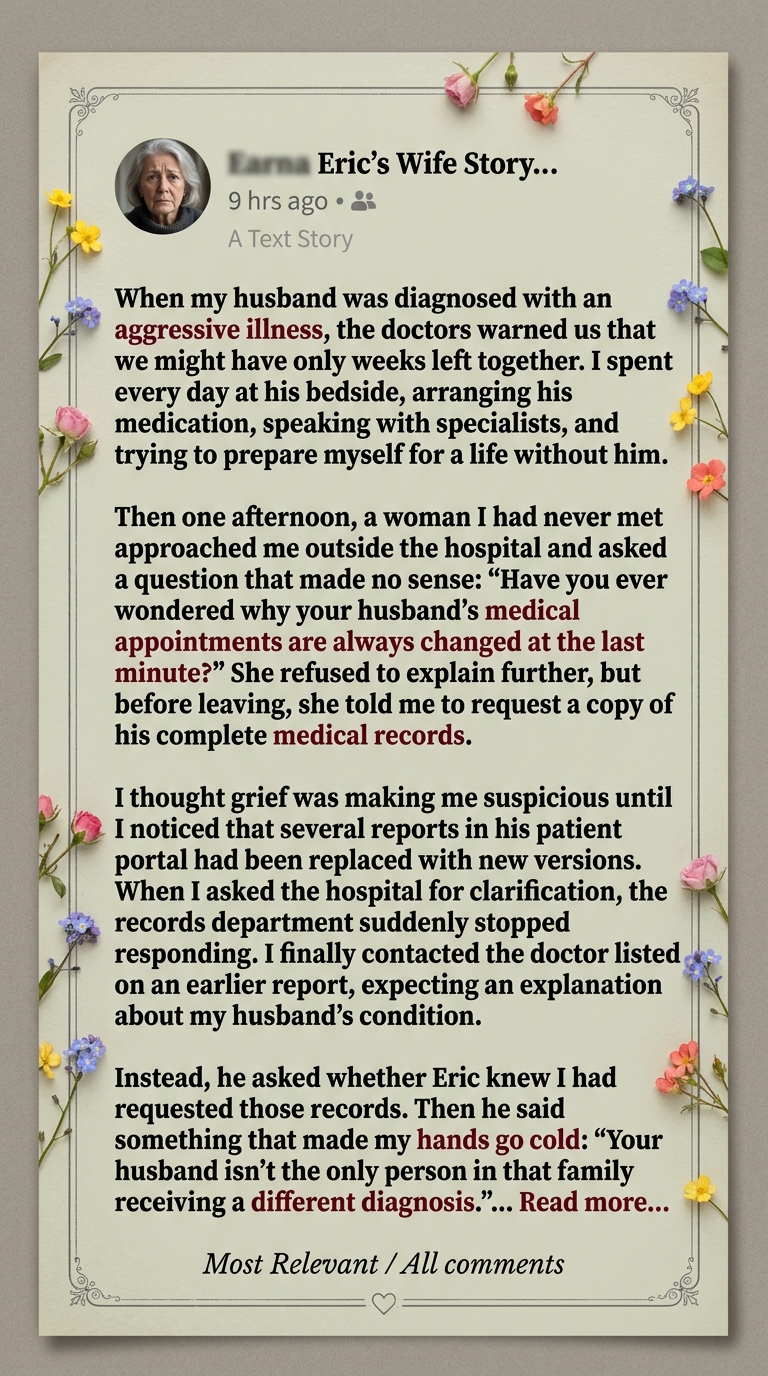
When my husband, Eric, was diagnosed with an aggressive illness, the specialist told us we needed to prepare for the possibility that he had only a few weeks left.
I remember the exact moment those words entered the room. Eric was sitting beside me, his fingers wrapped around mine, while the doctor explained the scan results. I kept waiting for him to say there had been a mistake, that another treatment might give us more time, or that the disease was not as advanced as it appeared.
Instead, he spoke gently about comfort, medication, and making the time we had left meaningful.
Eric was fifty-four. We had been married for twenty-seven years, and our daughter, Sophie, lived two hours away with her husband. We had planned to spend the following summer traveling along the coast. Now I was learning how to organize pain medication and recognize the signs that my husband was becoming too weak to stand.
I stopped thinking about the future.
Every morning, I drove to the hospital before breakfast. I spoke with nurses, collected prescriptions, asked questions about his treatment, and sat beside him while he slept. Some days he was alert enough to joke with me. On others, he barely opened his eyes.
I believed I was doing everything possible to keep him comfortable.
Then, one afternoon, a stranger approached me outside the hospital.
I was sitting on a bench near the entrance, trying to eat a sandwich I had bought hours earlier. The woman looked to be in her early sixties. She wore a navy coat and carried a folder against her chest.
“Are you Eric Lawson’s wife?” she asked.
I stood immediately.
“Who are you?”
“My name is Helen. I worked with someone who treated your husband.”
I waited for her to explain.
Instead, she asked, “Have you ever wondered why his medical appointments are always changed at the last minute?”
I stared at her.
“What do you mean?”
She glanced toward the hospital doors.
“Please request a complete copy of his medical records. Not the summary in the patient portal. Everything. The original reports, appointment history, amendments, and specialist correspondence.”
“Why?”
“I can’t explain it here.”
She turned to leave.
I followed her for several steps.
“Wait. Are you saying someone has made a mistake with his treatment?”
Helen stopped but didn’t turn around.
“I’m saying you should not assume every document in that portal is the document that was originally written.”
Then she walked away.
I stood outside the hospital, holding my unfinished sandwich, wondering whether exhaustion and fear were making me suspicious of a woman I had never met.
But her question stayed with me.
That evening, I opened Eric’s patient portal.
I had used it countless times to check appointment dates and medication instructions. I knew where the reports were stored, and I remembered reading several of them when his diagnosis was first confirmed.
Something seemed different.
An imaging report dated six weeks earlier had a new publication date. A consultation summary contained a paragraph I didn’t remember seeing. Another document had been replaced entirely, although the portal still showed the original appointment date.
I downloaded what I could and compared the files.
The differences were small but significant. One report described a suspicious area requiring further investigation. The newer version called it an established secondary lesion.
Another report had originally recommended an additional specialist review. The replacement version stated that the review had been completed.
I couldn’t understand why those changes had been made.
The next morning, I visited the medical records department.
“I need the complete original records for my husband,” I told the clerk. “Including previous versions and any amendments.”
She looked at the screen.
“Are you requesting them as his authorized representative?”
“Yes. Eric signed the necessary consent forms when he was admitted.”
She typed for several minutes, then frowned.
“There seems to be a restriction on this account.”
“What kind of restriction?”
“I’ll need to speak with the records supervisor.”
I waited nearly forty minutes before a supervisor named Mr. Grant appeared.
He explained that certain documents required additional authorization because of a pending clinical review.
“What clinical review?”
“I can’t discuss that without checking with the treating department.”
“Then please check.”
He promised to contact me.
I heard nothing that day.
I called again the following morning. The department transferred me to another extension, where a recording instructed me to leave a message. I left three messages over the next four days.
No one returned my calls.
By then, I was frightened enough to contact the doctor listed on the earlier imaging report.
His name was Dr. Samuel Reed. According to the document, he had reviewed Eric’s scan before the diagnosis became so severe.
I managed to reach his office through the hospital’s specialist directory.
When he answered, I explained who I was and asked whether he could clarify the differences between the reports.
There was a long silence.
Then he asked, “Does Eric know you’ve requested those records?”
I felt my stomach tighten.
“He’s my husband. I’ve been managing his care from the beginning.”
“That isn’t what I asked.”
“Why would that matter?”
Dr. Reed lowered his voice.
“Because your husband isn’t the only person in that family who has been receiving a different diagnosis.”
My hands went cold.
“What family?”
He hesitated.
“Has anyone spoken to you about your husband’s brother?”
Eric had an older brother named Paul. They had been close when they were young, but their relationship had become distant after their father died. Paul lived in another state and had suffered from a serious illness several years earlier.
I knew he had undergone surgery, but Eric rarely discussed it.
“What does Paul have to do with this?”
Dr. Reed asked me to come to his office the following afternoon. He said he could not discuss another patient’s medical information over the telephone, but there were matters involving Eric’s records that he was permitted to explain.
I barely slept that night.
The next day, I arrived with the downloaded reports, my notes, and a list of every appointment that had been changed.
Dr. Reed was waiting.
He was a quiet man in his late fifties, with tired eyes and a habit of pressing his fingertips together when he was thinking.
He examined the documents I had brought.
“These are not the versions I signed,” he said.
I felt my pulse quicken.
“What does that mean?”
“It means the reports were amended after I submitted them. Some amendments may have been legitimate corrections. Others do not reflect my original clinical findings.”
He opened his computer and brought up a copy of the report from the day Eric had first been scanned.
The original report described a localized abnormality that required a biopsy. It did not establish that the disease had spread.
A later version stated that the abnormality was consistent with an advanced malignant process and recommended palliative management.
“Who changed it?” I asked.
“That is part of the investigation.”
I stared at him.
“Are you telling me my husband might not be dying?”
Dr. Reed didn’t rush to answer.
“I’m telling you that the diagnosis currently being used to guide his care may not be supported by the original evidence. I cannot tell you what he has until the necessary tests are completed.”
I covered my mouth.
For weeks, I had been preparing to lose my husband. I had watched him become weaker, believing the disease was advancing beyond treatment.
Now I was being told that the foundation of his diagnosis might be wrong.
Dr. Reed explained that the hospital had recently identified irregularities in a group of patient records handled through a specialized administrative unit. Several reports had been altered after clinical approval, and some follow-up appointments had been canceled without the treating physicians’ authorization.
The changes were not random.
They involved patients whose treatment plans had been transferred to a particular private oncology network.
The network was owned by a company called Meridian Health Partners.
I recognized the name immediately.
Eric’s younger cousin, Daniel, worked there as a regional operations director.
Daniel had always been the ambitious member of the family. He spoke frequently about healthcare management, new treatment centers, and the business side of medicine. When Eric first became ill, Daniel had offered to help arrange appointments through the network.
Eric had accepted.
At the time, I had been grateful.
Dr. Reed explained that Daniel’s company had been contracted to coordinate specialist referrals and records administration for several hospitals. The arrangement gave its staff access to appointment systems and certain administrative documents.
It did not give them authority to change medical findings.
“Why would anyone do that?” I asked.
Dr. Reed looked uncomfortable.
“That is what investigators are trying to establish.”
Then he showed me another record.
It belonged to Paul, Eric’s older brother.
Years earlier, Paul had been diagnosed with a serious but treatable condition. His original specialist had recommended a particular course of treatment and regular monitoring.
However, a later report in the shared network system described his condition as more advanced and recommended a different treatment pathway.
Paul had eventually transferred to another hospital after becoming dissatisfied with the care he was receiving.
He had never known that the earlier report had been altered.
I felt a chill move through me.
“Why would someone change both brothers’ records?”
Dr. Reed leaned back.
“Because the changes may have been connected to something outside their individual treatment.”
He explained that the original records showed both men had been referred through the same administrative network. Their cases had been used in an internal performance report to justify a new treatment partnership.
The company had been presenting unusually high numbers of patients requiring expensive specialist interventions. If those figures were accurate, the partnership would have been profitable.
If the diagnoses had been exaggerated or the treatment recommendations manipulated, the arrangement could have generated substantial revenue at the patients’ expense.
But Dr. Reed was careful.
“We have evidence of unauthorized amendments. We have evidence of referral irregularities. We do not yet have proof of who ordered them or why.”
I left his office feeling as though the ground beneath my life had shifted.
When I returned to Eric’s room, he was awake.
He looked at my face and immediately noticed something was wrong.
“What’s happened?”
I sat beside him.
“I spoke with Dr. Reed.”
His expression changed.
“What did he tell you?”
I explained everything, including the original reports and the altered diagnosis.
Eric closed his eyes.
For several seconds, he said nothing.
Then he whispered, “I was afraid you’d find out.”
I stared at him.
“What?”
He turned toward the window.
“Daniel told me there might be complications with the records. He said the hospital was reviewing a few administrative errors. He told me not to worry you.”
“How long have you known?”
“Since the beginning of last month.”
I felt something inside me break.
“You knew there was a question about your diagnosis, and you let me believe you were dying?”
“I didn’t know what was true.”
“Then why didn’t you tell me?”
Eric struggled to sit up.
“Because Daniel said the original report had been reviewed by another specialist and that the changes were only technical. He said if I challenged the treatment plan, the insurance authorization could be delayed.”
I took his hand.
“Eric, the doctor said the original report did not establish advanced disease.”
“I know.”
“Why didn’t you ask for another opinion?”
He looked at me with tears in his eyes.
“Because I was scared. And because Daniel told me the new treatment was my best chance.”
I was angry, but beneath the anger was something worse: the realization that my husband had been carrying this fear alone while I sat beside him, believing we had no time left.
“What happened to Paul?” I asked.
Eric looked down.
“Daniel told me Paul had refused treatment years ago. He said there was nothing more to be done.”
“Was that true?”
“I don’t know.”
We sat in silence.
Then Eric told me something that made the situation even more troubling.
A few weeks before his diagnosis, Daniel had visited him at home. He had brought paperwork for Eric to sign, explaining that the forms would simplify insurance authorization and transfer certain treatment decisions to Meridian’s specialist team.
Eric had signed several pages without reading every line.
He thought he was authorizing the release of medical records.
He had not realized that one document also gave the network permission to coordinate treatment decisions within a defined scope.
It did not allow anyone to falsify medical findings, but it had made it easier for Daniel’s company to direct Eric’s care.
I asked whether he had kept a copy.
He shook his head.
I promised him I would find out what had happened.
The following morning, I contacted the hospital’s patient advocate and requested an immediate independent review. I also provided Dr. Reed’s findings and the altered reports.
This time, the hospital responded.
The patient advocate arranged a meeting with the clinical director and an external records auditor. They confirmed that an internal review had already identified suspicious changes involving multiple patients.
The hospital temporarily suspended the affected administrative access while the records were examined.
A few days later, Dr. Reed performed a new review of Eric’s imaging and arranged an independent biopsy.
The results were not simple.
Eric did have cancer. The original abnormality was real, and it required treatment. But the evidence did not support the advanced diagnosis recorded in the altered report.
The disease was localized and potentially treatable.
The new specialist explained that Eric would need surgery followed by a carefully selected treatment plan. His condition was serious, but he was not expected to die within weeks.
I cried when I heard those words.
Not because everything was suddenly fine, but because we had been given something we thought had already been taken from us.
Time.
Eric underwent surgery three weeks later.
The operation was difficult, and his recovery was slow. There were complications involving an infection, but the medical team treated them promptly. After several weeks, he was able to return home.
Meanwhile, the investigation continued.
The records audit revealed that Daniel had not acted alone. A senior administrator at Meridian had created a process that allowed certain staff members to submit amendments under physicians’ names when treatment referrals were being redirected.
Daniel had approved several of those referrals.
He had also received financial incentives tied to the network’s growth targets.
Investigators found that Paul had been one of the earlier patients affected by the same process. His original diagnosis had been more limited than the later report suggested. He had undergone additional procedures that his original specialist had not recommended.
Paul was contacted and invited to have his records reviewed independently.
When he learned what had happened, he was devastated.
He had spent years believing his condition was incurable. He had changed jobs, sold his home, and withdrawn from family life because he thought he had little future.
His new doctors confirmed that he had been treated for a serious illness, but the later record had exaggerated its severity and influenced decisions that should have been made by his treating specialists.
The truth did not erase the years he had lost.
But it gave him a chance to understand what had actually happened.
Daniel initially denied responsibility. He claimed he had trusted the administrators and believed the changes were legitimate. However, internal emails showed that he had been warned about unauthorized amendments months earlier.
Instead of reporting the problem, he had instructed staff to keep the referrals moving until the end of the financial quarter.
He had chosen the company’s performance targets over the patients whose lives were affected.
The senior administrator and Daniel were removed from their positions. The matter was referred to regulators and law enforcement, and the affected patients were offered independent medical reviews. The hospital also changed its records system so that every amendment required traceable authorization from the responsible clinician.
Daniel contacted Eric after the investigation became public.
He apologized and said he had never intended to hurt anyone in the family.
Eric listened without interrupting.
Then he said, “You knew people were being given information that wasn’t true. You knew I was frightened, and you used that fear to keep me quiet.”
Daniel began explaining again.
Eric ended the call.
For a long time, I thought the hardest part of that experience would be remembering how close we had come to losing him.
But it wasn’t.
The hardest part was understanding how easily someone could manipulate a medical record and make a family believe there was no hope left.
A diagnosis is supposed to help people understand what is happening to their bodies. It should never become a tool for someone else’s ambition.
Months later, Eric returned to the hospital for a follow-up appointment.
The scans showed no evidence of active disease. His doctors remained cautious, and he continued regular monitoring, but the immediate danger had passed.
On the drive home, he reached across the center console and took my hand.
“I thought I was going to leave you alone,” he said.
I squeezed his fingers.
“I thought I was losing you.”
He looked at me.
“I’m sorry I didn’t tell you.”
“I wish you had trusted me with the truth.”
He nodded.
We didn’t pretend the experience had left us unchanged. Eric struggled with guilt over the patients who had suffered, and I sometimes found myself checking every medical document twice. We attended counseling together and learned how to speak about fear without hiding behind reassurance.
A year later, Paul visited us.
He was healthier, though he still carried anger about the years he had lost. Eric apologized for believing Daniel’s explanation without questioning it. Paul accepted the apology, but he made it clear that rebuilding their relationship would take time.
We understood.
That evening, the three of us sat on the back porch while the sun disappeared behind the trees.
Eric looked at his brother and said, “We were both told to prepare for an ending that wasn’t actually written for us.”
Paul gave a tired smile.
“Then we’d better make better use of what we’ve got.”
I watched them talking and thought about Helen, the stranger who had approached me outside the hospital.
I never learned exactly how she had obtained the information. She later contacted the patient advocate and provided a statement confirming that she had previously worked in records administration for Meridian. She had left after raising concerns about unauthorized changes and had recognized Eric’s name when she saw it in an internal review notice.
She had not been able to prove what was happening herself, but she had known enough to point me toward the original records.
I sent her a letter thanking her.
She replied with one sentence:
“Families should never have to fight the records to find the truth about someone they love.”
I kept that letter.
Eric still has medical appointments, and we still take each new scan seriously. We no longer assume that a reassuring report means everything is fine or that a frightening one tells the entire story. We ask questions, request explanations, and make decisions with the doctors directly responsible for his care.
The illness was real. The fear was real. The time we nearly lost was real.
But the weeks we were told we had left together were based on a diagnosis that should never have been presented as certain.
And because one woman refused to stay silent, we were given the chance to discover the truth before it was too late.