For thirty-eight years, my father worked at the paper mill on the edge of town. He left the house before sunrise, came home smelling of hot metal and machine oil, and spent most evenings rubbing the stiffness out of his hands.
He rarely complained. Even after a conveyor accident damaged his shoulder, he returned to work as soon as the doctors allowed it. He had two children to raise, a mortgage to pay, and a firm belief that a parent’s problems should never become a child’s burden.
My sister, Elaine, had married Marcus twelve years earlier. Marcus worked in corporate finance and had a talent for making ordinary conversations sound like business presentations. He measured people by their salaries, their job titles, and the size of their houses.
Dad never impressed him.
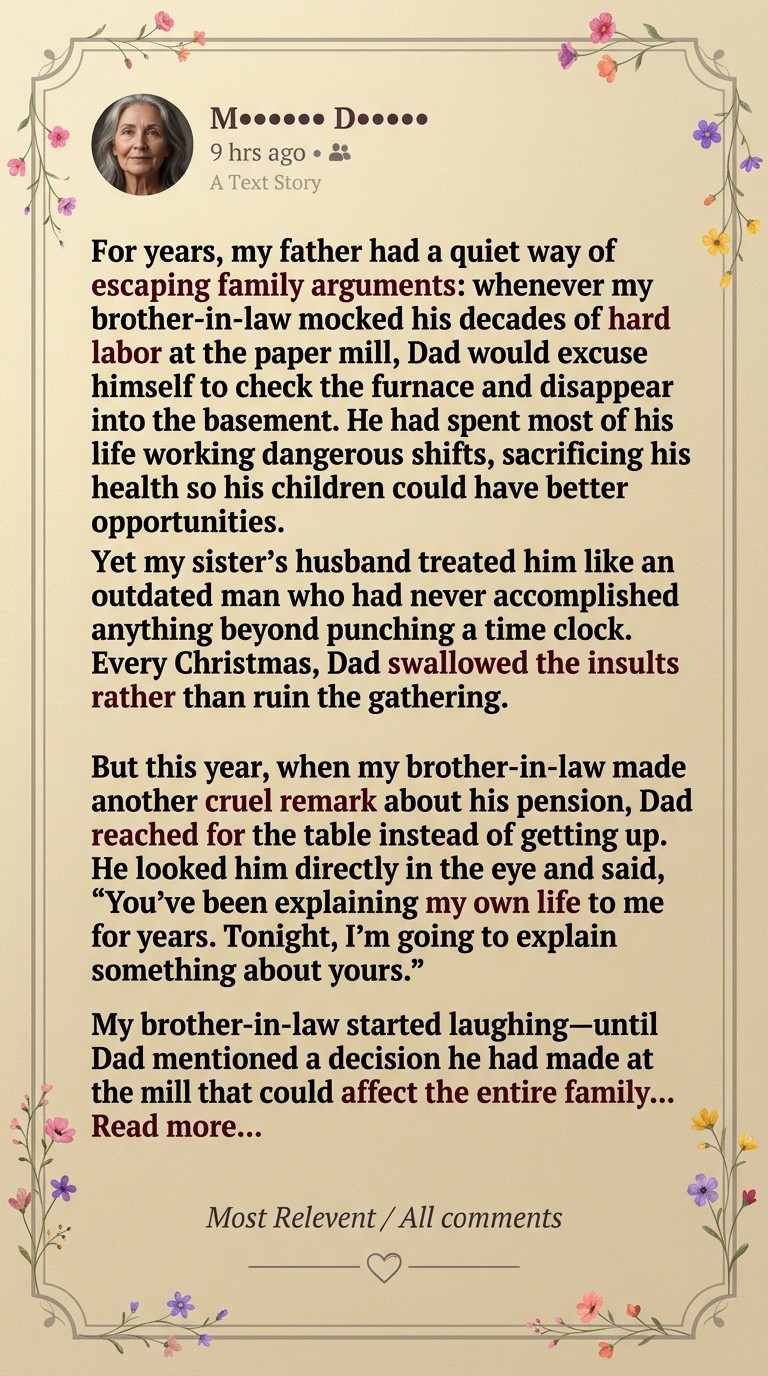
At family dinners, Marcus would find some way to bring up the mill. He called it a place for men who had failed to find better opportunities. He joked about Dad’s pension, his worn-out work boots, and the fact that he had never managed anyone beyond a production crew.
Dad always responded with a small smile.
Then he would stand, say he needed to check the furnace, and disappear into the basement until the conversation moved on.
I used to follow him sometimes. I would find him sitting on an old wooden stool beside the furnace, listening to the pipes knock.
“Why do you let Marcus talk to you like that?” I asked him once.
Dad shrugged.
“Your sister loves him. I don’t want every holiday to become a contest between two stubborn men.”
“But he thinks you’re stupid.”
Dad looked at me over his glasses.
“People who need to make someone else feel small usually have something they’re trying to hide.”
I thought it was just another one of his quiet observations. I didn’t understand how much he meant it until Christmas Eve.
That year, Marcus arrived carrying an expensive bottle of wine and wearing a watch that seemed designed to be noticed. He spent the first hour discussing a new investment property and complaining about the difficulty of finding reliable employees.
Dad listened politely.
When Elaine asked him whether he was enjoying retirement, Dad said he was doing well. He had a small garden, repaired things around the house, and occasionally helped an old neighbor with carpentry.
Marcus laughed.
“That’s the problem with people who retire from places like the mill. They spend their whole lives following instructions, and then they don’t know what to do when nobody tells them what comes next.”
Elaine gave him a warning look.
“Marcus.”
“What? I’m just saying. At least I made sure I wouldn’t have to depend on a pension that barely keeps up with inflation.”
Dad continued cutting his potatoes.
Marcus wasn’t finished.
“Honestly, Frank, you should have left years earlier. You could have invested in something useful instead of spending four decades breathing chemicals and collecting a modest check.”
I watched Dad’s jaw tighten.
For a moment, I expected him to stand up and head downstairs.
Instead, he placed his fork beside his plate.
“Marcus,” he said calmly, “you’ve been explaining my own life to me for years. Tonight, I’m going to explain something about yours.”
Marcus leaned back and laughed.
“Well, this should be interesting.”
Dad reached into the inside pocket of his cardigan and removed a folded document.
He didn’t hand it to Marcus. He simply placed it in the middle of the table.
“Do you remember the Northline project?”
Marcus’s expression changed slightly.
“Of course. It’s one of the largest industrial redevelopment opportunities in the county.”
Dad nodded.
“And do you remember which company was selected to evaluate the mill’s future?”
“Your old employer, presumably.”
“That’s right.”
Marcus smiled again, though it seemed less comfortable now.
“I heard they were considering selling the property. That’s a complicated transaction. It takes people with serious experience to handle something like that.”
Dad looked directly at him.
“That’s why I was surprised when I saw your name on the proposal.”
The room went quiet.
Elaine turned toward her husband.
“What proposal?”
Marcus picked up his wineglass.
“It’s business. Nothing you need to worry about.”
Dad unfolded the paper.
“It became family business when you used my address as your reference location and listed me as someone who would verify your professional background.”
Marcus stopped moving.
Dad continued.
“I received a letter from the mill’s redevelopment office three weeks ago. They were checking the references for your consulting company. They wanted to know whether I could confirm that you had experience overseeing industrial operations.”
“That’s a misunderstanding,” Marcus said quickly.
“Maybe. So I called the office.”
Dad spoke without anger. That made the words seem heavier.
“I told them the truth. You have never worked at the mill. You have never managed an industrial operation. And I have never supervised you in any professional capacity.”
Marcus pushed his chair back.
“You had no right to interfere with my business.”
Dad didn’t raise his voice.
“You put my name on your application. That made it my business.”
Elaine looked from her husband to the document.
“Marcus, what is he talking about?”
Marcus rubbed his forehead.
“The company needed an industrial reference. I thought Frank could help. He knows the place better than anyone.”
“Did you ask him?” she said.
Marcus didn’t answer.
Dad folded his hands.
“There’s more.”
He explained that the mill had been considering several redevelopment proposals. The company owned a large section of industrial land, including an older production building that had become expensive to maintain. The Northline group wanted to acquire the property, remove the remaining equipment, and turn the site into a distribution complex.
Marcus’s consulting firm had submitted a proposal claiming it could manage the transition safely and efficiently.
But the mill had not selected a buyer yet.
The management team had asked several retired employees to review the proposals because they wanted people who understood the machinery, the environmental risks, and the surrounding community.
Dad was one of them.
I stared at him.
“You never told us you were involved.”
“I wasn’t allowed to discuss the process while it was underway,” he replied. “And I didn’t think anyone needed to know.”
Marcus’s face had turned pale.
“You’re saying you were evaluating my proposal?”
“I was one of several people asked to review the technical plans. I wasn’t responsible for the final decision.”
“Then you should have declared a conflict of interest.”
“I did. As soon as I recognized your company, I reported the connection and removed myself from that portion of the review.”
Marcus looked relieved for half a second.
Then Dad continued.
“But the safety committee found problems in your proposal that had nothing to do with me.”
He turned the document around.
The report described a plan to remove old machinery from the mill’s eastern production building. Marcus’s company had estimated the work would take six weeks and cost substantially less than competing proposals.
The problem was that the estimate treated several sections of the building as ordinary warehouse space.
Dad knew they weren’t.
For years, he had worked near the chemical recovery area. He knew which pipes had been sealed, which drainage channels had been altered, and which maintenance records were incomplete. Some of the equipment had been installed before modern environmental standards existed.
A demolition crew entering that section without proper testing could expose workers to dangerous residue.
Dad had raised the concern during the technical review.
The safety committee investigated and discovered that Marcus’s proposal had relied on outdated site drawings. It had also omitted the cost of several mandatory environmental assessments.
The low price that had made the proposal attractive was based on work that couldn’t legally or safely be skipped.
Marcus stared at the report.
“Those drawings came from the company,” he said.
“Some did,” Dad replied. “But the site inspection notes were available to every bidder. Your team never requested the additional records.”
“We had a deadline.”
“People working around those machines don’t get to ignore danger because a deadline is inconvenient.”
Marcus’s voice sharpened.
“You don’t understand how competitive contracts work.”
Dad looked at him for a long moment.
“I understand what happens when a man decides someone else’s safety is an acceptable expense.”
Nobody spoke.
Then Dad explained the decision he had made.
During his final years at the mill, he had served on a worker safety committee. He wasn’t an engineer, but he had years of practical experience and knew the machinery better than most people in the management offices.
When the mill began discussing redevelopment, he had been asked to help prepare a transition plan. He had agreed on one condition: the company would not approve demolition until an independent team completed a full environmental assessment.
Some executives had complained about the additional cost.
Dad refused to withdraw his recommendation.
The committee eventually accepted it.
That decision delayed the redevelopment process, but it also prevented the company from hiring a contractor under an unsafe plan. The mill had since required every bidder to submit revised estimates and detailed safety procedures.
Marcus’s proposal had been disqualified from the current round because it failed to meet the revised requirements.
It wasn’t because Dad had rejected him.
It was because the company had independently confirmed the deficiencies.
Marcus stood up.
“You’re enjoying this, aren’t you? You’ve been waiting years to embarrass me.”
Dad remained seated.
“No. I’ve been waiting years for you to understand that my work mattered.”
Marcus looked toward Elaine.
“Are you going to let him talk to me like this?”
Elaine didn’t answer immediately.
She had spent years defending Marcus whenever he mocked Dad. She used to say he was only joking, that his humor was misunderstood, that Dad was too sensitive about his job.
Now she looked at the report in front of her.
“Did you really use Dad’s name without asking?”
Marcus exhaled sharply.
“It was a reference. Nothing more.”
“You told me the contract was practically guaranteed.”
“It was until this nonsense happened.”
Dad shook his head.
“Marcus, the contract wasn’t yours to lose. You never earned it.”
That was the sentence that finally silenced him.
He grabbed his coat and walked toward the front door. Elaine remained at the table, staring at her plate.
A few minutes later, she followed him outside.
I found Dad in the kitchen rinsing his coffee cup.
“Are you all right?” I asked.
He nodded.
“I should have said something sooner.”
“You didn’t do anything wrong.”
He looked toward the window.
“I let him speak to me that way because I thought keeping peace was the same as protecting this family. I don’t think that anymore.”
The next morning, Elaine called.
She told us Marcus had admitted that he had used Dad’s name without permission. He had also acknowledged that his firm had submitted an incomplete proposal. He was furious about losing the opportunity, but for once Elaine wasn’t rushing to defend him.
“I keep thinking about all those Christmas dinners,” she said. “How many times did I hear him insult Dad and pretend it was harmless?”
I didn’t know what to tell her.
Over the following months, their marriage became strained. Marcus expected Elaine to treat the incident as a temporary embarrassment. She couldn’t. The problem wasn’t simply the failed contract. It was the years of contempt, the lies about his professional success, and the way he had used her father’s reputation when it suited him.
They began counseling, but Marcus refused to acknowledge the depth of the damage. Eventually, Elaine moved into a small apartment near her workplace. Their separation wasn’t dramatic. It was the result of many ordinary moments she could no longer pretend not to see.
Dad never celebrated what happened to Marcus. He didn’t contact the mill to ask about the failed proposal, and he never mentioned the matter again unless someone asked.
The redevelopment project continued under a different contractor. Before any machinery was removed, the company completed the environmental testing Dad had insisted upon. The work took longer and cost more than the original estimates, but the crews were able to finish without the dangerous shortcuts Marcus’s proposal had overlooked.
The mill also invited Dad to help train a group of younger maintenance workers before the final equipment was dismantled. He accepted, not because he wanted recognition, but because he hated the thought of decades of practical knowledge disappearing with the old building.
On his first morning back, I drove him there.
He stood outside the gate for a while, looking at the tall brick walls and the familiar windows.
“Do you miss it?” I asked.
“Some parts,” he said. “Not the noise. Not the shifts. Not the cold mornings.”
He smiled.
“But I miss knowing exactly what needed doing.”
A few weeks later, Elaine came to visit him. She apologized for not standing up for him sooner.
Dad listened without interrupting.
Then he took her hand.
“You don’t have to spend the rest of your life feeling guilty,” he told her. “Just don’t confuse keeping the peace with doing the right thing again.”
That Christmas, we gathered at Dad’s house without Marcus.
There was no grand speech, no confrontation, and no need for anyone to prove anything. Dad spent the afternoon showing his grandson how to repair a loose cabinet hinge. Elaine helped prepare dinner, and I watched Dad laugh when flour spilled across the kitchen floor.
At one point, I noticed the basement door standing open.
“You’re not going down there?” I asked.
Dad glanced at it and smiled.
“No. Furnace is fine.”
For the first time in years, he stayed at the table.
And when everyone raised their glasses, Elaine looked at him and said, “To the man who taught us that honest work is worth more than an impressive title.”
Dad lowered his eyes, embarrassed by the attention.
Then he lifted his glass.
He had spent most of his life making sure his family had a better future. It had taken us far too long to understand that the greatest thing he had given us wasn’t money, a house, or a comfortable retirement.
It was the example of a man who knew the value of his work—and never needed someone else’s approval to prove it.