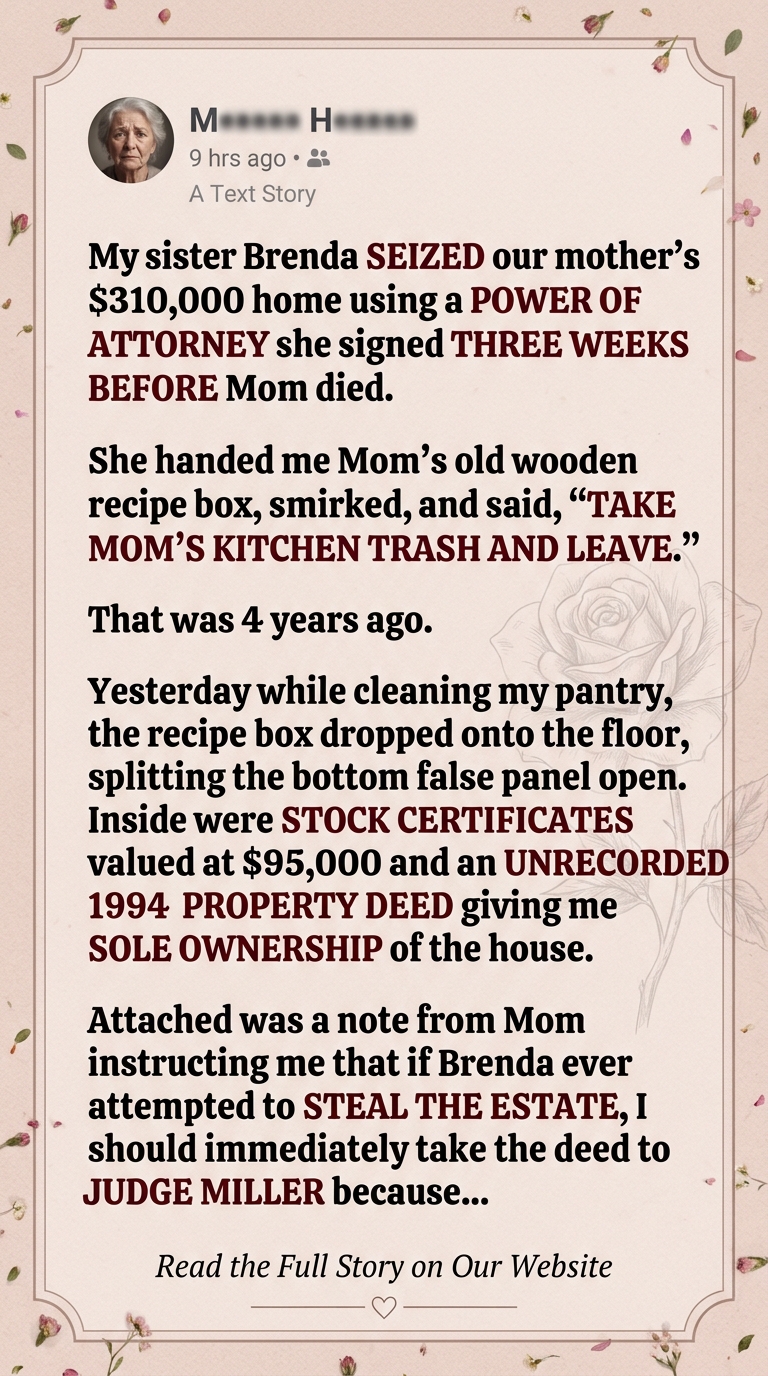
My sister Brenda took control of our mother’s house three weeks before Mom died.
She used a power of attorney Mom had signed during her final illness, transferred the property into her own name, and told everyone she was simply protecting the family from a complicated estate process.
The house was worth approximately $310,000. It had been our family home for nearly forty years, and I had spent most of my adult life helping Mom maintain it.
Brenda hadn’t.
She lived two hours away and visited when it suited her. I was the one who drove Mom to appointments, collected prescriptions, repaired leaking taps, and sat beside her when the pain made sleeping difficult.
But when Mom died, Brenda arrived with documents and an attorney.
She told me the house belonged to her now.
I questioned the transfer, but she waved away my concerns.
“Mom signed the power of attorney. She wanted me to handle everything.”
“She never told me she wanted you to own the house.”
Brenda gave me a thin smile.
“Not everything Mom did was meant to be discussed with you.”
A few days later, she appeared at my apartment carrying a cardboard box.
Inside was Mom’s old wooden recipe box, the one she had kept beside the stove for decades. Its corners were worn, and the lid still had a small burn mark from the time Mom accidentally left it too close to a hot pan.
Brenda handed it to me.
“Take Mom’s kitchen trash and leave.”
I stared at her.
“That’s what you’re giving me?”
“She left you plenty of memories. I have the house to take care of.”
I wanted to argue, but I was exhausted. The funeral had been less than a week earlier, and I couldn’t imagine fighting my sister while Mom’s flowers were still wilting on the dining room table.
So I took the recipe box.
For four years, it sat on a shelf in my pantry.
I rarely opened it. Sometimes I took out one of Mom’s handwritten recipes, especially her cinnamon apple cake, but most of the cards were too painful to read.
Then yesterday, while cleaning the pantry, I knocked the box off the shelf.
It struck the floor hard enough to split one corner of its wooden base.
I crouched to pick it up and noticed something strange. The bottom panel had shifted, revealing a narrow gap that shouldn’t have been there.
I pressed along the edge.
A thin wooden section came loose.
Inside was a small bundle wrapped in an old flour sack.
My hands began trembling as I unfolded it.
There were several stock certificates, a handwritten list of account numbers, and a property deed dated 1994.
I read the deed once.
Then again.
It named me as the sole owner of our mother’s house.
The document described the property by its legal boundaries and included the signatures of Mom and two witnesses. It had been properly notarized, but I could see no record of it having been registered with the county.
The stock certificates were worth approximately $95,000 based on the attached account statement.
At the bottom of the bundle was a folded note.
My name was written across the front in Mom’s handwriting.
I sat on the pantry floor and opened it.
“Dear Rachel,
If you are reading this, Brenda has probably done what I feared she might do. I hope I’m wrong, but I have seen how interested she has become in my house and finances.
The deed is real. I transferred the house to you in 1994, after your father died. You were the one who stayed with me when I had nothing but a leaking roof and two children to raise. I wanted you to have a secure home, and I never changed that decision.
I did not record the deed because your father had left unresolved business matters, and our attorney advised me to keep the transfer private until those matters were settled. He kept the original paperwork with the family records. I kept this copy because I wanted you to have proof if anything happened.
The stocks came from an account your father established for you. They were placed in my care while you were young, and I kept the certificates safe.
But there is something else you need to know.
If Brenda ever attempts to take the house using a power of attorney, do not confront her alone. Take the deed to Judge Miller immediately.
He knows what happened in 1994. He was the attorney who prepared the transfer before he became a judge, and he witnessed why I made it.
Do not let Brenda convince you that a power of attorney gave her ownership. It did not.
I love you both, but I will not pretend you have treated me equally.
Love,\
Mom.”
I read the letter several times.
Judge Miller.
I remembered him. He had attended my parents’ anniversary dinner many years earlier and had once helped Mom settle a disagreement with a contractor. He had retired from the bench, but his name was still familiar around town.
I didn’t call Brenda.
Instead, I contacted an estate attorney recommended by a colleague. I explained what I had found and sent photographs of the deed and letter.
He listened carefully.
“Don’t assume the deed automatically resolves everything,” he said. “We need to establish whether it was validly executed, whether the transfer was completed, and what happened to the title afterward. But the power of attorney alone would not have made your sister the owner.”
He also advised me not to deposit, sell, or transfer the stock certificates until their ownership and current value had been verified.
The following morning, he arranged a meeting with Judge Miller, who had agreed to review the historical documents.
When I entered his office, he was sitting beside a window with a thick folder on his desk.
He looked at the recipe box I had brought.
“Your mother kept that?”
I nodded.
“She told me to bring the deed to you if Brenda ever tried to take the house.”
His expression became serious.
“Then I believe we should look at the entire history.”
He examined the deed, checked the signatures, and compared the legal description with the property’s original records.
After several minutes, he removed his glasses.
“I remember this transfer,” he said. “Your mother was very clear about what she wanted.”
“Then why wasn’t it recorded?”
“Because there was a title complication at the time. Your father had guaranteed a business loan, and a creditor had filed a claim against another property he owned. Your mother wanted to make sure the transfer was properly documented before recording it. We arranged the deed, obtained the necessary signatures, and kept the original in secure storage while the creditor matter was resolved.”
He paused.
“Your mother later collected the original documents. I assumed she had recorded the deed herself, but apparently she never completed that final step.”
My stomach tightened.
“Does that mean Brenda owns the house?”
“No. It means we need to examine what happened after the deed was signed. An unrecorded deed can still be valid between the parties, depending on the law and the circumstances. The power of attorney is a separate matter. Your sister may have had authority to manage your mother’s affairs, but that authority did not automatically allow her to give herself your mother’s property.”
I felt a wave of relief, followed immediately by another question.
“Why did Mom tell me to come to you specifically?”
Judge Miller opened the folder.
“Because I witnessed something your sister may not know.”
He explained that in 1994, Brenda had been involved in a serious dispute with our father. She had borrowed money from him to start a small business, then refused to repay it. Their relationship deteriorated, and she moved away.
Mom had been devastated by the conflict.
She still loved Brenda, but she had become concerned that her older daughter viewed the family home as an asset rather than a place of belonging.
When Dad died, Mom decided that the house should go to the child who had remained responsible for maintaining it and helping her through difficult years.
She had not made the decision impulsively. She had discussed it with an attorney, signed the deed before witnesses, and arranged for the transfer to be documented.
Judge Miller leaned back.
“Your mother didn’t want to punish Brenda. She wanted to protect you from a future dispute.”
“Then why did she let Brenda believe she could have the house?”
“She didn’t. Your mother repeatedly told her that the house was not hers. Your sister simply refused to accept it.”
I stared at the deed.
“Can you help me recover it?”
“I can explain the history and provide the records I retained, but I can no longer act as your attorney. You’ll need independent counsel to handle the title and any litigation. I can, however, confirm the circumstances under which the document was prepared.”
He handed my attorney a copy of his old file.
It contained the original drafting notes, the witness information, and a letter from Mom confirming her intention to transfer the property to me.
There was also a document I hadn’t expected: a written instruction from Mom, dated several years before her death, asking that the deed remain part of her personal records and be provided to me if anyone attempted to claim the house through her power of attorney.
My attorney looked at it carefully.
“This is important.”
Over the next several weeks, he obtained the property records, the power of attorney, and the documents Brenda had used to transfer the title.
The power of attorney had been signed only three weeks before Mom died.
At the time, Mom was receiving treatment for a serious illness. Her doctor had documented periods of confusion caused by medication and complications from the disease. That did not automatically mean she lacked legal capacity when she signed the document, but it made the circumstances worth examining.
More importantly, the power of attorney did not authorize Brenda to transfer Mom’s property to herself.
The transfer paperwork contained a statement that Brenda was acting in Mom’s best interests. It did not disclose that Brenda was the recipient.
My attorney filed a formal challenge.
Brenda responded by accusing me of manufacturing the deed and trying to steal property from the estate.
She also claimed Mom had promised her the house.
During the first hearing, her attorney argued that the old deed had never been registered and should therefore be disregarded.
Judge Miller was called as a witness because of his involvement in the original transaction. He confirmed that he had prepared the deed before taking office, witnessed its execution, and retained contemporaneous records establishing Mom’s intention.
The judge overseeing the case asked whether the deed had ever been revoked.
No evidence of revocation was produced.
The court also examined the power of attorney. It found that Brenda had used it to make a transfer that benefited herself, without proper authority and without the safeguards required for such a transaction.
The court ordered the title transfer set aside while the deed’s validity and priority were resolved.
The final decision came several months later.
The deed was recognized as a valid transfer made in 1994. The court directed that the property records be corrected to reflect my ownership. Brenda’s later transfer was declared ineffective.
She also had to account for the money she had collected from renting out the house during the four years she controlled it. Some of that money had gone toward legitimate maintenance and property expenses, but the remainder had to be returned.
The stock certificates were another matter.
My attorney worked with the transfer agent and financial institution to verify the account. The certificates were genuine, and the shares belonged to me under the arrangement established by my father. Their value was close to the amount listed in Mom’s note.
I didn’t feel wealthy when the matter was finished.
I felt tired.
Brenda called me the evening after the final ruling.
“You got what you wanted,” she said.
I looked at the recipe box on my kitchen table.
“I wanted Mom’s wishes respected.”
“She was sick. She wasn’t thinking clearly.”
“Judge Miller confirmed the deed was signed thirty years earlier.”
“You’re acting like I stole something.”
I was silent for a moment.
Then I said, “You gave me a box of recipes and told me to leave. You knew I was grieving, and you used that moment to make sure I wouldn’t question you.”
“I was handling the estate.”
“You were handling it for yourself.”
She began crying, but I couldn’t tell whether it was regret or anger.
“I thought Mom wanted me to have the house.”
“Then why did you hide the deed?”
She had no answer.
I ended the call.
I didn’t celebrate the outcome. I didn’t send Brenda a photograph of the court order or remind her of the things she had said to me.
I simply returned to the house.
The front steps needed repairing, the garden had become overgrown, and the kitchen cabinets were still the same faded cream color Mom had chosen decades earlier.
I spent the first weekend cleaning the kitchen.
Then I took the recipe box from its shelf and placed it beside the stove.
I made Mom’s cinnamon apple cake using the card with the flour stain in the corner. When it came out of the oven, the smell filled the house so completely that, for a moment, I could almost hear her telling me I had added too much cinnamon.
I smiled through my tears.
Brenda had thought she was giving me something worthless when she handed me that old wooden box.
She hadn’t understood that Mom had trusted it with more than recipes.
It held the proof of a promise made long before the arguments, the illness, and the funeral.
And in the end, the most important thing inside it wasn’t the deed or the stock certificates.
It was the reminder that my mother had made her decision carefully, and she had never forgotten the daughter who stayed.