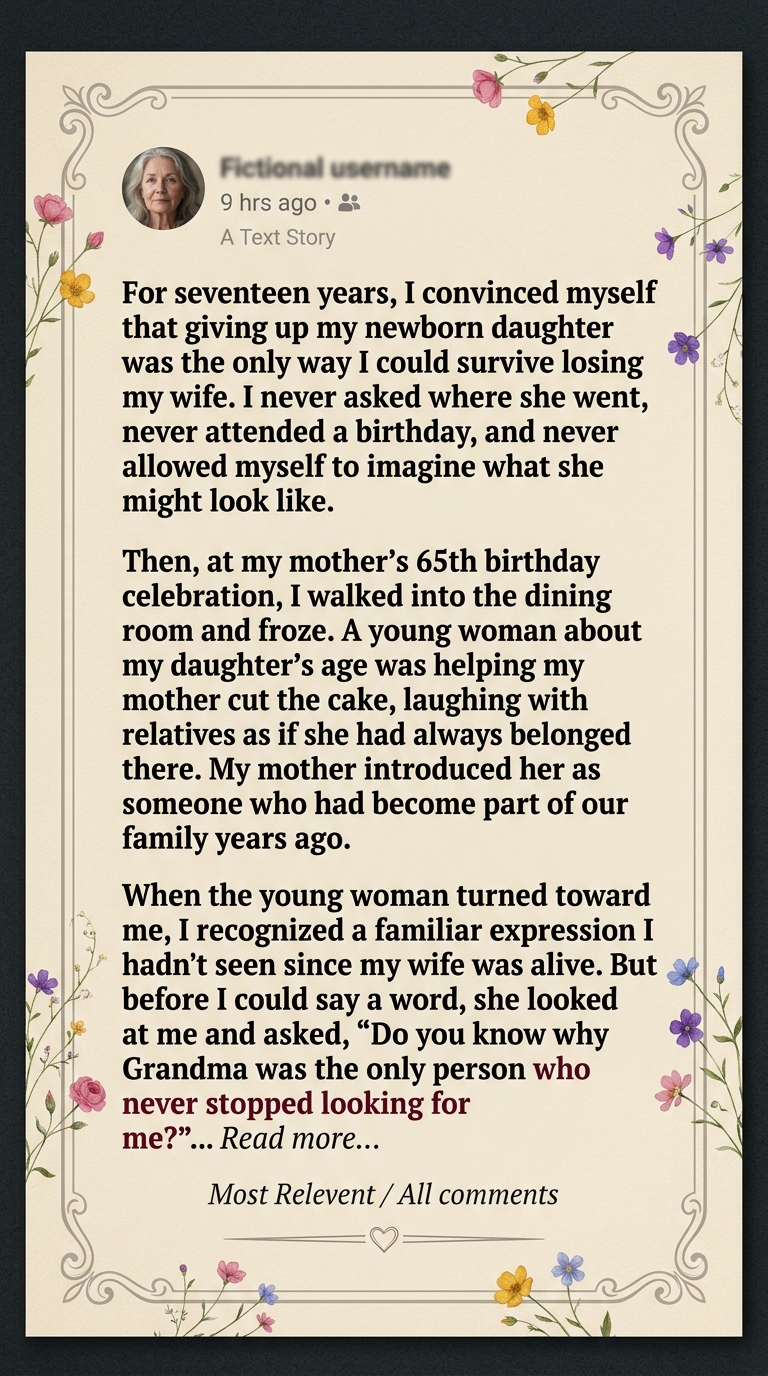
For seventeen years, I had treated my daughter’s existence like a room in a house I refused to enter.
Her name was Sophie. I knew that much. I also knew she had been born on a rainy Thursday in October, three days after my wife, Anna, died from complications following childbirth.
After the funeral, I couldn’t bear to look at the baby.
Every time I heard her cry, I remembered the hospital room, the doctors’ exhausted faces, and the moment someone told me Anna wasn’t coming home.
My mother, Margaret, tried to help. She offered to care for Sophie while I returned to work and slowly recovered. But I was twenty-seven, frightened, and convinced that every part of my life had collapsed beyond repair.
A family friend arranged for Sophie to live with another family who had been hoping to adopt. My mother begged me to reconsider.
“You’re grieving,” she told me. “Don’t make a decision you can’t undo.”
I told her I couldn’t raise a child who would remind me every day of the woman I’d lost.
The adoption was completed through the proper process. I signed the papers, handed over my parental rights, and left the office without asking for the family’s address.
I told myself that was the only way I could survive.
For years, I avoided conversations about children. I never asked my mother whether Sophie was happy. I didn’t celebrate her birthdays or wonder whether she had inherited Anna’s dark hair.
I simply kept living.
I worked, moved to another city, dated occasionally, and eventually returned to the town where I had grown up. My mother never stopped mentioning Sophie, but I always changed the subject.
When she asked whether I had ever wondered about my daughter, I answered with the same sentence.
“She’s better off without me.”
My mother never agreed.
Then, on her sixty-fifth birthday, everything I had buried came walking toward me.
The celebration was being held at her house. Relatives filled the dining room, children ran through the hallway, and someone had arranged flowers beside the old family photographs.
I arrived late because of work.
As I entered the dining room, I noticed a young woman standing beside my mother, helping her cut the birthday cake.
She was probably seventeen, perhaps eighteen. She had dark brown hair tied loosely behind her head and a warm, familiar smile.
My mother placed an arm around her shoulders.
“Everyone, this is Sophie,” she announced. “She’s been part of our family for years.”
The young woman laughed at something my aunt said.
Then she turned toward me.
I stopped moving.
Her eyes were Anna’s eyes. More than that, she had the same slight tilt of her head Anna used whenever she was listening carefully to someone.
I couldn’t breathe properly.
My mother noticed my expression.
“David,” she said softly, “come and meet her.”
Sophie studied me for a moment.
Then she asked, “Do you know why Grandma was the only person who never stopped looking for me?”
The room became quiet.
I looked at my mother.
“What does she mean?”
My mother set down the cake knife.
“Perhaps we should sit down.”
Sophie didn’t look away from me.
“I’ve wanted to ask you something for a long time,” she said. “But Grandma told me I should decide when I was ready.”
I pulled out a chair.
My mother sat opposite me, her hands folded tightly on the table.
“After the adoption, you told me not to contact the family,” she began. “I respected that. I thought you needed time. But I never believed you would want to forget your daughter forever.”
“You said she was part of another family.”
“She was. And they loved her. But I also knew that if you ever changed your mind, you would need a way to find her.”
I shook my head.
“Then why didn’t you tell me?”
“Because I had no right to break the adoption agreement or interfere with her parents’ lives. I couldn’t simply take her from the family who had raised her.”
Sophie looked down.
“Grandma didn’t take me from anyone,” she said. “She met my parents when I was little. They knew who she was. They agreed that I could visit her.”
I turned toward her.
“You knew about me?”
“Since I was nine.”
The answer hit me harder than I expected.
“Who told you?”
“My adoptive mother. She said I had been adopted as a baby because my birth mother died and my birth father wasn’t able to raise me. She didn’t make you sound like a monster. She told me you were grieving and made a decision you couldn’t handle at the time.”
I lowered my eyes.
Sophie continued.
“Grandma started visiting after she found out where I was. She never tried to replace my parents. She came to school plays, brought books, and remembered every birthday. My parents were comfortable with it because they knew she loved me.”
My mother wiped her eyes.
“I didn’t want Sophie to grow up believing she had been abandoned by everyone on your side of the family,” she said. “I couldn’t raise her, but I could make sure she knew she had a grandmother.”
I stared at my mother.
For seventeen years, I had imagined that she had accepted my decision and moved on.
Instead, she had quietly built a relationship with the child I had refused to know.
“Why didn’t you tell me you had found her?” I asked.
“I tried,” she replied. “Several times. You told me not to bring her up. You said you wanted a clean break. Eventually, I stopped asking.”
I remembered those conversations. I had dismissed them as my mother’s inability to accept reality.
I hadn’t realized how much I had demanded that she carry alone.
Sophie reached into her handbag and took out a small photograph.
It showed a little girl sitting on a wooden bench beside my mother. She had two missing front teeth and was holding a stuffed rabbit.
“That’s me when I was seven,” she said. “Grandma took that picture.”
I held it carefully.
“Your smile,” I whispered.
She nodded.
“Grandma said I smiled like my birth mother.”
My throat tightened.
“Your mother was named Anna.”
“I know.”
“She loved painting. She used to sing while cooking. She hated being late, but she was late for almost everything.”
Sophie smiled faintly.
“My parents told me about her. Grandma showed me some photographs.”
I looked at my mother.
“Why didn’t you tell me Sophie was coming tonight?”
“Because she wanted to meet you herself. I didn’t want her first encounter with you to be arranged like an appointment you might cancel.”
Sophie pulled her chair closer to the table.
“I didn’t come here to demand anything,” she said. “I have parents who raised me. They are my family, and I love them. I don’t want to replace them or make you feel like you owe me a relationship.”
I nodded, unable to speak.
“But I wanted to know what happened,” she continued. “I wanted to know whether you ever thought about me.”
There was no clever answer.
I could have told her I was young. I could have explained the grief, the shock, the sleepless nights, and the way the hospital had become unbearable to me.
All of it was true.
None of it changed what I had done.
“I thought about you,” I said. “More times than I can count. But every time I imagined looking for you, I remembered the day your mother died. I was afraid that meeting you would bring everything back.”
Sophie listened without interrupting.
“I told myself you were better off without me because it was easier than admitting I was too frightened to try.”
My mother reached for a napkin.
I continued.
“I don’t expect you to forgive me. I don’t expect you to call me Dad. I don’t even know whether you want me in your life. But I’m sorry I never gave you the chance to decide whether you wanted to know me.”
Sophie looked at the photograph in my hands.
“That’s the first thing I’ve wanted to hear from you,” she said.
The celebration slowly resumed, but the evening had changed. My relatives gave us space, and my mother moved the cake to the kitchen so Sophie and I could talk without everyone listening.
She told me about her adoptive parents, Daniel and Ruth. They had struggled with infertility for years before adopting her. They had raised her with patience and affection, and she had never doubted that she was wanted.
She loved biology and hoped to study environmental science at university. She played the piano, disliked olives, and had recently started learning to drive.
I learned that she had visited my mother every few weeks during her childhood. They baked together, worked in the garden, and watched old films on Sunday afternoons.
Then she asked about Anna.
I told her about our first meeting at a bookstore, our disastrous first date, and the way Anna used to leave small paintings around the house for me to discover.
Sophie listened with an expression I recognized from the photograph.
“Do you still have any of her paintings?” she asked.
“I do. They’re in a box at my apartment.”
“Could I see them sometime?”
I nodded.
“Whenever you want.”
Before she left, Sophie stood near the front door with her coat over one arm.
“I don’t know what happens after tonight,” she said. “I need time to think.”
“Of course.”
“But I’d like to meet again.”
I felt my eyes burn.
“I would like that too.”
She hugged me briefly. It wasn’t the embrace of a daughter who had been waiting seventeen years to come home. It was cautious, almost formal, and I understood why.
She had no obligation to make me feel better.
After she left with my mother, I stayed in the dining room for a long time.
The next morning, I called Daniel and Ruth. I expected anger, and I was prepared to accept it.
Instead, Daniel spoke calmly.
“Sophie has been thinking about meeting you for several months,” he said. “We wanted her to make the decision herself. We love her, David. Nothing about this changes that.”
“I understand.”
“Then understand something else. She has had a full life. She has a mother and father who raised her, grandparents who love her, friends, school memories, and plans for the future. If you want to know her, you need to respect the life she already has.”
“I will.”
“And don’t make her responsible for your regret.”
His words stayed with me.
Over the following months, Sophie and I began slowly.
Our first meeting outside the birthday celebration was at a quiet café. The next was a visit to my apartment, where I showed her Anna’s paintings and photographs.
She asked questions, but not all at once. Sometimes she wanted to hear stories about her mother. Other times she wanted to talk about university applications or complain about a difficult chemistry assignment.
I learned not to force conversations about the past.
I also began attending family gatherings with Daniel and Ruth when Sophie invited me. At first, I felt like an outsider. But Ruth made an effort to include me without pretending that the circumstances were ordinary.
One afternoon, she handed me an old photograph of Sophie as a toddler.
“She used to fall asleep holding this,” Ruth said.
It was a photograph of Anna.
I looked at her, surprised.
“You kept this?”
“Of course,” Ruth replied. “She deserved to know where she came from. Loving her never meant hiding that part of her life.”
I thanked her, and for the first time, I understood that the people who had raised my daughter had not stolen a place in her heart.
They had given her a home when I couldn’t.
A year after the birthday celebration, Sophie invited me to her university entrance ceremony. Daniel and Ruth sat on either side of her. My mother was in the row behind them.
When Sophie received her acceptance letter for environmental science, she ran over to us, holding it above her head.
I hugged her only after she opened her arms.
That evening, she gave me a small framed painting.
It was a simple watercolor of a woman standing beside a window, sunlight falling across her shoulders.
“Grandma said Mom used to paint like this,” Sophie explained. “I wanted to make something that reminded me of her.”
I placed it beside Anna’s old paintings.
For seventeen years, I had believed that the only way to survive losing my wife was to erase the daughter who reminded me of her.
My mother had understood something I hadn’t: grief didn’t require forgetting, and love didn’t have to belong to only one family.
Sophie never called me Dad. She called me David, and I never asked her to change it. We were building a relationship at her pace, not repairing the past according to my wishes.
I couldn’t give her back the birthdays I had missed or the years I had chosen not to know her.
But I could stop making the same choice.
And when my mother celebrated her sixty-sixth birthday the following year, Sophie stood beside me as we carried the cake into the dining room.
This time, when she laughed, I didn’t freeze.
I simply smiled, grateful that I had finally learned how to stay.