The first cruel thing my sister said about my husband happened before I had even finished walking down the aisle.
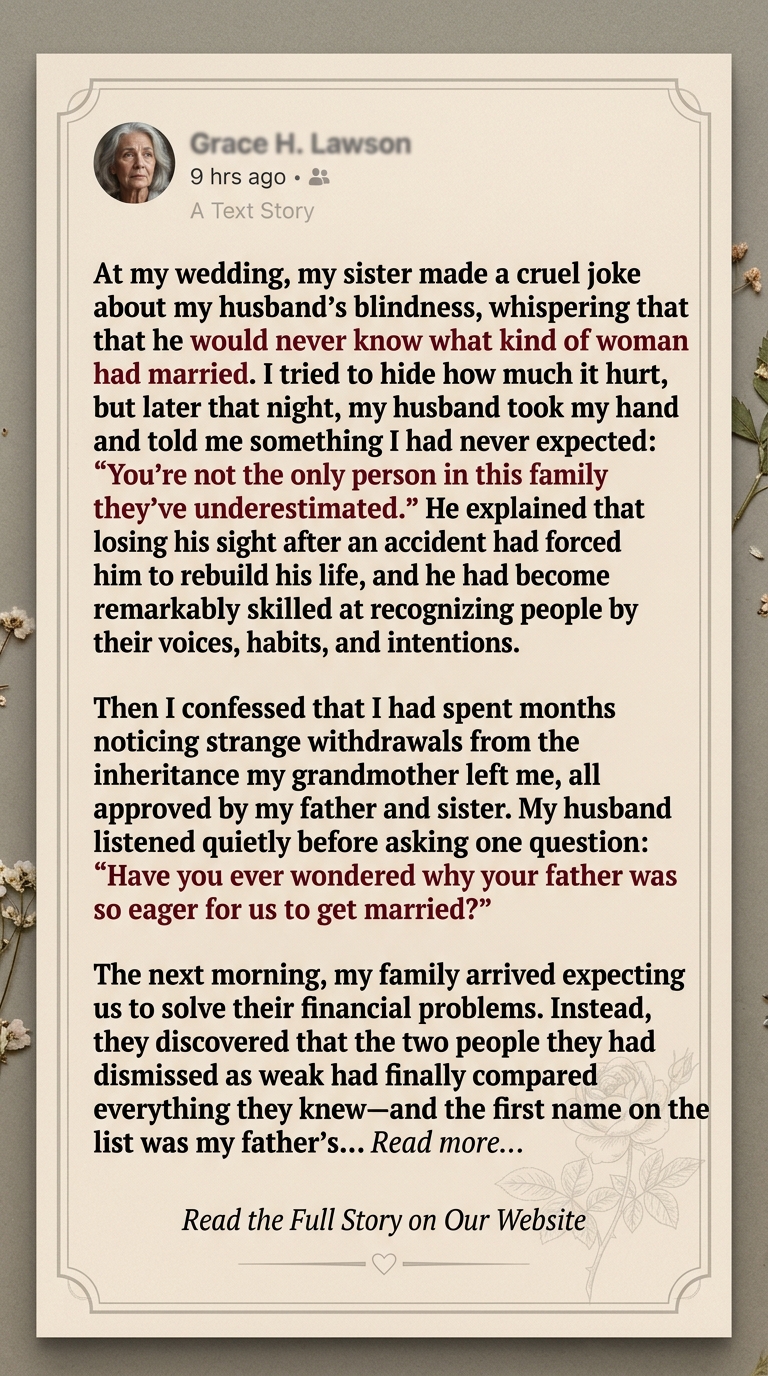
She stood beside our cousins, holding a glass of champagne, and leaned close enough for me to hear her whisper.
“Imagine marrying a man who can’t even see what he’s getting himself into.”
A few people laughed.
I kept my smile in place, though my cheeks burned. My husband, Daniel, stood beside me with one hand resting lightly on his white cane. He had lost his sight three years earlier in a road accident, but he had never allowed that loss to become the definition of his life.
He couldn’t see the people laughing, but he could hear them.
And somehow, that made their cruelty feel even worse.
I squeezed his hand.
“Are you all right?” I whispered.
Daniel smiled. “I’m marrying you. That’s a pretty good reason to be all right.”
The ceremony continued, and I tried to put my sister’s remark behind me. But the comment followed me through the reception, lingering in my thoughts whenever I heard another burst of laughter.
My sister, Vanessa, had always enjoyed making herself feel superior. She had a successful-looking career, an expensive wardrobe, and a talent for turning other people’s insecurities into entertainment. Our father encouraged her behavior, often describing her as the practical one in the family.
I was apparently the emotional one.
That evening, after the guests had left and we were finally alone in our hotel suite, Daniel sat beside me on the edge of the bed.
“You’ve been quiet since the ceremony,” he said.
“Vanessa embarrassed me.”
“She embarrassed herself.”
I looked at him. “You heard what she said?”
“I heard what she said. I also heard your father laugh, your aunt change the subject, and your mother tell someone that Vanessa was only joking.”
He paused.
“People often think blindness means I don’t notice things. They forget that most people reveal themselves without needing to be seen.”
I leaned against his shoulder.
“I’m sorry they treated you that way.”
“Don’t apologize for their behavior,” he replied. “But there’s something I want you to understand. Losing my sight forced me to rebuild almost everything about my life. I had to learn new ways to recognize people, navigate unfamiliar places, and judge situations. I’ve become very good at noticing patterns.”
He turned toward me.
“And you’re not the only person in this family they’ve underestimated.”
I frowned. “What do you mean?”
“Tell me about the money you’ve been worried about.”
My stomach tightened.
For months, I had noticed withdrawals from the inheritance my grandmother left me. The money had been placed in an investment account after her death, with my father, Robert, helping manage the arrangements. He had assured me that the account was performing well and that I shouldn’t worry about every transaction.
But the numbers never seemed right.
At first, I assumed I had misunderstood the statements. Then I noticed several withdrawals I couldn’t explain. Whenever I asked my father, he said the money had been moved into temporary investments. Vanessa backed him up, claiming she had helped organize the transfers.
I had never given either of them permission to spend my inheritance.
“I think something is wrong,” I admitted. “But Dad says everything is legitimate. Vanessa gets angry whenever I ask questions.”
Daniel listened without interrupting.
“How much has disappeared?”
“I don’t know exactly. At least eighty thousand dollars.”
He was silent for a moment.
Then he asked the question that changed everything.
“Have you ever wondered why your father was so eager for us to get married?”
I stared at him.
“What does our marriage have to do with my inheritance?”
“Possibly nothing. But your father asked me several unusual questions before the wedding. He wanted to know whether I could manage financial documents independently, whether I planned to return to work, and whether I would need someone to handle my banking.”
I felt a chill move through me.
“What did you tell him?”
“That I already manage my own affairs. Then he asked whether you had ever discussed giving me authority over your finances.”
I shook my head.
“I never discussed that with him.”
“Neither did I.”
Daniel reached for his phone and opened a voice recording.
“I want you to hear something.”
The recording began with my father’s familiar voice.
“Once they’re married, things will be easier. She trusts him, and he won’t be able to check every detail himself. Vanessa can handle the paperwork. We just need to keep everything looking ordinary.”
Another man’s voice answered, but I couldn’t identify him.
“What if she asks questions?”
My father’s reply was calm.
“She’s always been easy to reassure.”
The recording ended.
I sat frozen.
“Where did you get that?”
“Your father called me last week while I was waiting for a taxi outside your parents’ house. He didn’t realize his phone had connected to my recording device after I answered another call. I kept it because I recognized his voice and the conversation sounded suspicious.”
Daniel explained that he had recently started using an accessible recording and note-taking system to manage his daily appointments and important conversations. He had not been secretly following my family or trying to investigate them. He had simply preserved a conversation that concerned him.
“I didn’t want to accuse anyone without understanding what I was hearing,” he said. “But after what you told me tonight, I think we need professional help.”
The next morning, my father called.
He sounded unusually cheerful.
“Congratulations again, sweetheart. Vanessa and I thought we should come by. There are a few financial matters we need to discuss now that you’re married.”
I looked at Daniel.
He nodded.
“Tell him we’ll be here.”
By ten o’clock, my father and sister were sitting in our living room. Vanessa carried a designer handbag and looked around as if she were inspecting a property she expected to own.
My father placed a folder on the coffee table.
“We have a temporary cash-flow problem,” he began. “The family business needs some money to get through the next few months. Your grandmother would have wanted the family to help one another.”
I stared at him.
“How much?”
“About sixty thousand.”
Vanessa leaned forward.
“It’s not a gift. It’s a temporary transfer. Dad will put it back once the next contract closes.”
I looked at the folder.
“Why is my inheritance being used to solve the family’s business problems?”
My father’s smile disappeared.
“Because we’ve been managing it responsibly.”
“You’ve withdrawn money without my permission.”
He sighed as though I were being unreasonable.
“Your grandmother trusted me to look after you. I know what I’m doing.”
Daniel spoke from beside me.
“Then you won’t mind explaining the transactions.”
My father turned toward him.
“This is a family matter. You don’t need to involve yourself.”
Daniel’s expression remained calm.
“My wife is my family. Her money is her property. That makes it my concern when someone is using it without her consent.”
Vanessa laughed.
“Oh, please. You can’t even read the statements.”
The room became silent.
Daniel tilted his head slightly.
“I don’t need to read them to know when someone is avoiding a question.”
My father closed the folder.
“This is getting ridiculous. Your wife is confused, and you’re encouraging her.”
“No,” I said. “I’m finally asking questions.”
I placed a printed list of transactions on the table.
The statements showed that money had been transferred from my inheritance account into a company called R.M. Property Services. The company was registered to my father, but its records listed Vanessa as the person authorized to make payments.
Several transfers had been described as investment expenses. Others were labeled administrative costs.
I had asked my bank for the transaction history two days earlier, before the wedding. The bank had also confirmed that my father had no authority to withdraw money from the account. His role had been limited to helping me establish the original investment arrangement.
He had crossed that boundary.
My father looked at the pages.
“Those were legitimate business expenses.”
“Then show me the contracts,” I replied.
He didn’t answer.
Vanessa reached for the papers, but Daniel placed his hand over the stack.
“There’s another issue,” he said.
He explained that the recording from my father’s call had been reviewed by an attorney. The attorney had advised us not to make accusations based on an incomplete conversation, but the recording raised serious questions about a possible attempt to exploit my trust and Daniel’s disability.
More importantly, the attorney had discovered that my father had recently requested information about adding Daniel as an authorized person on my account.
Daniel had refused to sign anything.
My father stood up.
“I was trying to protect my daughter.”
“From what?” I asked. “Her own money?”
He turned toward me, and for the first time I saw something other than confidence in his face.
Fear.
Vanessa tried another approach.
“You’re making a terrible mistake. Dad has always handled everything for you. You wouldn’t even understand these investments without him.”
“Then explain them to me,” I said.
She opened her mouth, but no explanation came.
Daniel remained still.
“There’s one more thing we should discuss,” he said.
My father looked at him sharply.
“What now?”
“The company receiving the transfers has been operating at a loss. Its registered business address is a rented office that has been empty for months. Several payments went to personal credit accounts rather than property investments.”
Vanessa’s face changed.
She had been using the company to cover debts from a failed property renovation project. My father had helped her move the money, believing that a future sale would allow them to replace it before I noticed.
But the sale never happened.
The money was gone.
My father had also been using my inheritance to make payments on a business loan he had personally guaranteed. He had concealed the transfers by describing them as temporary investments.
He had not planned to return the money immediately. He had planned to keep moving it until the business recovered.
And if it didn’t, he intended to blame the losses on poor market performance.
I looked at him, struggling to recognize the man who had taught me to ride a bicycle and stayed beside my grandmother during her final illness.
“You knew this was my money,” I said.
“I was going to replace it.”
“When?”
“When things improved.”
“And if they didn’t?”
He lowered his eyes.
Vanessa began crying, but her tears did not soften me.
She had helped make the transfers. She had encouraged me to trust our father, and she had mocked Daniel because she believed his blindness made him easier to manipulate.
Now she was discovering that neither of us had been as helpless as she imagined.
I stood.
“You need to leave.”
My father looked up.
“Don’t do this to your family.”
“You did this to me. I’m simply refusing to let it continue.”
He left without another word. Vanessa followed, refusing to look at either of us.
The next few months were difficult. We worked with the bank and an independent forensic accountant to trace the transactions. The evidence showed that my father and Vanessa had knowingly diverted my inheritance to cover personal and business expenses.
The matter went through the appropriate legal process. Some of the money was recovered from remaining company assets. The rest became part of a repayment judgment, and both of them faced financial and legal consequences for their actions.
My father eventually admitted that he had convinced himself he was borrowing from me temporarily. Vanessa admitted that she had feared losing her lifestyle if the business collapsed. Neither explanation made what they had done acceptable.
I stopped speaking to them for a time.
Daniel never pressured me to forgive them. He understood that family relationships could be complicated, especially when love and betrayal existed in the same place.
One evening, several months after the wedding, I found him sitting by the open window, listening to the rain.
“Do you ever wish you could see again?” I asked.
He considered the question.
“Sometimes,” he said. “I miss the small things. Your expression when you’re trying not to laugh. The color of the sky before a storm. But I don’t spend every day thinking about what I’ve lost.”
He reached for my hand.
“I’ve learned that seeing clearly and understanding clearly aren’t the same thing.”
I sat beside him.
For years, my family had treated his blindness as a weakness and my trust as stupidity. They believed they could make decisions for us because they thought we would never recognize what was happening.
They were wrong.
Daniel hadn’t saved me by discovering some extraordinary secret. He had simply listened when I spoke, noticed what others overlooked, and refused to let people use his disability as an excuse to dismiss him.
And I had finally learned that being a good daughter did not mean surrendering my judgment or allowing my family to control my future.
Our marriage began with a cruel joke.
But it became the place where I learned that the people who truly see you are not always the ones looking at you.