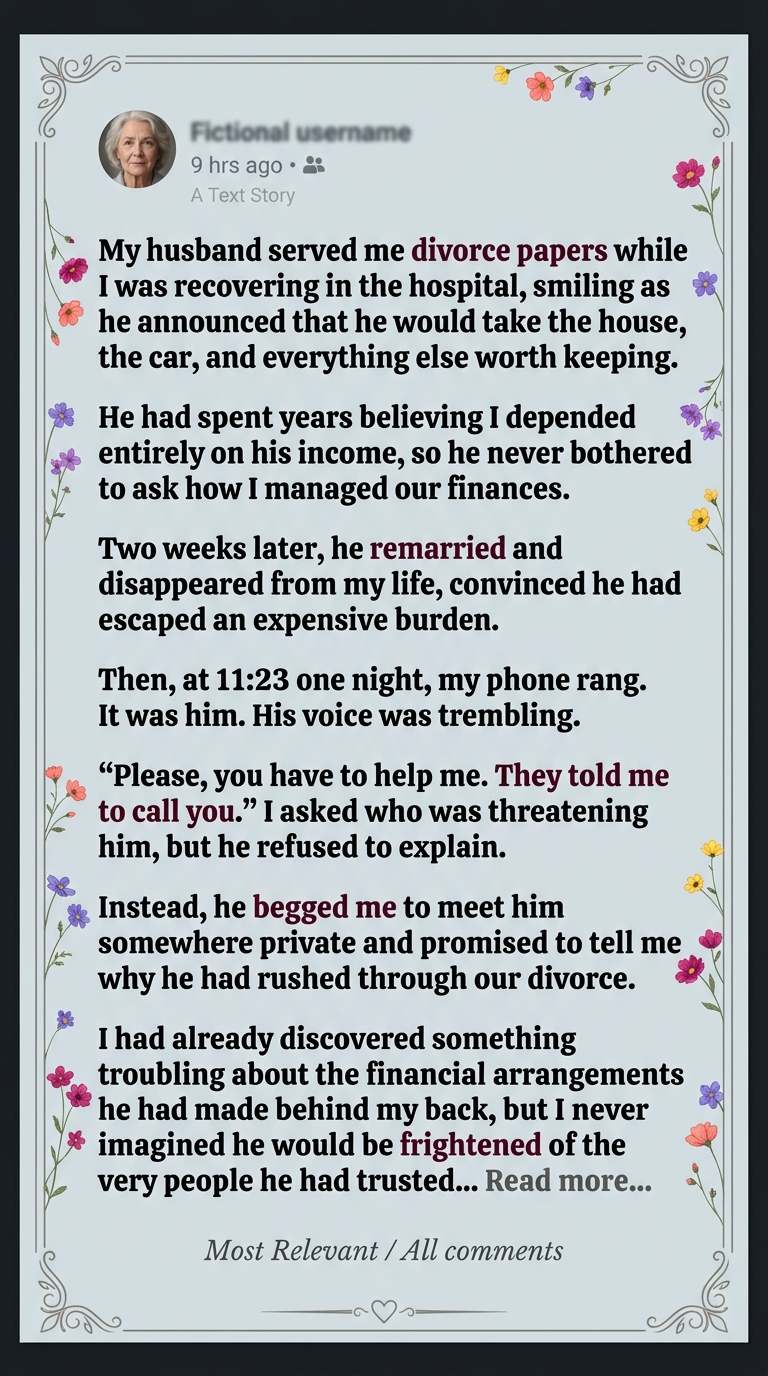
The first time my husband served me divorce papers, I was lying in a hospital bed with an IV in my arm.
The second time I heard from him, he was begging me to save him.
I had been recovering from emergency surgery after a serious infection. The doctors expected me to remain in the hospital for several more days, and I was still weak enough that walking to the bathroom left me exhausted.
Daniel arrived one afternoon carrying a small bouquet of flowers.
For a moment, I thought he had finally decided to act like a husband.
Then he placed a folder on my bedside table.
“I’ve spoken to an attorney,” he said. “It’s better if we settle everything now.”
I looked at the folder.
“What is it?”
“Divorce papers.”
I stared at him, waiting for him to explain that he was joking.
He wasn’t.
We had been married for eighteen years. We had built a comfortable life together, raised a son who was now studying engineering, and survived more than a few difficult seasons.
Our marriage had not been perfect, but I had never imagined he would choose the day I was recovering from surgery to end it.
“Why now?” I whispered.
Daniel pulled a chair closer.
“Because I don’t want another year of arguments. I’ve carried this marriage long enough.”
I looked at him.
“You’ve carried it?”
He smiled faintly.
“Let’s be realistic. I earned the money. The house is in my name. The car is in my name. Most of what we own came from my work.”
I almost laughed.
For years, Daniel had believed that because his salary arrived in his bank account, he controlled our entire financial life.
He had never asked how the household bills were paid, how our investments performed, or why we never seemed to struggle even when his company reduced bonuses.
He had simply assumed everything happened because he worked.
“What are you asking for?” I said.
“I’m keeping the house and the car. You can take your personal belongings. I’ll be generous about the rest.”
I looked at him for a long time.
“You’re asking me to sign away everything while I’m in the hospital?”
“Don’t make this difficult. You’ll have somewhere to stay.”
He pushed the folder closer.
Then he stood, straightened his jacket, and said something I would remember for years.
“You’ve always depended on me, Claire. You’ll manage better once you accept that.”
I didn’t sign anything.
I told him I needed time to review the papers.
He seemed irritated, but he left the folder behind.
After he walked out, I called my sister, Helen. She arrived an hour later and immediately noticed the documents.
“Did he seriously bring you divorce papers here?”
“Yes.”
She read the first page and shook her head.
“Don’t sign a single thing until someone independent reviews this.”
I agreed.
What Daniel didn’t know was that I had never depended entirely on his income.
I had worked in accounting before our son was born. After taking a few years away from full-time employment, I began managing the finances for a small group of local businesses. Eventually, I built a consulting practice that gave me a steady income.
I had also been responsible for our household budgeting from the beginning.
Daniel transferred money into our joint account every month. I paid the bills, handled the insurance, maintained the investment contributions, and managed the savings.
Over the years, I had invested a portion of my own earnings and a portion of our joint savings in diversified funds and property investments.
Some assets were jointly owned. Others were in my name alone because they had been purchased with my separate earnings or inherited from my parents.
Daniel knew I handled the paperwork.
He simply never cared enough to understand it.
While I was recovering, my attorney reviewed the divorce proposal. It was far more aggressive than Daniel had suggested. He had listed the house, the car, and several accounts as his exclusive property, even though some were jointly owned.
He had also failed to disclose an investment account that we had both contributed to over the years.
My attorney advised me not to sign and began preparing a complete financial disclosure.
Two weeks after serving me the papers, Daniel remarried.
I learned about it from a photograph posted by one of his colleagues.
His new wife was a woman named Melissa, someone he had met through his business network. They had apparently been together for several months before he filed for divorce.
He had rushed through the separation because he wanted to start his new life without dealing with the financial consequences of ending the old one.
I was hurt, but I wasn’t surprised.
The divorce proceeded through attorneys. I refused to accept his first proposal, and the financial review eventually established which assets were joint, which were separate, and what each of us was entitled to receive.
Daniel was furious when he learned that I had my own investments.
“You never told me you had all this money,” he complained during one conversation.
“I never hid it,” I replied. “You never asked.”
He accused me of keeping secrets, although I had spent years sharing household statements and financial summaries with him.
Eventually, the divorce was finalized.
I kept the property that belonged to me, received my lawful share of the joint assets, and moved into a smaller home near Helen.
Daniel kept the house he had wanted so badly.
He also kept the car.
I thought that would be the end of our relationship.
Then, at 11:23 one night, my phone rang.
I was reading in bed when his name appeared on the screen.
For several seconds, I considered ignoring it.
Then I answered.
“Hello?”
“Claire?”
His voice sounded strange.
“What’s wrong?”
“Please. You have to help me.”
I sat up.
“Help you with what?”
“They told me to call you.”
“Who?”
He breathed heavily.
“Please don’t ask questions over the phone. I need to see you.”
“Daniel, if someone is threatening you, call the police.”
“No. You don’t understand. I can’t involve the police yet.”
I felt a chill.
“Then tell me who is threatening you.”
He lowered his voice.
“It’s people I trusted. People who helped me after the divorce. They know about the accounts.”
“What accounts?”
He went silent.
Then he said, “The ones I opened before we separated.”
I remembered the financial review.
My attorney had discovered that Daniel had opened several business accounts shortly before filing for divorce. He had described them as ordinary accounts connected to his consulting work, but the transactions had never been properly explained.
At the time, I had assumed he was trying to keep his new business arrangements separate from our marital finances.
Now I wondered whether there was something more.
“I’ll meet you,” I said, “but only in a public place.”
He agreed immediately.
We arranged to meet the following afternoon at a café near the courthouse.
When I arrived, Daniel was already sitting in the back corner.
He looked older than I remembered. His expensive watch was gone, and his hands trembled as he stirred a coffee he hadn’t touched.
“Thank you for coming,” he said.
“Tell me what’s happening.”
He glanced toward the windows.
“Do you remember Marcus?”
I did.
Marcus was Daniel’s former business partner. They had worked together for nearly ten years before Daniel left to start a separate consulting company.
Marcus had attended our wedding, visited our home, and once spent an entire Christmas with our family.
“What about him?”
“He introduced me to two investors after the divorce. They said they could help me expand my company.”
“And?”
“They offered to provide capital if I transferred some client contracts into a new business.”
I frowned.
“Why would you do that?”
“They said it was a normal restructuring. I trusted Marcus. He told me the paperwork was standard.”
Daniel rubbed his face.
“I signed everything.”
“What did you sign?”
He took a breath.
“Personal guarantees. Loan agreements. A transfer of my consulting company’s receivables.”
I stared at him.
“You guaranteed the loans personally?”
He nodded.
“How much?”
“Almost nine hundred thousand dollars.”
I felt my stomach tighten.
“Daniel, why would you borrow that much?”
“They told me the business was worth more than enough to cover it. They said the money would be used to acquire a smaller firm, and I would receive a share of the new company.”
“Did you receive anything?”
He shook his head.
“That’s the problem. The acquisition never happened.”
He explained that the investors had transferred the borrowed money through several companies. The business he thought he was buying did not exist in the form described to him.
The company listed as the acquisition target had been dissolved months earlier.
When Daniel began asking questions, Marcus stopped answering his calls.
Then the lenders contacted him.
They wanted repayment.
I sat back.
“Why did you wait until now to tell me?”
Daniel looked ashamed.
“Because I didn’t think it would become a problem.”
“You signed nearly a million dollars in guarantees. How could you think it wouldn’t become a problem?”
He lowered his head.
“Marcus told me it would be settled before anyone noticed.”
I studied his face.
“Who told you to call me?”
“An investigator.”
I stiffened.
“What investigator?”
“A woman named Evelyn. She works with a financial crimes unit. She contacted me yesterday.”
He explained that Evelyn had been reviewing the investors’ activities after several other business owners reported similar transactions.
She had discovered that Daniel’s company had received money from the same network of businesses.
The investigators had also found payments made to Marcus and two other people.
Daniel was frightened because he had been told that his signature appeared on documents authorizing the transfers.
“Did you authorize them?” I asked.
“I signed what Marcus gave me. I didn’t know the money was being moved like that.”
“Did you read the documents?”
He hesitated.
“Not carefully.”
I closed my eyes briefly.
That was Daniel’s greatest weakness. He had always believed confidence was the same thing as understanding.
“Why did the investigator tell you to call me?”
He reached into his jacket and placed a folded sheet of paper on the table.
It was a copy of a financial statement from one of the companies involved.
My name appeared on it.
I read the page twice.
The company had listed me as a financial adviser and authorized representative.
I had never worked for them.
“I didn’t put your name there,” Daniel said quickly. “Marcus handled the paperwork.”
I looked up.
“Why is my name on this?”
Daniel swallowed.
“Because they wanted to show that the business had professional financial oversight. Marcus said it would make the investors more comfortable.”
I felt anger rising.
“You used my name without my permission?”
“I thought it was just a reference. I didn’t know they were using it on official documents.”
I pushed the paper away.
“You don’t get to put my name on anything because you think it will make people trust you.”
He looked desperate.
“That’s why I need your help. You understand financial records. You can explain that I didn’t know what they were doing.”
I stared at him.
For eighteen years, he had treated my financial knowledge as something that existed only to make his life easier.
Now he wanted me to use it to protect him.
“Did you tell the investigator that I had nothing to do with the company?”
“I told her you never worked there.”
“Did you tell her you used my name without permission?”
He nodded.
“Then you need to cooperate fully and tell the truth.”
He reached across the table.
“Can you come with me? They want to speak to you.”
I pulled my hand away.
“I’ll speak to them if they contact me directly. But I won’t help you hide anything.”
His face fell.
“Claire, please. If they think I was involved, I could lose everything.”
I looked at him.
“You already risked everything when you signed documents you didn’t understand and allowed someone to use my identity.”
He looked down.
For the first time since I had known him, Daniel seemed to understand that his decisions had consequences he couldn’t simply transfer to someone else.
The following morning, Evelyn contacted me through my attorney.
She explained that investigators had found my name on several documents connected to the investment network. They wanted to establish whether I had knowingly participated.
I provided my employment records, professional history, bank statements, and correspondence showing that I had never been associated with the companies.
I also supplied the original financial documents from our divorce proceedings, which established that Daniel had been operating his new business independently.
The investigation continued for several months.
It eventually revealed that Marcus and the two investors had been using fake acquisition agreements to obtain loans from private lenders. They moved the funds through newly created companies, then left the borrowers responsible for the guarantees.
Daniel was one of several business owners caught in the scheme.
But the investigation also uncovered something more troubling.
Daniel had known that some of the transfers were unusual. He had received questions from his own accountant and had ignored them because Marcus assured him everything was legitimate.
He hadn’t designed the fraud, but he had been careless and willing to overlook warning signs when he believed the arrangement would make him wealthy.
He was not entirely innocent.
Marcus and one of the investors were eventually charged with fraud and related financial offenses. Daniel cooperated with investigators, provided his records, and admitted what he had signed and what he had failed to verify.
The lenders pursued the guarantees, and Daniel’s business collapsed.
He sold the house to settle part of his obligations and moved into a rented apartment.
His new marriage ended less than a year after it began. Melissa had believed he was financially secure and had not expected to inherit the consequences of his failed business.
Daniel called me once more after everything became public.
This time, he wasn’t trembling.
He sounded exhausted.
“I lost the house,” he said.
“I heard.”
“Melissa has left.”
“I’m sorry things have turned out this way.”
He was quiet.
Then he asked, “Do you ever think about what would have happened if I hadn’t divorced you?”
I considered the question.
“You would still have been responsible for the decisions you made. I couldn’t have prevented that.”
“I thought you depended on me.”
“I know.”
“I was wrong.”
I didn’t answer immediately.
For years, I had wanted him to recognize that I had contributed more to our life than he had ever acknowledged. I had wanted him to understand that managing a household, building investments, and keeping a family financially stable were forms of work too.
But hearing him admit it now brought me no satisfaction.
“I hope you learn from this,” I finally said.
“I wish I had listened to you.”
“So do I.”
We ended the call.
Daniel eventually entered a repayment arrangement with his remaining creditors and began working as a salaried consultant. He had to rebuild his professional reputation from the beginning.
I heard that he was cooperating with the legal proceedings against Marcus and the others.
I didn’t follow his progress closely.
My own life had become quieter. I returned to work, spent more time with my son, and continued managing my investments. The house I bought after the divorce became a place where I could make decisions without explaining or defending every choice.
One evening, my son asked whether I hated his father.
I thought about it.
“No,” I said. “But I don’t trust him anymore.”
“Do you feel sorry for him?”
“Sometimes. But feeling sorry for someone doesn’t mean taking responsibility for their mistakes.”
My son nodded.
I hoped he would remember that.
The night Daniel called at 11:23, he had believed I was the only person who could save him because I understood the financial world he had ignored.
He had once served me divorce papers while I was lying in a hospital bed, convinced I had nothing without him.
Now he understood that the life he had dismissed as something he provided had been built by two people, and that the woman he believed was dependent on him had been the one keeping the finances organized all along.
I had not wanted him to lose everything.
I had simply wanted him to recognize that I was never the helpless person he imagined.
And when he finally needed help, I gave him the one thing he had never given me during our marriage:
The truth, without pretending it would protect him from the consequences.