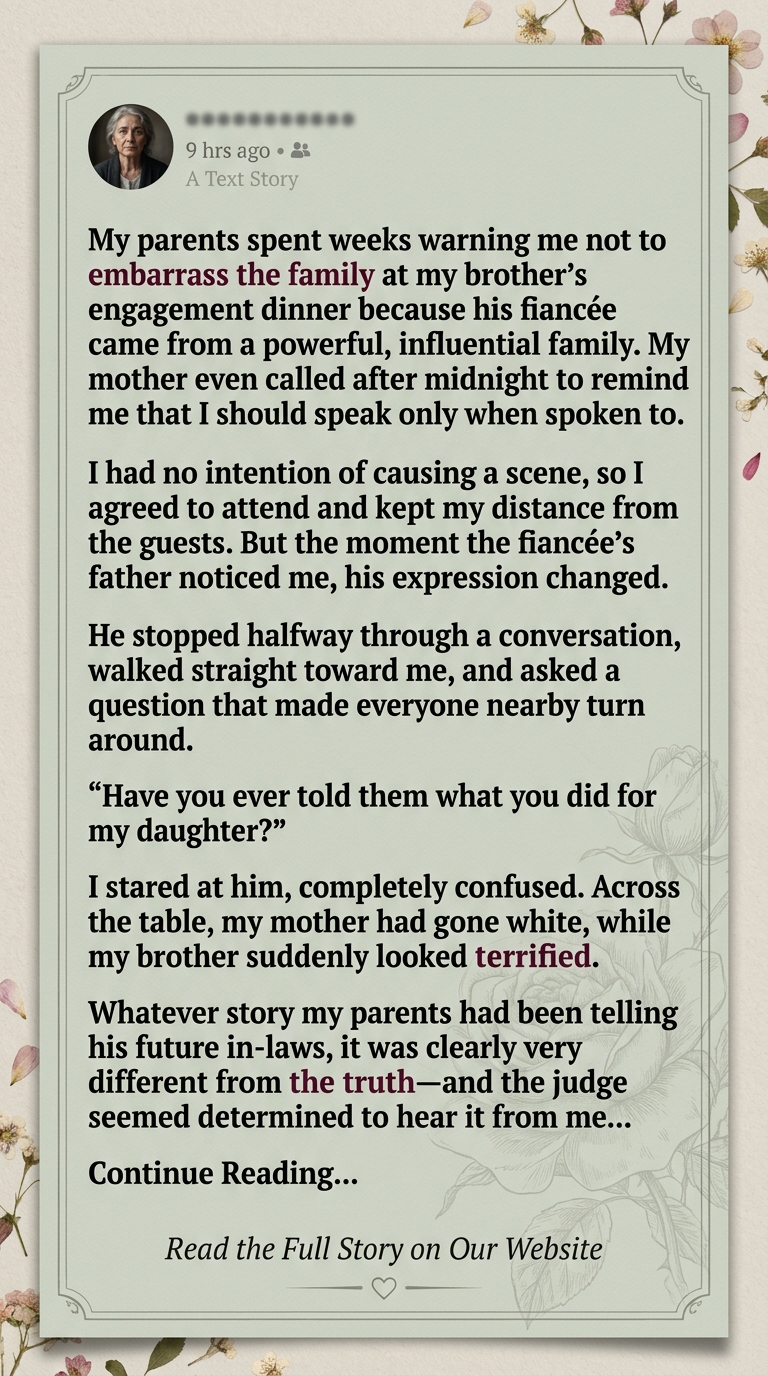
For three weeks before my brother’s engagement dinner, my parents treated my attendance like a problem they needed to manage.
My mother called repeatedly to remind me what to wear, how to speak, and which subjects to avoid. My father told me not to discuss my work, my past, or anything that might make the family uncomfortable.
Then, shortly after midnight the night before the dinner, my mother called again.
“I want you to understand something,” she said. “This family has worked very hard to build a relationship with the Whitmores. Your brother’s future depends on this marriage. Please don’t embarrass us.”
“I’ve never embarrassed you.”
“Just remember to speak when you’re spoken to. And don’t bring up things that happened years ago.”
I sat silently for a moment.
“What things?”
She ignored the question.
“Please, just do as I’m asking.”
The Whitmores were wealthy and influential. My brother, Andrew, was marrying their daughter, Olivia. Her father, Judge Robert Whitmore, had served on the state appellate court before retiring. He was respected, well connected, and known for supporting several legal education programs.
My parents had spent months praising the family.
They spoke about the Whitmores as though marrying into their circle would finally give our family the recognition it deserved.
I had no interest in competing for their approval.
I lived in another city, worked as a rehabilitation coordinator, and had built a quiet life that had little to do with my parents’ social ambitions.
Still, Andrew was my brother. I agreed to attend.
When I arrived at the hotel, my mother immediately approached me.
“Thank goodness you’re here,” she whispered. “Your dress is a little plain, but it will do. Just stay near the back.”
I glanced toward the entrance.
“Where’s Andrew?”
“Speaking with Olivia’s family.”
“And Dad?”
“Talking to some guests. Please don’t wander around.”
I gave her a tired smile and walked toward a small table near the windows.
The dinner began with speeches, photographs, and several carefully rehearsed stories about how Andrew and Olivia had met.
My father spoke about the importance of family values.
My mother described Andrew as a hardworking young man who had always been willing to help others.
I nearly laughed when she said that.
Andrew had never been particularly interested in helping anyone unless there was something to gain.
But I kept quiet.
Then Judge Whitmore stood to speak.
He was in his late sixties, with silver hair and a calm manner. He spoke warmly about his daughter, thanked our parents for welcoming her into their family, and praised Andrew’s ambition.
As he finished, his eyes moved across the room.
Then they stopped on me.
His expression changed.
He lowered the microphone, spoke briefly to his wife, and walked directly toward my table.
I stood automatically.
“Mr. Whitmore?”
He looked at me for several seconds.
Then he asked a question that made the people around us turn.
“Have you ever told them what you did for my daughter?”
I stared at him.
“I’m sorry?”
He shook his head slightly.
“Have you ever told your family what happened at St. Catherine’s?”
My mother, standing near the head table, went completely pale.
Andrew stopped speaking to one of his future in-laws.
Judge Whitmore looked around.
“I think everyone should hear this.”
My father hurried toward us.
“Robert, perhaps we should discuss this privately.”
The judge turned toward him.
“Why privately? Your family has spent considerable time discussing the importance of character tonight. I think this is relevant.”
He looked back at me.
“Three years ago, my daughter was involved in a serious accident. Do you remember?”
I nodded slowly.
“Yes.”
Olivia had been twenty-three at the time. She had been driving home from a volunteer program when another vehicle struck her car on a rural road.
I had been working at St. Catherine’s Rehabilitation Center, where she was transferred after emergency surgery.
But I hadn’t known she was Judge Whitmore’s daughter.
She had been unconscious when I first met her, and her medical records identified her by her full name, Olivia Whitmore. I had no reason to connect her to the influential family my parents admired.
The judge continued.
“When she woke up, she couldn’t move her left hand properly. The doctors weren’t certain how much function she would recover. She was frightened, angry, and convinced her life was over.”
I remembered Olivia clearly.
She had been stubborn, intelligent, and terrified of becoming dependent on other people.
“I was part of her rehabilitation team,” I said quietly.
Judge Whitmore nodded.
“You were more than that. You were the person who refused to let her believe that her future had ended.”
I looked down.
My work had never felt extraordinary. It was simply what I did.
Olivia had struggled through months of rehabilitation. She had difficulty gripping objects, writing, and completing ordinary tasks. Some days she refused to participate.
I had worked with her on small goals: holding a cup, fastening buttons, turning pages, and eventually writing her name again.
When she became discouraged, I reminded her that progress was rarely dramatic.
One afternoon, she had thrown a therapy device across the room.
“I’ll never be normal again,” she said.
I sat beside her.
“Maybe your life won’t look exactly the way it did before. That doesn’t mean it can’t be yours.”
She had cried for nearly twenty minutes.
Then she asked me to help her try again.
Over the following months, she made remarkable progress.
She eventually regained enough hand function to return to university and complete her degree.
But there was something else I remembered.
During her final month at the center, Olivia had asked whether I could attend a small celebration her family was organizing.
I declined because I was scheduled to work.
She had smiled and told me she would find another way to thank me.
I hadn’t heard from her afterward.
Until that evening.
Judge Whitmore looked toward the head table.
“Olivia told us repeatedly that one member of her rehabilitation team had changed the way she understood her own recovery. She wanted to thank that person properly. But when she tried to find you, she was told you had left the profession.”
I frowned.
“I never left.”
His expression darkened.
“That’s what we discovered.”
He turned toward my parents.
“Your daughter was the rehabilitation coordinator who worked with Olivia. When my daughter asked your family for help finding her, someone told us she had abandoned her career after a professional complaint.”
I felt my stomach tighten.
“What?”
My mother lowered her eyes.
Andrew looked as though he wanted to disappear.
Judge Whitmore continued.
“We were also told that she had been dismissed from St. Catherine’s for mishandling a patient’s care.”
I stared at him.
“That never happened.”
“I know. We contacted the center directly. Your employment record was excellent.”
The room had become so quiet that I could hear the air-conditioning.
I turned toward my mother.
“Why would you tell them that?”
She opened her mouth but couldn’t answer.
Andrew finally spoke.
“It was a misunderstanding.”
Judge Whitmore looked at him.
“What was?”
Andrew rubbed his forehead.
“Olivia asked about my sister. Mom said she had some problems at work.”
I shook my head.
“You knew I was still working there.”
He didn’t look at me.
Judge Whitmore’s voice became firmer.
“Your mother told Olivia that her family should be careful about becoming too involved with someone whose professional conduct had been questioned. She said your sister had become unstable after a difficult patient case.”
I felt as though the room had tilted.
I remembered the phone call from my mother three years earlier.
She had asked whether I would consider leaving St. Catherine’s and moving closer to home. She said the family needed me.
I had refused.
At the time, I thought she was simply disappointed.
Now I understood that something else had been happening.
Judge Whitmore turned to my mother.
“Why did you do that?”
My mother finally spoke.
“We were trying to protect Andrew.”
“From what?”
She looked toward my brother.
“From complications. We didn’t know what Olivia’s family would think if they became close to someone with a difficult history.”
I stared at her.
“You invented a professional complaint?”
“We didn’t invent anything,” she replied quickly. “There had been a disagreement at your workplace.”
I remembered the disagreement.
A senior administrator had wanted to discharge a patient before the rehabilitation team considered him ready. I had objected and requested another assessment. The matter had been reviewed internally, and the administrator’s decision had been changed.
No complaint had ever been filed against me.
No disciplinary action had been taken.
I had told my mother about the incident because I had been frustrated by the administrator’s behavior.
She had turned a disagreement into a story about professional misconduct.
Andrew finally stepped forward.
“Mom was worried Olivia’s father wouldn’t approve of our family. She thought it would be better if he didn’t ask too many questions about Claire.”
I looked at him.
“So you knew?”
He hesitated.
“I knew Mom had exaggerated.”
“And you let them believe I was professionally unreliable?”
He lowered his voice.
“I was trying to protect my relationship.”
I almost couldn’t believe him.
“You protected your engagement by allowing them to believe your sister had harmed a patient?”
“That’s not what I said.”
“It’s what they were told.”
Judge Whitmore raised a hand.
“Andrew, I think you should stop.”
Then he turned to me.
“Claire, I owe you an apology. My daughter should have been able to thank you years ago. Instead, she was given false information about someone she respected.”
I shook my head.
“You don’t owe me an apology for what my family said.”
“I do. I believed them without checking. I should have contacted the center immediately.”
He paused.
“Olivia has been asking about you for months. She wanted to invite you to the engagement dinner herself, but your mother told her you were uncomfortable attending family events.”
I looked toward the head table.
My mother was crying now, but I couldn’t tell whether she was ashamed or frightened that her story had collapsed.
At that moment, Olivia appeared beside her father.
She had been standing near the entrance to the private dining room.
“Claire?”
I turned.
She smiled, though her eyes were already wet.
“I was hoping you’d be here.”
I walked toward her.
She hugged me carefully.
“I never forgot what you taught me,” she whispered. “I still use the exercises you showed me when my hand gets stiff.”
I smiled.
“How is it?”
She lifted her left hand and opened and closed her fingers.
“Not perfect. But mine.”
We laughed softly.
Then she looked at my family.
“I asked Andrew about you several times. He told me you didn’t want anything to do with us.”
Andrew looked down.
Olivia continued.
“Then I heard you had been dismissed from your job. I couldn’t understand it. You were one of the most careful people I had ever met.”
She turned to her father.
“That’s why I asked him to look into it.”
Judge Whitmore nodded.
“We contacted the rehabilitation center last week. They confirmed Claire’s employment history and provided the information she had authorized them to share.”
My mother finally spoke.
“Olivia, we were only trying to avoid misunderstandings.”
Olivia looked at her.
“You told me the person who helped me recover was dangerous to patients. How is that avoiding a misunderstanding?”
My mother had no answer.
The dinner was interrupted for nearly twenty minutes.
Some guests quietly returned to their seats. Others moved toward the bar, pretending not to have heard anything.
I didn’t want to remain there.
I had come to support my brother, not to become the subject of a public family investigation.
I thanked Olivia and her father, then collected my coat.
Before I could leave, Andrew followed me into the hallway.
“Claire, wait.”
I turned.
“What?”
He looked exhausted.
“You’ve made this much worse than it needed to be.”
I stared at him.
“I didn’t say anything. Your future father-in-law asked me a question.”
“You could have handled it privately.”
“I didn’t know what you and Mom had told them. I didn’t even know there was a story.”
He rubbed his face.
“Mom was worried. She thought if Olivia’s family knew you had been involved in a serious patient situation, they might judge all of us.”
“There was no serious patient situation.”
“I know that now.”
“You knew it before tonight.”
He looked away.
For a moment, I felt the old instinct to make things easier for him.
I had spent much of my childhood doing that. When Andrew broke something, I took the blame. When he forgot an important family responsibility, I covered for him. When our parents were disappointed in him, I was expected to understand.
But I was no longer a child.
“I hope your marriage works,” I said. “But you need to understand that protecting your future doesn’t give you permission to destroy someone else’s reputation.”
I left.
The following morning, Olivia called me.
She apologized again and asked whether I would meet her for coffee.
We met a few days later.
She told me that she had been uncomfortable with the way my parents spoke about me long before the engagement dinner. They had repeatedly described me as difficult, overly sensitive, and unwilling to support Andrew.
She had initially accepted their explanation because she assumed they knew me better.
But after remembering her rehabilitation, she began questioning why the person who had helped her so much was being described so negatively.
She also told me something I hadn’t known.
After leaving St. Catherine’s, she had wanted to establish a small grant program for patients who couldn’t afford extended rehabilitation. She had hoped I might advise the program.
My parents had told her I was no longer working in the field.
“I didn’t want to believe it,” she said. “But I should have checked.”
I told her I was still working and would be happy to review the program’s plans when they were ready.
She smiled.
“Then maybe we can finally do what I wanted to do three years ago.”
Over the next several months, I helped Olivia develop the grant program. We worked with rehabilitation professionals and local charities to identify patients who needed additional support after their insurance coverage ended.
I did not take a leadership position or accept special treatment.
I simply contributed my professional experience.
Andrew and Olivia’s wedding went ahead, although the family atmosphere changed considerably.
My mother eventually apologized in person.
She admitted that she had been afraid I would overshadow Andrew’s engagement by drawing attention to my work and that she had exaggerated the story because she believed the Whitmores would consider me unsuitable company.
I told her that an apology could not undo what she had done.
She nodded.
“I know.”
My relationship with her remained distant for a long time.
Andrew also apologized, though it took him longer to understand that remaining silent had made him part of the lie. We eventually began speaking again, but I no longer covered for him or accepted responsibility for keeping our parents comfortable.
A year after the engagement dinner, Olivia invited me to the opening of the rehabilitation grant program.
The first recipient was a young woman who had suffered a serious hand injury and feared she would never return to her work as a violin teacher.
I watched her practice with a therapist, slowly rebuilding strength and coordination.
She struggled, grew frustrated, and tried again.
I recognized that expression immediately.
After the ceremony, Olivia stood beside me.
“Do you remember what you told me when I thought my life was over?”
I smiled.
“That progress isn’t always dramatic?”
She shook her head.
“You told me that my life could still belong to me, even if it looked different.”
She looked toward the young woman practicing across the room.
“I think that’s what we’re giving people here.”
I watched the patient carefully turn her injured hand around the instrument.
For the first time in a long while, I felt no need to prove anything to my family.
The truth had not needed a dramatic speech from me. It had simply needed someone willing to ask the right question and listen to the answer.
My parents had spent weeks warning me not to embarrass the family.
But the only thing that embarrassed them that evening was the truth they had worked so hard to hide.