My mother-in-law had never believed that marriage gave me the right to privacy.
Patricia treated our bedroom as an extension of her own home. She walked in whenever she pleased, opened drawers without asking, inspected the laundry, and sometimes sat on the edge of our bed while Julian and I were getting dressed. If I objected, she laughed and reminded me that she was Julian’s mother.
For a long time, I tolerated it because I wanted peace in my marriage.
That ended on a Tuesday morning when she entered our bedroom while I was changing.
“Patricia, please knock before coming in,” I said, pulling my robe closed. “This is our private space.”
She looked at me as though I had insulted her.
“Private space? You’re living in my son’s house.”
“I bought this house before Julian and I married.”
Her expression hardened. “My son owns this house, not you.”
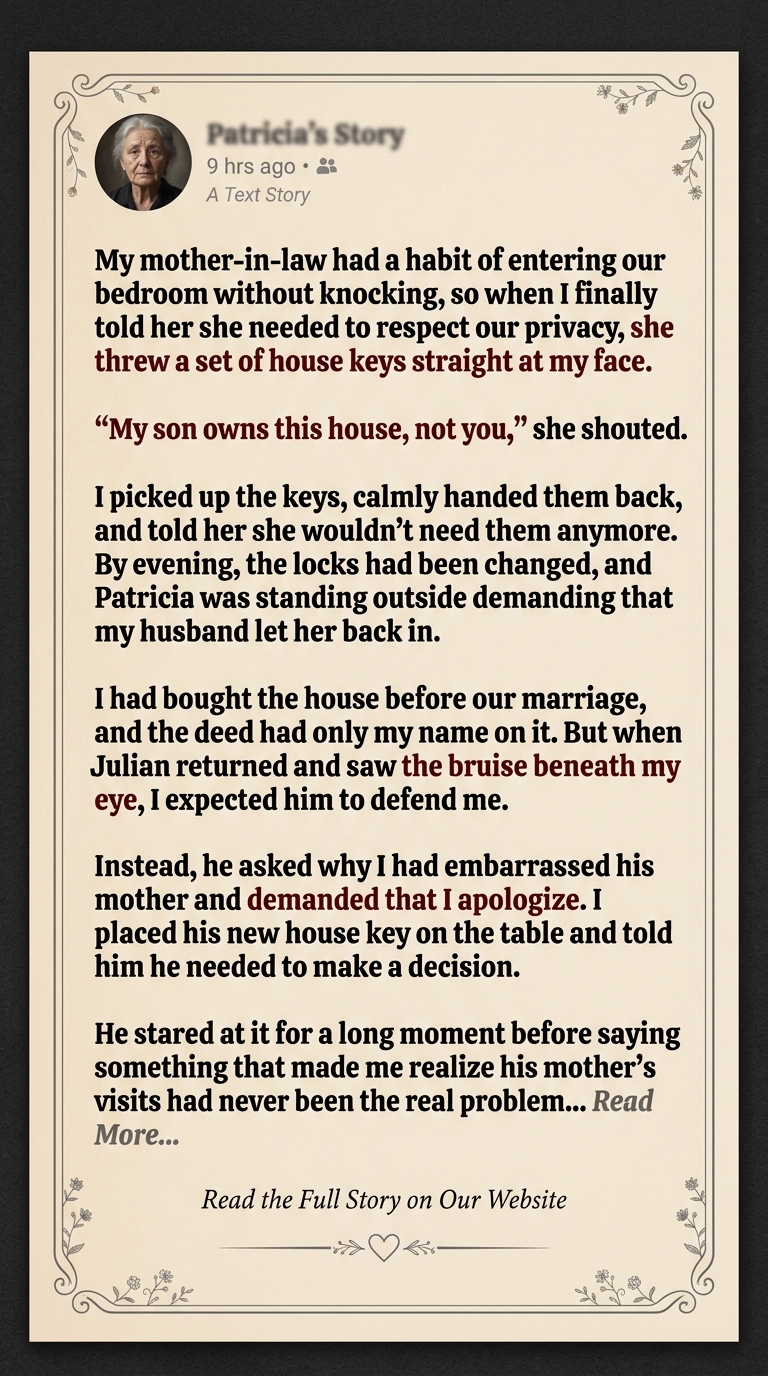
She snatched the spare keys from the dresser and threw them at me. One struck just beneath my eye. The metal edge left a small cut, and I felt a sharp sting spread across my cheek.
“Don’t ever tell me what I can do in my son’s home,” she shouted.
I stared at her for a moment, then picked up the keys and placed them in her palm.
“You won’t need these anymore.”
She laughed as she walked away.
By the time she returned that evening, the locks had been changed. Her key no longer worked, and she stood outside the front door shouting for Julian to let her in.
But Julian wasn’t home yet.
I had called a locksmith after photographing the injury and speaking with my solicitor. The house was registered solely in my name, and I had never given Patricia permission to enter whenever she wanted. The spare keys were a convenience, not a permanent right.
I wasn’t trying to punish her. I was ending an arrangement that had become unbearable.
When Julian finally arrived, his mother was still standing on the front path, furious and demanding an explanation.
He came inside, saw the bruise beneath my eye, and barely looked at it.
“What have you done?” he asked.
“Your mother threw the keys at my face.”
“She didn’t mean it.”
“She hit me, Julian.”
He sighed as if I were making his evening unnecessarily difficult.
“You know how she is. Why did you have to embarrass her by changing the locks? She’s my mother. She should be able to visit.”
“Visiting isn’t the same as walking into our bedroom whenever she wants.”
“You’re making this into a bigger problem than it needs to be. Just apologize, give her a new key, and let this go.”
I had expected him to be angry with his mother. I had even expected him to be uncomfortable about the situation.
I had not expected him to defend the person who had struck me.
I walked to the kitchen, took the new house key from the counter, and placed it on the table between us.
“Then you need to make a decision.”
He looked at the key.
“What does that mean?”
“It means I won’t live with someone who thinks his mother has more rights in my home than I do. If you believe she should have unrestricted access, you can decide whether you want to live here under my rules or somewhere else under hers.”
His expression changed.
“You can’t throw me out of my own house.”
“Your name isn’t on the deed.”
He stared at me for several seconds. Then he said something that made me realize the problem had started long before Patricia threw those keys.
“She told me you would eventually change your mind,” he said. “We agreed that once she moved in, you’d stop acting like this place belonged only to you.”
I felt my stomach tighten.
“Moved in?”
Julian looked away.
He explained that Patricia had been planning to move into our house for months. She had told him that she was tired of living alone and that he should arrange a bedroom for her. According to him, it was a temporary arrangement until she found somewhere smaller.
But he had never discussed it with me.
“She was going to move into my house without asking me?”
“She needs help. I thought you’d understand once she was here.”
“How long?”
He hesitated.
“She was hoping to stay permanently.”
I looked at him, trying to understand how he could have made such a decision without even speaking to me.
Then he added, “And she said it would be easier if you got used to her having a key.”
That explained the constant visits, the bedroom intrusions, and her confidence when she told me that the house belonged to her son.
Patricia hadn’t simply been ignoring my boundaries. She had been testing how much control she could establish before announcing that she was moving in.
But Julian’s next admission was worse.
He told me that his mother had already arranged for a removal company to collect some of her furniture the following Saturday. He had promised to help her prepare the spare bedroom.
I asked whether he had considered what I wanted.
He didn’t answer.
I sat down and pressed a cold cloth against my cheek.
“Julian, when did you decide that our marriage meant I had to give up control of my own home?”
He rubbed his forehead.
“You’re twisting everything. I was trying to help my mother.”
“You could have helped her by discussing it with me. Instead, you let her believe she could move into my house without my permission.”
He stood up.
“She’s not a stranger. She’s my mother.”
“And I’m your wife. Yet you didn’t think I deserved to know.”
For the first time that evening, he looked uncertain.
I told him I wanted him to stay with his mother for a few days while we considered what came next. He refused at first, insisting that he had done nothing wrong.
But when I repeated that I would not give Patricia another key or allow her to move in, he picked up his coat.
“Fine,” he said. “Maybe you’ll realize how unreasonable you’re being when I’m gone.”
He left without looking back.
The next morning, I contacted my solicitor and arranged to have the locks changed again. Not because I expected Julian to break in, but because I no longer wanted anyone assuming that marriage or family relationships automatically gave them authority over my property.
I also made it clear to the locksmith that no additional keys would be issued without my permission.
Patricia called repeatedly.
At first, she demanded that I apologize. Then she accused me of turning her son against her. Finally, she left a message saying that I had destroyed the family by refusing to give her a place to live.
I didn’t respond.
Three days later, Julian returned.
He looked tired, and he carried a small overnight bag. He asked if we could talk without arguing.
I agreed.
He sat at the dining table and admitted that his mother had been pressuring him for months. She had told him that a good son would never allow his wife to place conditions on his mother’s access to the family home.
He said he had felt guilty about her living alone and had convinced himself that I would eventually accept the arrangement.
“Why didn’t you just ask me?” I said.
“Because I knew you’d say no.”
His answer hurt more than I expected.
He hadn’t forgotten to consult me. He had deliberately avoided asking because he wanted to make the decision without giving me the opportunity to refuse.
I asked him whether he understood why that was unacceptable.
He nodded, but then he added, “I still think you went too far changing the locks.”
I looked at him carefully.
“Your mother hit me, Julian. You didn’t ask whether I needed medical attention. You asked why I embarrassed her.”
He lowered his eyes.
“I was caught between you.”
“No. You were standing beside her while she treated me as though I had no rights in my own home.”
We talked for another hour. I told him that I wasn’t asking him to abandon his mother. He could visit her, help her find accommodation, pay for repairs, or arrange whatever support he could afford.
But she would not move into my house, and she would not have unrestricted access to our private rooms.
I also told him that if he wanted to remain married, he needed to understand that decisions about our home required both of us to agree.
Julian asked for time.
I gave him two weeks.
During that time, he stayed with Patricia. He called regularly, but most conversations eventually returned to the same argument. His mother insisted that I had humiliated her. He continued to say that I should have handled the situation more gently.
What he never said was that she had no right to strike me.
On the thirteenth day, he came back and told me he had decided to rent a small apartment near his workplace.
I asked whether he was leaving our marriage.
He said he didn’t know.
He explained that he loved me but couldn’t accept the idea that his mother might never be welcome in our home again.
I reminded him that she was welcome when she respected our boundaries. What she wasn’t welcome to do was enter without permission, assault me, or move in against my wishes.
He said he understood, but he still wasn’t ready to choose between us.
I finally realized that he was asking me to keep waiting until I surrendered.
So I told him we needed to separate.
The months that followed were difficult, but they were also clarifying. We attended counseling for a short time, yet Julian continued to believe that his mother’s expectations should carry special authority in our marriage. He eventually admitted that he had never intended to tell her she couldn’t move in permanently.
We agreed to divorce.
Because the house had been purchased before our marriage and remained solely registered in my name, it stayed with me. We divided our other shared possessions through the normal legal process, and neither of us contested the ownership of the property.
Patricia never apologized for throwing the keys. She told relatives that I had driven her son away because I couldn’t accept another woman having a place in his life.
I stopped trying to correct every version of the story.
A year later, I repainted the bedroom and replaced the old dresser. I moved the bed closer to the window, where the morning light came in, and turned the spare room into a small office.
One afternoon, while sorting through a drawer, I found the original spare key Patricia had thrown at me.
I held it for a moment before dropping it into a box of old household items.
It was just a piece of metal, but I remembered how much had been revealed that morning.
I had thought the problem was a mother-in-law who didn’t understand privacy. The truth was that my husband had allowed someone else to make decisions about our marriage because he was afraid to disappoint her.
And when I finally refused to surrender my boundaries, he treated my refusal as the betrayal.
I never regretted changing those locks.
The house had been mine before Julian entered my life, but the peace inside it was something I had to reclaim for myself.