The message arrived at 12:07 a.m., just as I was finishing a report for work.
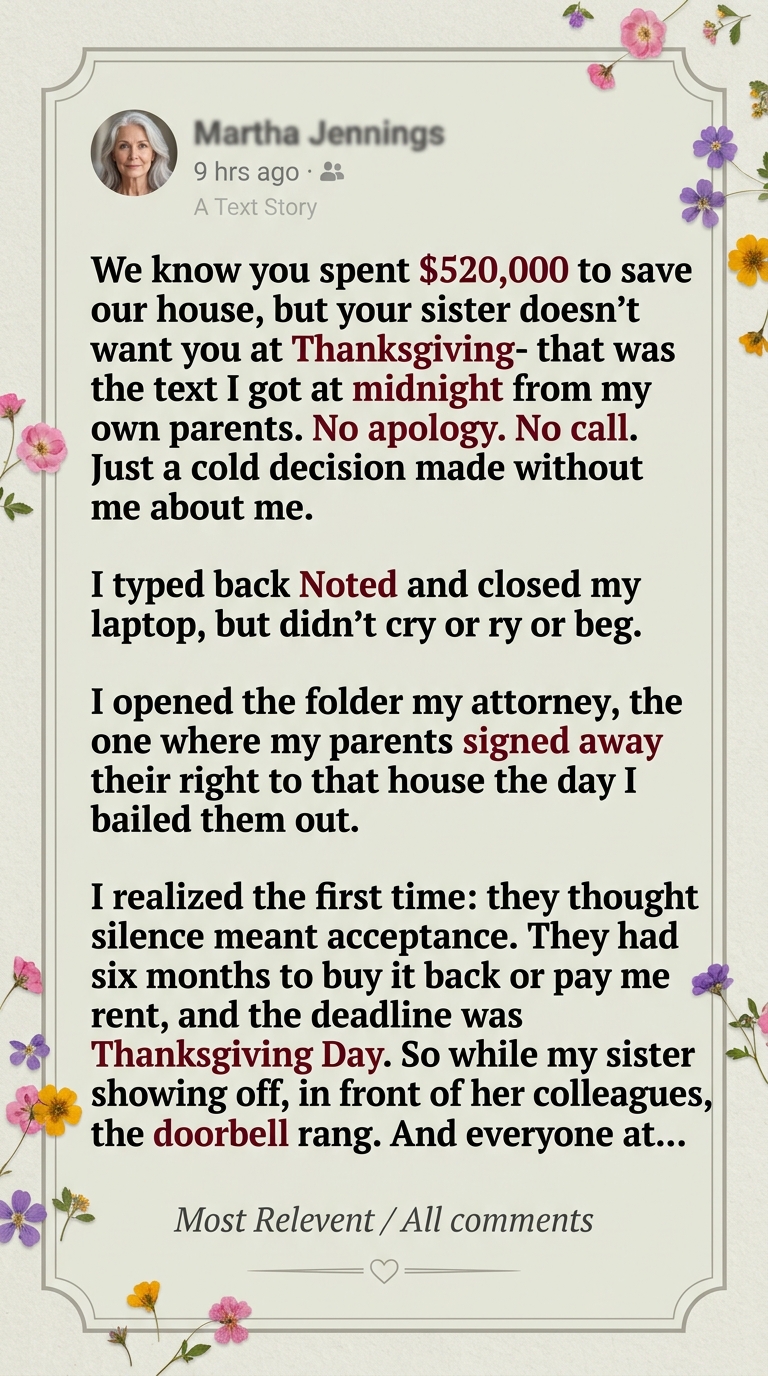
We know you spent $520,000 to save our house, but your sister doesn’t want you at Thanksgiving. She feels uncomfortable around you, and we don’t want any arguments. Please respect her wishes.
I read it twice.
There was no thank-you. No apology. Not even a phone call.
My parents had just informed me that I was no longer welcome at a family gathering in the house I had personally saved from foreclosure.
I typed two words.
Noted.
Then I closed my laptop, opened the locked drawer beneath my desk, and removed a blue folder.
Inside were the documents my parents had signed six months earlier, when they had come to me desperate and nearly out of options.
They had forgotten something important.
I hadn’t saved their house out of blind generosity. I had saved it under a written agreement, and the final deadline was Thanksgiving Day.
My name was on the deed.
My parents had six months to buy the property back at the agreed price or begin paying rent under the terms of the contract.
They had chosen neither.
And now they had just given me a reason to stop pretending that family loyalty meant accepting whatever they decided.
Six months earlier, my father had called me at work.
His voice was barely recognizable.
“Claire, we need help.”
I was thirty-six, working as a financial risk consultant in Chicago. My younger sister, Vanessa, was thirty-two and had recently married a successful corporate attorney named Richard. My parents had always treated her as the family success story. She had the elegant apartment, expensive clothes, impressive friends, and a talent for making ordinary achievements sound extraordinary.
I was the practical one.
I paid my bills, kept my finances private, and rarely asked anyone for help.
When my father explained that the bank had issued a final foreclosure notice on their house, I was shocked.
The property had been in our family for twenty-seven years. It was a large brick house on a quiet street, with a wide porch, an old oak tree in the front yard, and a kitchen where my mother had hosted every holiday gathering since we were children.
My father had operated a small construction supply business, but a failed expansion had left him with substantial debt. My parents had refinanced the house twice, believing they could recover once business improved.
It hadn’t.
They owed more than they could repay, and the foreclosure sale was only weeks away.
“Why didn’t you tell me earlier?” I asked.
My mother began crying.
“We didn’t want to worry you.”
That wasn’t the truth. They hadn’t wanted me to know how badly things had gone because they were embarrassed.
I asked how much was needed to settle the mortgage and outstanding charges.
My father hesitated.
“Five hundred and twenty thousand.”
I stared at the figure.
It was a considerable amount, even for someone with my income. I had spent years saving and investing, but I wasn’t willing to transfer half a million dollars based on a promise that things would somehow work out.
I told them I would consider helping, but only if we put everything in writing.
My father became offended.
“I’m your father. Do you really need a contract?”
“Yes,” I replied. “Because I want everyone to understand exactly what is happening.”
My attorney, Daniel Brooks, reviewed the property records and prepared an agreement. My parents transferred ownership of the house to me in exchange for my payment of the outstanding debt and foreclosure costs.
They retained the right to buy it back within six months by repaying the full agreed amount, including the specified transaction costs. If they didn’t exercise that right, I would retain ownership and they would have to arrange a rental agreement if they wished to remain in the property.
The agreement was signed, witnessed, and registered properly.
My parents understood it.
My father even read the documents twice before signing.
“You’re saving our home,” he said afterward.
I transferred the money directly to the lender and the parties handling the foreclosure. The debt was settled, the proceedings were stopped, and my parents remained in the house.
I didn’t ask them to thank me.
I simply wanted them to have time to recover.
For the first few weeks, everything seemed normal.
My mother called to discuss repainting the dining room. My father asked whether I could help him compare insurance policies. Vanessa sent a message saying she was glad the family house had been saved.
Then something changed.
Vanessa began referring to the property as though the agreement didn’t exist.
At a family dinner, she announced that she and Richard were considering hosting their annual company gathering at my parents’ house.
“There’s plenty of room,” she said. “And the garden looks wonderful in photographs.”
I reminded her that the house was legally mine.
She rolled her eyes.
“It’s still Mom and Dad’s home. Don’t make everything about paperwork.”
I looked at my parents.
My father changed the subject.
My mother asked whether anyone wanted dessert.
I let it go.
A month later, Vanessa began arranging renovations without consulting me. She ordered new curtains, replaced the dining room chandelier, and hired someone to landscape the front garden.
When I asked who was paying, she said Richard had arranged everything.
“It’s an investment in the family property,” she explained.
I told her that any permanent changes needed my approval.
She laughed.
“You really think owning the paperwork makes you the head of this family?”
I didn’t answer.
The most revealing moment came when my mother mentioned that Vanessa had been telling people she would eventually inherit the house.
I asked her why she had allowed that misunderstanding to continue.
“She’s your sister,” my mother said. “You have more than enough. She and Richard are trying to build a future.”
“And what about the agreement?”
My mother sighed.
“You know how your father is. He doesn’t like discussing money.”
That was when I began to understand that my parents had never accepted the arrangement emotionally, even though they had signed it legally.
They saw my payment as an act of family duty, not a transaction with conditions.
They wanted the benefit without acknowledging the responsibility.
Still, I gave them time.
The six-month deadline was approaching, and I assumed they would either repay the amount or ask to negotiate a rental arrangement.
Instead, I received the midnight message.
I read the agreement again that night.
There was no clause allowing my parents to exclude me from the property while continuing to enjoy the benefits of my payment. There was no promise that I would surrender ownership whenever Vanessa felt uncomfortable.
The next morning, I called Daniel.
“Has the buyback deadline passed?” I asked.
“Not yet,” he replied. “It’s still several days away. But they haven’t exercised the option or contacted us about financing.”
“What happens if they don’t?”
“Then ownership remains with you under the registered agreement. We can proceed with a formal notice regarding their continued occupancy.”
I looked at the calendar.
Thanksgiving was six days away.
“Prepare the notice,” I said. “And please make sure everything is handled correctly.”
Daniel reminded me that I couldn’t simply remove my parents from the property without following the proper legal process. I understood. I wasn’t interested in changing locks or creating a confrontation.
I wanted the agreement enforced.
On Thanksgiving morning, Vanessa posted photographs online.
She was standing in my parents’ living room beside a table decorated with gold candles and fresh flowers. Her colleagues from Richard’s law firm were arriving, and she had written a caption about being grateful for family traditions.
One photograph showed my mother’s dining table.
Another showed Vanessa standing beneath the staircase, holding a glass of champagne.
The house looked beautiful.
It also looked like a place where I had been deliberately erased.
At 11:40 a.m., I received another message from my mother.
Please don’t come today. Vanessa has invited important people, and we don’t want you upsetting her.
I didn’t reply.
At noon, I put on my coat, placed the blue folder in my bag, and drove to the house.
I wasn’t alone. Daniel had arranged for a property representative to accompany me, and a process server had the formal notice ready.
When I arrived, several expensive cars were parked along the street.
Through the front windows, I could see people moving around the living room. Music played softly, and the dining room was full.
I rang the bell.
Vanessa opened the door.
Her smile disappeared.
“What are you doing here?”
“I need to speak with Mom and Dad.”
She stepped into the doorway.
“Didn’t they tell you not to come?”
“They did.”
“Then why are you here?”
“Because I own the property.”
Her expression hardened.
“Don’t start this today, Claire. Richard’s colleagues are here.”
I held up the blue folder.
“Then perhaps you should ask our parents why they invited everyone into a house they no longer own.”
She stared at me.
Before she could answer, my father appeared behind her.
“Claire, this isn’t the time.”
I looked past him.
“Have you repaid the $520,000?”
His face changed.
“We’re working on it.”
“Have you exercised the buyback option?”
“We haven’t had enough time.”
“You had six months.”
My mother appeared in the hallway.
“Please, not in front of everyone.”
I looked at her.
“You sent me a message at midnight telling me I wasn’t welcome in the house I saved. You didn’t ask whether I was comfortable. You didn’t explain anything. You simply decided I no longer belonged.”
Vanessa folded her arms.
“Because you make everything about money. You’re always reminding us what you did.”
I turned toward her.
“I haven’t mentioned the money in months. I didn’t even ask for a thank-you. But you have been making decisions about my property, inviting people into it, and telling everyone you expect to inherit it.”
Richard stepped out of the dining room.
“What is going on?”
Vanessa immediately changed her tone.
“Nothing. Claire is having another issue about the house.”
Daniel stepped forward and introduced himself.
“I’m Daniel Brooks, Ms. Bennett’s attorney. We are here to deliver formal notice regarding the property’s ownership and the expiration of the repurchase period.”
Richard looked at the folder.
“Repurchase period?”
My father lowered his eyes.
Daniel explained that my parents had transferred ownership to me six months earlier, in exchange for the payment that prevented foreclosure. They had retained a limited right to buy the property back within the agreed period.
That period had expired without payment.
The ownership had therefore remained with me.
The room became quiet.
Vanessa looked at my father.
“You told me the house was still yours.”
My father said nothing.
“You told me Claire was only helping with the mortgage!”
I looked at her.
“Did you really believe someone would transfer $520,000 without securing the property?”
Richard took the agreement from Daniel and began reading.
His expression grew more serious with every page.
Finally, he looked at my father.
“Why didn’t you tell us this?”
My father rubbed his forehead.
“We thought we’d have the money by now.”
“You told me the property was part of Vanessa’s future inheritance,” Richard replied.
My sister turned toward him.
“Don’t blame me. Mom and Dad said that.”
My mother began crying.
“We were trying to keep everyone happy.”
Daniel interrupted gently.
“The agreement is clear. Your daughter is the registered owner. The repurchase option has expired, and she has instructed us to serve notice regarding the continued occupancy.”
Vanessa looked at me as though I had betrayed her.
“You’re going to throw our parents out?”
“No,” I said. “I’m giving them the opportunity to arrange a rental agreement or move to another suitable property. They cannot continue living here indefinitely without addressing the agreement.”
My father finally spoke.
“Claire, where are we supposed to go?”
I looked at him.
“That was something you should have considered before deciding I wasn’t welcome.”
He looked genuinely wounded.
For a moment, I felt the familiar instinct to rescue him from the consequences of his own decisions.
But I remembered the years I had spent working, saving, and planning so I could help my parents when they needed it. I remembered how quickly they had accepted the money and how easily they had dismissed my place in the family afterward.
I wasn’t going to make another promise simply because someone was crying.
The property representative explained the next steps. My parents had a reasonable period to negotiate a tenancy or arrange their departure, subject to the applicable legal process. Nothing would happen that day.
Vanessa’s colleagues had gathered near the dining room. Some looked uncomfortable. Others were pretending not to listen.
Richard closed the folder.
“I think we should end the gathering,” he said quietly.
Vanessa stared at him.
“But everyone is here.”
“Your parents’ property situation is not something we should be discussing in front of my colleagues. And I don’t think we should continue celebrating while this is unresolved.”
He asked the guests to leave.
Within half an hour, the house was nearly empty.
I remained in the hallway with my parents.
My mother wiped her eyes.
“We didn’t think you would actually enforce the agreement.”
I looked at her.
“That is exactly the problem.”
My father sat on the staircase.
“We thought you were helping us because you loved us.”
“I was. But loving you didn’t mean giving you permission to ignore what we agreed.”
He looked up.
“Can we work something out?”
I nodded.
“If you want to rent the house, we can discuss fair terms. If you want to move, I’ll give you reasonable time. But I won’t pretend the agreement never happened.”
Vanessa returned from the kitchen.
“You’re really going to keep the house?”
“I haven’t decided what I’ll do with it long-term.”
“Then why not just give it back?”
“Because you don’t get to decide what happens to property that belongs to me.”
She stared at me, then turned away.
The following week, my parents met with Daniel to discuss their options. They couldn’t afford to repay the full amount, and their financial situation hadn’t improved enough to support the house’s ongoing costs.
They asked to remain as tenants.
I agreed to consider it, but only under a formal rental agreement with clear responsibilities, a reasonable rent, and a fixed term. I also required them to stop making changes to the property without permission.
My father objected to the idea of paying rent to his own daughter.
I reminded him that I had paid $520,000 to prevent the house from being taken by the bank.
After several conversations, they accepted the arrangement.
They remained in the house for the agreed period while preparing to move into a smaller property they could afford. I didn’t rush them, and I didn’t make their departure more difficult than necessary.
Vanessa was furious.
She accused me of destroying the family and humiliating our parents in front of her colleagues. Richard eventually told her that she needed to stop treating the house as an inheritance she had already received.
Their marriage survived the argument, but the holiday gatherings became more complicated.
My parents apologized months later. My mother admitted that they had expected me to keep helping without ever insisting on boundaries. My father acknowledged that he had allowed Vanessa to believe the house would eventually belong to her because he didn’t want to disappoint her.
I accepted their apologies, but I didn’t transfer the property back.
Eventually, my parents moved into a smaller home closer to my father’s remaining business contacts. I sold the old house after they left, recovered my investment, and used part of the proceeds to strengthen my retirement savings.
I didn’t use the money to punish anyone, and I didn’t make a public announcement.
I simply moved forward.
The following Thanksgiving, I received an invitation from my parents.
It was a short message from my mother.
We would like you to join us this year. We understand if you need time, but there will always be a place for you.
I read it several times.
Then I replied that I would come.
When I arrived, the gathering was smaller. Vanessa was there with Richard, and my father was helping set the table. Nobody mentioned the old house.
During dinner, my mother raised her glass.
“To family,” she said.
I lifted mine, but I added something.
“To family that respects one another.”
Nobody argued.
I had learned that protecting the people you love doesn’t require surrendering every boundary. And helping someone through a crisis doesn’t mean they own your future decisions.
My parents had once believed my silence meant I accepted being excluded.
They were wrong.
I had simply stopped begging for a place at a table when I was the one who had helped keep the roof above it.