The Woman Who Wore My Face
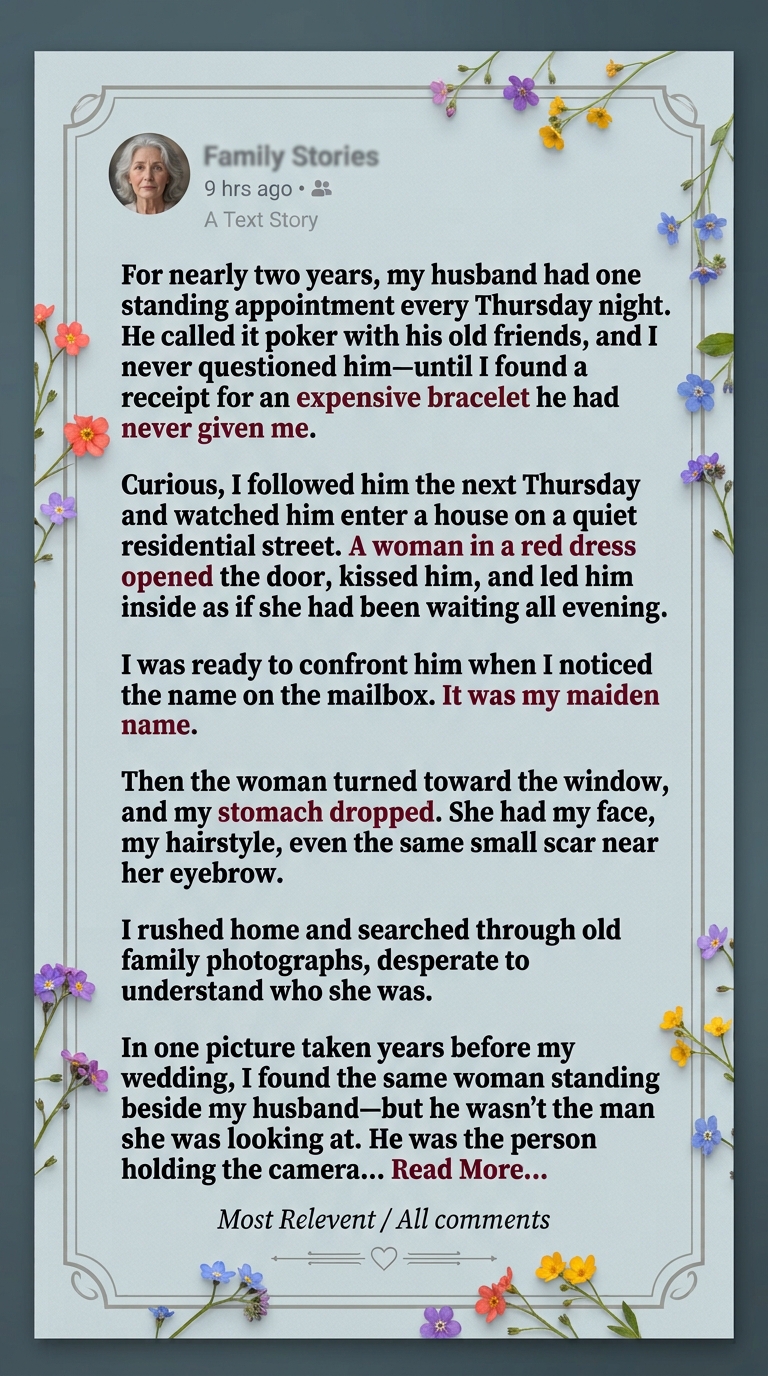
For nearly two years, my husband had spent every Thursday evening playing poker with the same group of old friends.
At least, that was what he told me.
His name was Daniel, and we had been married for eleven years. He was not the kind of man who usually disappeared without explanation. He paid the bills on time, remembered birthdays, and called if he expected to be late. His Thursday nights had become such a familiar part of our routine that I barely noticed them anymore.
Then, one afternoon, I found a receipt inside the pocket of his winter coat.
It was for a diamond bracelet costing nearly four thousand dollars.
I stared at the date. The purchase had been made three weeks earlier, on a Thursday.
Daniel had never given me a bracelet.
When I asked him about it that evening, he barely looked up from his phone.
“Probably a gift for someone at work,” he said. “The company needed something for a retirement celebration.”
He said it so casually that I almost believed him.
Almost.
The following Thursday, I waited until he left, then followed him.
He drove past the restaurant where his friends supposedly played poker, continued through several residential streets, and parked outside a pale yellow house with white shutters.
I stopped several houses away.
A woman in a red dress opened the front door. She was about my height, with the same dark hair I wore and the same habit of tucking one side behind her ear. Daniel leaned forward and kissed her. She smiled, took his hand, and pulled him inside.
My first reaction was anger.
My second was confusion.
Then I noticed the mailbox.
The name engraved on it was HARTWELL.
My maiden name.
I had not used that surname in eleven years.
I stepped closer, trying to see through the front window. The woman appeared again, carrying two glasses of wine. When she turned toward the light, my breath caught.
She had my face.
Not merely a passing resemblance. Her eyes, nose, chin, hairstyle, and even the small curved scar above her left eyebrow were almost identical to mine.
I had received that scar when I fell against a garden gate at the age of nine.
I returned home without confronting Daniel.
For hours, I searched through old family photographs, spreading albums across the living-room floor. I needed to know whether I was looking at a stranger, a relative, or something I couldn’t yet explain.
Then I found a photograph taken at a summer gathering, almost thirteen years earlier.
I was standing beside my father near the garden steps. Behind us, a young woman in a blue dress was laughing at someone outside the frame.
She had the same face as the woman in the red dress.
I turned the photograph over.
My mother’s handwriting identified the gathering, but not the woman.
I searched the other pictures until I found one from the same afternoon. This time, the woman stood closer to the camera. Her hand rested on the shoulder of a young man.
I recognized him immediately.
Daniel.
But he wasn’t standing beside her as a boyfriend. He was holding the camera in one hand, and she was looking directly at him with an expression that made my stomach tighten.
I turned the photograph over.
There was a short message written in blue ink:
For Daniel, who always knows how to make me smile. Love, Elise.
I had never heard the name Elise in connection with my husband.
I waited for him that night.
When Daniel returned, I placed the photograph on the kitchen table.
He stopped walking.
For several seconds, he didn’t say anything.
Then he pulled out a chair.
“Where did you find that?”
“Who is Elise?”
He rubbed his forehead.
“She’s someone I knew a long time ago.”
“Someone you still visit every Thursday?”
He looked at me.
“You followed me?”
“I found a receipt for a bracelet you never gave me. Then I watched you kiss a woman who looks exactly like me outside a house carrying my maiden name. I think I deserve an explanation.”
Daniel sat down.
“Her name is Elise Hartwell,” he said. “She’s your half-sister.”
I felt the room shift around me.
“My what?”
He explained that before my mother married my father, she had given birth to a daughter named Elise. The child’s father was a man she had known briefly while working in another city. When the relationship ended, the baby was placed with a family through a private adoption arrangement.
My mother had never told me.
Daniel had met Elise years earlier, long before our wedding, when he worked as a photographer for a small community magazine. He had been assigned to photograph a charity event where she was volunteering.
“She recognized your name when I mentioned I was dating you,” he said. “At first, I thought it was a coincidence. Then she showed me a photograph of your mother.”
“Why didn’t you tell me?”
“She asked me not to.”
I stared at him.
“And you agreed to keep my own family history from me?”
Daniel looked ashamed.
“At the time, she was frightened. She had only recently learned the truth herself. She didn’t know whether you would want to meet her. She asked me to wait until she was ready.”
“How long have you known?”
“Since before we got married.”
The answer hurt more than I expected.
He had sat beside me at our wedding while knowing that someone who shared my face and my childhood history was living somewhere nearby.
“And the bracelet?” I asked.
Daniel looked down.
“I bought it for her. It was a birthday gift.”
I laughed once, without humor.
“You’ve been buying expensive gifts for my secret sister while telling me you’re playing poker?”
“I was trying to help her.”
“Then why lie?”
He had no good answer.
After a long silence, Daniel told me that Elise had contacted him eighteen months earlier. She had been trying to understand her adoption records and had discovered that our mother had died without leaving any clear explanation. She was struggling with the possibility that her biological family had deliberately erased her.
Daniel said he had agreed to meet her because he knew how painful it could be to feel unwanted.
At first, their meetings had been occasional. Then they became weekly.
He had helped her find old records, locate former neighbors, and identify the people who might have known our mother before she married my father.
But somewhere along the way, he had made a decision for both women in his life.
He had decided I was better off not knowing.
“Did you ever intend to tell me?” I asked.
“Yes.”
“When?”
He couldn’t answer.
The next morning, I called the number Daniel had written on a piece of paper.
A woman answered.
“Hello?”
“Is this Elise?”
There was a pause.
“Yes.”
“My name is Claire Hartwell.”
I heard her inhale sharply.
“I know,” she whispered.
“Why didn’t you contact me yourself?”
“I was afraid.”
“Of me?”
“Of what you might think. I spent years wondering whether my mother had given me away because she didn’t want me. Then I found out she had another daughter. I didn’t know whether you knew about me, whether you hated me, or whether I would be ruining your life by appearing in it.”
I closed my eyes.
“You could have let me decide that.”
“I know.”
Her voice broke.
“I am sorry.”
We arranged to meet at a quiet café the following afternoon.
When Elise walked in, I felt the same shock I had experienced outside her house. Up close, the resemblance was even stronger. She had the same small scar, the same dark eyes, and the same slight crease beside her mouth when she tried not to smile.
She sat across from me and placed a folder on the table.
Inside were adoption records, old letters, and copies of documents she had spent months collecting.
One letter was from my mother.
It had been written shortly before her marriage to my father, when Elise was still a baby. My mother explained that she had been young, alone, and unable to provide the life she wanted for her child. She had chosen adoption because she believed it offered Elise a safer future.
The letter did not describe Elise as a mistake.
It described her as a child my mother had loved but could not raise.
There were also several letters my mother had written over the following years. Some had been returned unopened. Others had no recorded response.
Elise had never received most of them.
“I always thought she forgot me,” Elise said.
“She didn’t,” I replied.
I looked at the handwriting again. I recognized it immediately. My mother had written grocery lists, birthday cards, and notes for my school lunches in that same careful script.
I realized that the secret had not begun with Daniel.
It had begun with a woman who had made a painful decision and spent the rest of her life unable to explain it.
Elise told me she had found my name through an old family record. She had contacted Daniel because she recognized him from a photograph in her records and discovered he was married to me. He had agreed to help her, but he had insisted that she wait before approaching me.
“He said you were happy,” she explained. “He thought the truth would hurt you.”
I looked at her.
“It did hurt me. But not because you exist.”
She lowered her eyes.
“I know.”
“It hurt because the people who were supposed to trust me decided I couldn’t handle the truth.”
For the first time, she reached across the table.
I didn’t pull away.
We spent the afternoon comparing memories, photographs, and family details. Some things were familiar. Others belonged to a life I had never known. We discovered that we both hated cinnamon in coffee, had the same habit of tapping our fingers when nervous, and remembered our mother’s favorite song from childhood—even though we had grown up apart.
The similarities were astonishing, but the differences were just as important.
Elise had grown up with different parents, different traditions, and a different childhood. She was not a replacement for me, nor was I an answer to every question she had carried.
We agreed to take things slowly.
When I returned home, Daniel was waiting in the living room.
“Did you meet her?” he asked.
“Yes.”
“Are you all right?”
I placed my handbag on the table.
“I think I will be. But we need to talk about us.”
He nodded.
I told him that helping Elise had not been the problem. Keeping secrets, inventing excuses, and allowing me to believe I was imagining things had been the problem.
He apologized, but I made it clear that an apology could not immediately restore the trust he had spent nearly two years damaging.
We began counseling. Daniel also agreed to stop making private decisions about my family and to answer questions honestly, even when the answers were uncomfortable.
Our marriage did not return to what it had been before.
It had to become something more honest.
A few months later, Elise and I visited our mother’s grave together. We brought flowers and stood quietly for a while.
“I used to imagine meeting her,” Elise said. “I thought I would ask why she didn’t keep me.”
I took her hand.
“What would you ask now?”
She considered it.
“Whether she was happy.”
I looked at the photograph we had placed beside the flowers.
“I think she wanted us both to be.”
We stayed until the afternoon light began to fade.
I had spent weeks believing the woman in the red dress was someone who had stolen a part of my marriage. Instead, she was someone who had been missing from my family long before Daniel ever met her.
That didn’t excuse his lies.
But it gave me something I hadn’t expected to find: a sister.
And for the first time in years, Thursday evening no longer meant wondering where my husband had gone. It meant that sometimes Elise came over for dinner, bringing a dessert she insisted we both had to try.
We were still learning how to be sisters.
But at least now, neither of us had to stand outside the truth, waiting for someone else to open the door.