The Bracelet That Changed Everything
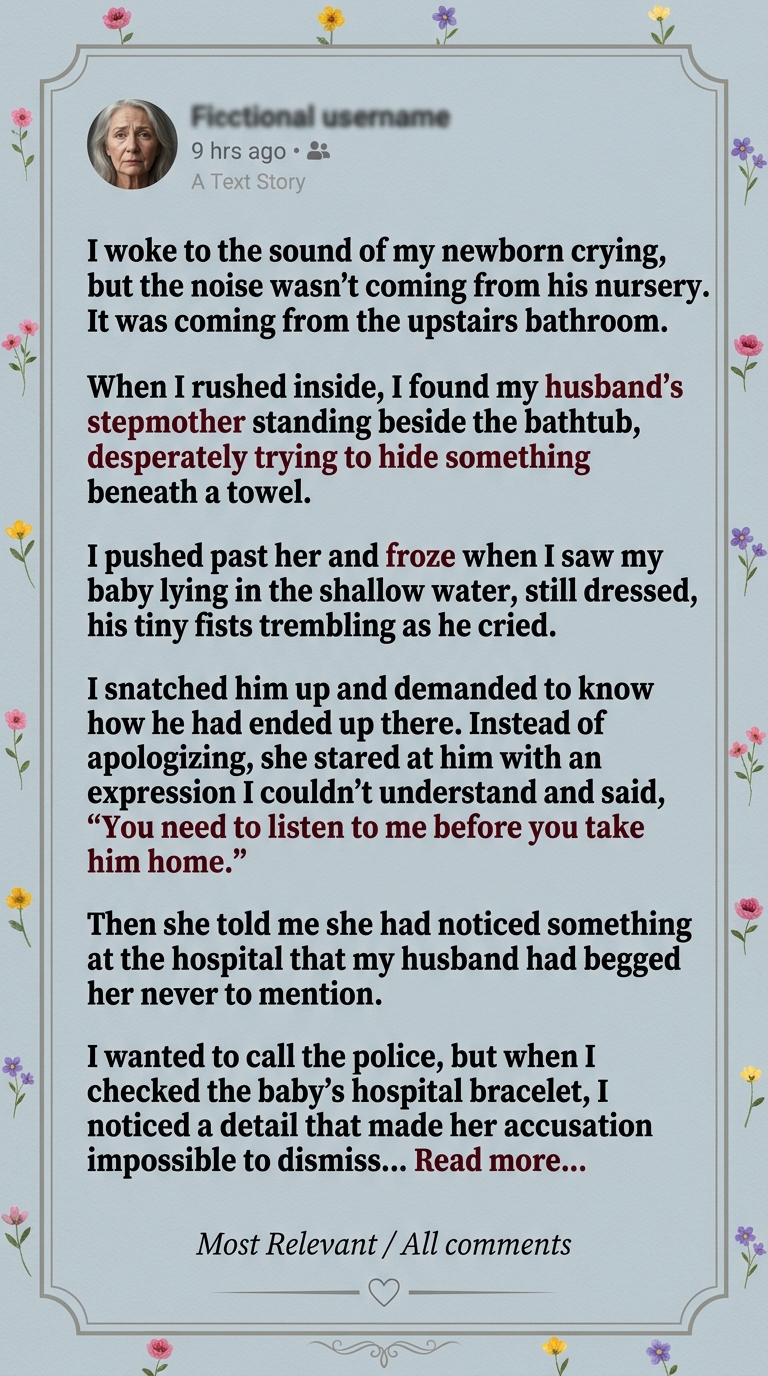
The sound of my newborn crying woke me just after two in the morning.
At first, I thought it was coming from the nursery. My husband, Daniel, had promised to take the night shift because I had barely slept since bringing our son home. But when I reached the hallway, I realized the crying was coming from upstairs.
The bathroom door was open.
I hurried toward it and found Daniel’s stepmother, Margaret, standing beside the bathtub. She was holding a thick towel against her chest, trying to conceal something behind her.
“What are you doing?” I demanded.
She turned so quickly that the towel slipped from her hands.
My baby was lying in the shallow water, still dressed in his little blue sleepsuit. His face was red from crying, and his tiny hands trembled as I lifted him from the tub.
I wrapped him in the towel and held him against my chest.
“What have you done to him?”
Margaret didn’t answer immediately. Her eyes moved from my face to the baby.
“You need to listen to me before you take him home.”
“Home? He’s already home! Why was he in the bathtub?”
“I didn’t put him there to hurt him.”
“Then why?”
She looked toward the stairs.
“Because Daniel has been lying to you about the baby.”
I felt my stomach tighten.
I wanted to call the police immediately, but my son was crying against me, and I needed to make sure he was safe. I checked his breathing, his color, and his temperature while Margaret stood motionless beside the sink.
Then I noticed the hospital bracelet still around his ankle.
The printed name was ours, but something else caught my attention.
The identification number ended in 7316.
I remembered that number because I had taken a photograph of the bracelet on the day he was born. In that photograph, the number ended in 7136.
I checked again.
7316\.
The digits were different.
“Why has his bracelet been changed?” I whispered.
Margaret closed her eyes.
“That’s what I’ve been trying to tell you.”
I stepped away from her.
“Start talking. Now.”
She explained that she had noticed something unusual at the hospital shortly after my delivery. Daniel had been alone with the baby while I was recovering from an emergency procedure. When Margaret entered the room, she saw him speaking quietly with a nurse near the newborn identification station.
She hadn’t thought much of it until she noticed that the bracelet on the baby’s ankle was different from the one she had seen earlier.
When she questioned Daniel, he told her the hospital had corrected a printing error.
Margaret had accepted the explanation at first.
But three days later, she received a telephone call from a woman named Sandra, a former nurse who had worked in the maternity ward. Sandra asked whether Margaret had noticed anything unusual about the baby’s identification records.
“She said there had been a serious mistake,” Margaret told me. “A mistake involving two newborns.”
My arms tightened around my son.
“What kind of mistake?”
Margaret looked directly at me.
“She believes the baby you brought home may not be the baby you gave birth to.”
For a moment, I couldn’t hear anything except my son’s crying.
“That is impossible.”
“I know how it sounds.”
“Daniel is his father. I was there when he was born. I held him.”
Margaret shook her head.
“You were under medication after the emergency procedure. You didn’t get to hold him until several hours later.”
I remembered the delivery room.
I remembered the sudden pain, the doctors moving quickly, and Daniel telling me everything was fine. I remembered waking in recovery and asking to see my baby. A nurse had brought him to me, wrapped in a pale blanket.
I had kissed his forehead and believed I was looking at the child I had carried for nine months.
“Why didn’t you tell me this before?”
“I tried. Daniel told me I was confused. He said if I mentioned it again, he would never let me see the baby.”
I stared at the woman who had frightened me by placing my newborn in a bathtub.
“Why was he in the water?”
Margaret’s face crumpled.
“Because I heard Daniel talking on the telephone downstairs. He said the hospital records had been corrected and that nobody would ever be able to prove what happened. Then he mentioned that you were planning to request your full delivery records.”
She had taken the baby upstairs because she wanted to examine the bracelet and compare it with an old photograph she had secretly saved.
“I panicked,” she admitted. “I thought if I could get the bracelet off, I could show you the number. I put him in the bathtub because the clasp was difficult to release, and I thought warm water might loosen it.”
“You put my newborn in water without telling me?”
“I know. It was foolish. I wasn’t thinking clearly.”
I moved farther away from her.
Whatever she believed she had discovered, she had put my baby in danger. I called emergency services and requested medical assistance. I also asked for police officers to attend.
Margaret didn’t try to stop me.
When the paramedics arrived, they examined my son. Thankfully, he showed no signs of breathing difficulty or injury. They advised taking him for a precautionary medical assessment because he had been placed in water without supervision.
The police separated us and took our statements.
Daniel arrived while the paramedics were preparing to leave.
He took one look at the officers and stopped in the doorway.
“What is going on?”
I held our baby closer.
“Why does his hospital bracelet have a different identification number?”
Daniel glanced at the ankle.
His expression changed for just a second.
Then he recovered.
“Because the hospital made a mistake with the first one. I’ve told you that.”
“Margaret says two babies were involved.”
He looked toward his stepmother.
“You’ve finally lost your mind.”
One of the officers asked Daniel to explain what had happened at the hospital. He said the delivery had been complicated, the staff had made an administrative error, and Margaret had become obsessed with it.
He sounded convincing.
But I remembered the way he had looked at the bracelet.
He hadn’t been surprised.
At the hospital, a pediatrician examined my son again. While we waited, an officer arranged for the maternity hospital to be contacted and asked that the original identification records be preserved.
A hospital administrator eventually arrived with a senior nurse.
After reviewing the initial records, she confirmed that there had been an identification discrepancy involving two newborn boys delivered within the same hour.
One baby had been born to me.
The other had been born to a woman named Rachel Morgan.
Both mothers had undergone emergency procedures. Both babies had been moved between the delivery and recovery areas while their mothers were receiving treatment.
The hospital’s records showed that a nurse had noticed a mismatch between two identification bands and reported it. A replacement bracelet had been printed, but the original discrepancy had not been properly investigated.
The administrator looked uncomfortable.
“We need to conduct a formal review before drawing any conclusions.”
“Does that mean you don’t know which baby is mine?” I asked.
She lowered her eyes.
“Not with certainty.”
I felt the floor disappear beneath me.
Daniel immediately stepped forward.
“This is absurd. We know he’s ours.”
The administrator asked whether he would consent to a DNA test.
He hesitated.
It was only a moment, but I saw it.
“Of course,” he finally said.
The test was arranged through an independent laboratory, with samples collected under proper identification procedures. Rachel Morgan was contacted through the hospital, and she agreed to participate.
Two days later, the results arrived.
My husband was not the biological father of the baby we had brought home.
Neither was I.
The child in my arms belonged to Rachel and her husband.
I sat on the edge of the hospital bed, staring at the report.
The baby I had carried, delivered, and spent every night caring for was somewhere else.
I asked where my son was.
The hospital administrator explained that Rachel’s baby had been discharged to her family, while the baby I had delivered had gone home with them.
The records showed that the mix-up had happened during a hurried transfer after the emergency procedures. The nurse who discovered the discrepancy had tried to report it, but a supervisor had instructed her to wait until the records could be checked.
The replacement bracelets had then been printed using the wrong patient information.
When the hospital reviewed the incident, it discovered that Daniel had been contacted about the discrepancy before discharge.
I turned toward him.
“You knew?”
He didn’t answer.
“Daniel, did you know?”
He finally sat down.
“Yes.”
The word was barely audible.
He explained that a hospital administrator had called him the morning after the birth. The staff had discovered a possible identification error and wanted both families contacted immediately.
Daniel had been terrified.
He said he had spent years dreaming of becoming a father. When he saw the baby in our room, he had already begun to love him. He convinced himself that the hospital might be mistaken and that exchanging the babies would destroy two families.
“So you decided to keep quiet?” I asked.
“I thought we could get another test privately.”
“You knew there was another mother searching for her child?”
He looked down.
“I was afraid.”
“Were you ever going to tell me?”
He said nothing.
I understood then why Margaret had been desperate to speak with me. Daniel had asked her to remain silent, and she had eventually become convinced that the hospital’s investigation would expose the truth.
She had made a terrible decision by putting the baby in the bathtub, but the accusation she had brought me was real.
I asked the police to record Daniel’s admission and requested that the hospital preserve every communication and medical record. The hospital began a formal investigation into the identification failure and the concealment of the discrepancy.
The following afternoon, I met Rachel.
She entered the hospital room carrying a small knitted blanket. Her husband, Thomas, stood beside her.
Neither of us knew what to say.
She looked at the baby in my arms.
“Is he doing well?”
I nodded.
“He’s healthy.”
Her eyes filled with tears.
“I’ve been wondering why he has my husband’s ears.”
I almost smiled, but the moment was too painful.
We sat together for nearly an hour, sharing photographs, birth details, and the little things we had noticed about the children. Rachel told me that she had spent two days in the hospital asking why her baby looked different from the newborn she remembered seeing immediately after delivery.
Her concerns had been dismissed as exhaustion.
She had eventually requested additional records, but the hospital had failed to provide a clear explanation.
When she looked at me, I saw the same grief reflected in her face.
“I don’t want to take him away from you,” she said.
I held the baby carefully.
“I don’t want to lose him either.”
We both began crying.
The hospital arranged a supervised meeting between the two families and provided counseling support. The children were examined, and the necessary legal and medical procedures were followed to establish their identities.
My biological son was healthy.
He had been living with Rachel and Thomas for nearly three weeks.
When I first held him, I noticed that his fingers curled around mine in exactly the same way I had imagined they would. He had a small patch of dark hair at the back of his head and a faint birthmark near his shoulder.
I wanted to memorize every detail.
But I also knew that he had already begun bonding with the people who had cared for him since birth.
Rachel felt the same about the baby I had been raising.
We agreed that the children needed stability more than either family needed to win an argument. With professional guidance, we began a gradual transition that allowed both boys to become familiar with their biological parents without abruptly removing the caregivers they already knew.
Daniel moved out while the investigation continued.
Our marriage could not survive the fact that he had knowingly concealed the possibility that another family was raising our biological child. He had made an irreversible decision on behalf of both mothers because he was afraid of losing the baby he had already learned to love.
I understood his fear.
I could not excuse his deception.
The hospital eventually acknowledged its identification failure and the subsequent mishandling of the complaint. The nurse who had first reported the discrepancy was cleared of wrongdoing, and the supervisor who had ordered the issue delayed was disciplined. The hospital also introduced new verification procedures for newborn transfers.
Margaret apologized for placing the baby in the bathtub. She admitted that panic had made her act recklessly. I accepted that she had been trying to expose the truth, but I made it clear that she could never again make decisions involving my child without my permission.
Months later, both boys were spending regular time with their biological parents. The arrangement was not always easy. There were difficult conversations, unexpected emotions, and days when I had to remind myself that loving one child did not mean betraying the other.
The baby I had brought home still reached for me when he was tired. I remained an important part of his life, even though he was not biologically mine.
And the son I had given birth to was slowly becoming familiar with my voice, my face, and the people who had been waiting to know him.
One evening, Rachel and I sat together while the boys played on a blanket between us.
She looked at me and said, “I used to think the hospital had taken my baby from me.”
I watched the two little boys reach for the same soft toy.
“So did I.”
We sat quietly for a moment.
Neither of us had chosen this beginning. Neither of us could recover the weeks we had lost. But we could decide what happened next.
The tiny bracelet that had exposed the truth had nearly destroyed two families.
Instead, we chose to build something neither of us had expected: a relationship in which our children would never have to grow up believing that love belonged to only one household.
And whenever I looked at the two boys, I remembered the night I had rushed into that bathroom.
I had thought I was saving my baby from an immediate danger.
I hadn’t known that the greatest danger had begun in a hospital room, when someone decided that the truth was too frightening to tell.