The first thing I noticed was that my wife wasn’t smiling when she told me she was pregnant.
She was standing in the kitchen, holding a small white pregnancy test between her fingers. Her eyes were wet, and she kept looking at my face as though she were waiting for something terrible to happen.
“Daniel, I’m pregnant.”
For several seconds, I couldn’t find a response.
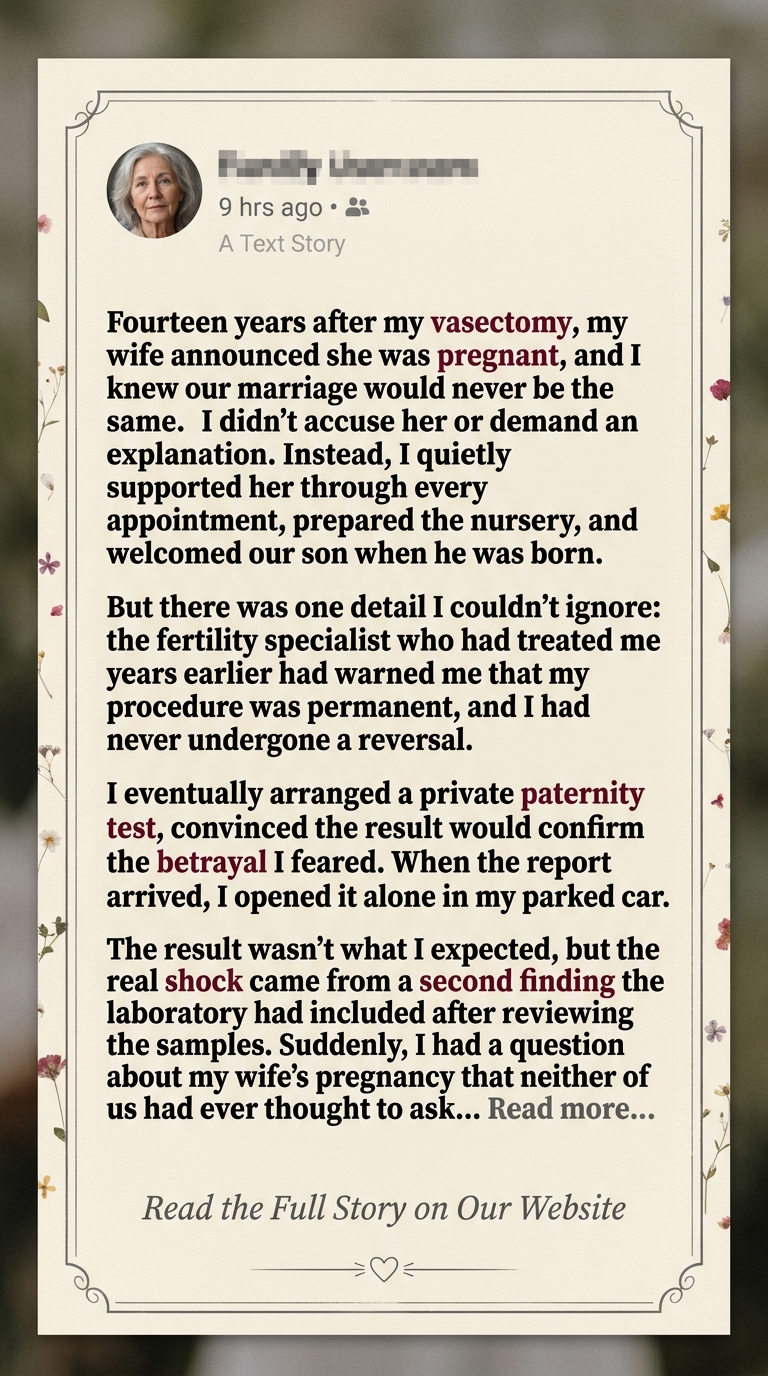
Fourteen years earlier, I had undergone a vasectomy. The specialist had explained that the procedure was intended to be permanent. I had returned for the follow-up testing, received confirmation that my sperm count was clear, and never considered a reversal.
My wife, Laura, knew all of this.
We had agreed that two children were enough. Our daughters, Emily and Sophie, were now teenagers, and we had built a comfortable life around the family we already had.
I looked at the pregnancy test again.
“Are you sure?”
She nodded.
“I took three.”
I wanted to ask how it was possible. I wanted to know whether she had been with someone else. But I also saw how frightened she looked, and I couldn’t bring myself to turn that moment into an interrogation.
“Have you seen a doctor?”
“Not yet.”
“Then let’s make an appointment.”
She started crying.
I held her, although my mind was moving in a direction I didn’t want to admit.
The first appointment confirmed the pregnancy. Laura was nearly nine weeks along, and the ultrasound showed a developing baby with a heartbeat.
The doctor congratulated us.
I smiled when I was expected to smile.
On the drive home, Laura rested her hand on my arm.
“You’re quiet.”
“I’m processing everything.”
“Are you angry?”
“No.”
It wasn’t a complete answer, but it was the only one I could give without saying something I might regret.
I began supporting her through the pregnancy. I attended appointments, helped prepare the nursery, and made sure she had everything she needed. I drove her to the hospital when morning sickness became severe and took over more of the household responsibilities when she grew tired.
Our daughters were delighted.
Emily, who was sixteen, immediately began searching for baby names. Sophie, fourteen, wanted to help decorate the nursery.
They were excited about having a little brother or sister.
I didn’t want my suspicions to poison their happiness.
But the question remained.
How could my wife be pregnant after my vasectomy?
I remembered the specialist who had performed the procedure. His name was Dr. Robert Hayes. He had explained that vasectomies were highly effective, but that a reversal would require another operation. He had also warned me that a rare failure could occur if sperm returned to the semen through a process called recanalization.
I had understood the possibility, but I had also completed the recommended follow-up tests.
For fourteen years, I had believed the matter was settled.
I called the clinic and requested my old records. They confirmed that my post-procedure semen analysis had shown no sperm. The doctor had documented the result and discharged me from follow-up care.
I read the report several times.
It didn’t prove that pregnancy was impossible. Rare late failures had been reported, although they were uncommon.
But I needed more than possibilities.
I arranged a private appointment with a new fertility specialist. I explained the history, provided my medical records, and asked whether a vasectomy could fail after so many years.
He told me it was possible, but exceptionally uncommon.
He recommended a semen analysis and explained that a DNA test could establish paternity.
I left the clinic with an appointment scheduled.
For several days, I considered whether I should tell Laura what I was doing. Each time I imagined the conversation, I saw her frightened expression in the kitchen.
I decided to wait until I had something concrete.
When the baby was born, he arrived just before sunrise on a rainy Thursday.
The nurse placed him in Laura’s arms, and she began crying.
“He’s beautiful,” she whispered.
I stood beside the bed, staring at his tiny face.
His name was Noah.
I held him for the first time while Laura watched me carefully.
“Do you love him?” she asked.
I looked at her.
“Of course I do.”
And I did.
Whatever questions existed between us, Noah was an innocent child who had done nothing wrong.
I continued being the father he needed. I changed diapers, learned how to prepare bottles, and walked around the living room at three in the morning when he refused to sleep.
Emily and Sophie adored him.
Our house became noisy again, filled with baby clothes, feeding schedules, and the familiar exhaustion of raising a newborn.
But the unanswered question followed me.
Six weeks after Noah’s birth, I collected the samples for the paternity test.
The laboratory explained the process and asked for samples from Noah and me. I paid for the test myself and requested that the results be sent directly to my private email.
The waiting period felt longer than it should have.
One afternoon, I parked outside a grocery store and opened the report on my phone.
I expected to see a number confirming that I was Noah’s biological father or a statement excluding me.
Instead, the first page showed a result that made my hands go cold.
Probability of paternity: 99.9999%.
I read it again.
Then again.
I was Noah’s biological father.
For several minutes, I sat in the car without moving.
The result didn’t make sense with what I knew about my vasectomy. I wondered whether there had been an error, whether the samples had been mixed up, or whether I had misunderstood the medical procedure all those years ago.
Then I noticed an additional section attached to the report.
The laboratory had performed an expanded genetic comparison because the samples showed an unusual pattern worth reviewing.
It was not a routine paternity conclusion.
The report indicated that Noah and I shared a rare inherited genetic marker associated with a particular family lineage. That marker was consistent with the relationship established by the paternity analysis, but the laboratory had also identified something else.
A second sample comparison had been requested through the laboratory’s genetic counseling service.
It involved a cheek-swab sample I had provided during the initial consultation and an archived sample from my original vasectomy records, which the clinic had retained as part of a research project.
The report noted a discrepancy between the archived sample and the genetic profile in my current sample.
I read the explanation carefully.
The archived sample had been collected before my vasectomy. The current sample had been collected years later.
The difference wasn’t evidence of infidelity. It suggested that my sperm-producing system had changed in a way that required further medical investigation.
I called the laboratory.
A genetic counselor explained that the report could not diagnose a medical condition. The unusual marker needed to be reviewed by a specialist, and the archived material had limitations.
She recommended that I speak with a reproductive urologist.
I scheduled the appointment.
When I arrived, Dr. Hayes was no longer practicing at the original clinic. Another specialist, Dr. Martin, reviewed my records.
He asked about the operation, my follow-up tests, and whether I had experienced any complications.
Then he examined the archived documentation.
“Your original procedure appears to have been performed correctly,” he said. “And your follow-up test was clear.”
“Then how did my wife become pregnant?”
He explained that vasectomy failure could occur years later, although it was rare. In some cases, a small passage could reform between the separated ends of the vas deferens, allowing sperm to enter the semen again.
He ordered a new semen analysis.
The result showed sperm in my sample.
A second test confirmed it.
The specialist explained that the most likely explanation was late recanalization. The original vasectomy had been successful, but a tiny channel had eventually reconnected.
I sat quietly.
“So I could have fathered this child naturally?”
“Yes. Based on the results, that’s medically plausible.”
I left the clinic with a medical explanation that had seemed almost impossible only a few weeks earlier.
But there was still something bothering me.
Why had the laboratory included that additional genetic comparison?
I called the genetic counselor again and asked her to explain the second finding more carefully.
She clarified that the rare marker was not a sign of a disease or a second biological father. It was an inherited variation that helped confirm the genetic relationship between Noah and me. The unusual feature was that the laboratory had detected the same marker in the archived pre-procedure sample and the current sample, despite a difference in the surrounding genetic data.
The comparison had prompted a quality review because the archived sample had been stored for years.
The review confirmed that the samples belonged to me.
There was no hidden diagnosis, no unexpected relative, and no evidence of a laboratory mix-up.
The second finding had simply triggered the additional review that made the paternity result more reliable.
I was relieved, but the experience left me thinking about how close I had come to accusing Laura of something she hadn’t done.
When I returned home, she was sitting on the nursery floor folding Noah’s tiny clothes.
“How was your appointment?” she asked.
I sat beside her.
“I need to tell you something.”
She stopped folding.
I explained the paternity test, the medical consultation, and the late failure of my vasectomy.
Laura listened without interrupting.
When I finished, she covered her mouth.
“You thought I had cheated?”
“I was afraid of it.”
“Why didn’t you ask me?”
“Because I didn’t know how to ask without hurting you. And because I didn’t want to accuse you without knowing the truth.”
She looked down at the clothes in her hands.
“Do you know how frightening it was when I first saw that positive test?”
I shook my head.
“I thought you would believe the worst. I knew about your vasectomy. I knew what the doctor had told us years ago. I was terrified you would think I had done something.”
I reached for her hand.
“I should have talked to you.”
“Yes,” she whispered. “You should have.”
She explained that she had taken the pregnancy tests alone because she wanted to confirm the result before telling me. When the third test was positive, she had spent nearly an hour sitting in the bathroom, trying to understand what it meant for our family.
She had considered the possibility that the vasectomy had failed, but she hadn’t known how to explain it.
She had been waiting for me to ask questions.
I had been waiting for a test result.
We sat together for a long time.
Eventually, I told her what the specialist had found.
She laughed through her tears when I explained that a tiny passage had apparently reopened after fourteen years.
“All those years of believing we couldn’t have another baby,” she said.
“Apparently, our bodies had other plans.”
She rested her head against my shoulder.
I apologized for keeping the paternity test secret.
She admitted that she had been too afraid to ask what I was thinking during the pregnancy.
Neither of us pretended that the experience had been easy.
The trust between us had been shaken, even though neither of us had betrayed the other. We agreed to talk more openly, especially when fear made us want to hide things.
I also arranged a follow-up consultation about the late vasectomy failure. The specialist discussed the options, including another procedure if we wanted to prevent another unexpected pregnancy. We decided not to rush into anything until we had considered our family plans carefully.
A few months later, Noah was sleeping through most nights.
One evening, I found Emily and Sophie sitting on the nursery floor, arguing over which storybook their brother liked best.
Laura was watching them from the doorway.
I stood beside her.
“Do you ever think about how different our lives would be if that test had shown something else?” I asked.
She took my hand.
“I think about how much damage fear can do when people stop talking to each other.”
I looked at Noah sleeping in his crib.
For weeks, I had imagined that the truth would destroy my marriage. Instead, it had revealed how easily uncertainty could become suspicion when neither person knew how to speak about it.
The test had answered the question I thought mattered most.
I was Noah’s father.
But the deeper lesson was that a marriage couldn’t survive on silent assumptions, even when those assumptions eventually turned out to be wrong.
Fourteen years after my vasectomy, I had become a father again.
And this time, I understood that being a father meant more than welcoming a child into the world. It meant choosing honesty, patience, and trust even when fear made those choices difficult.