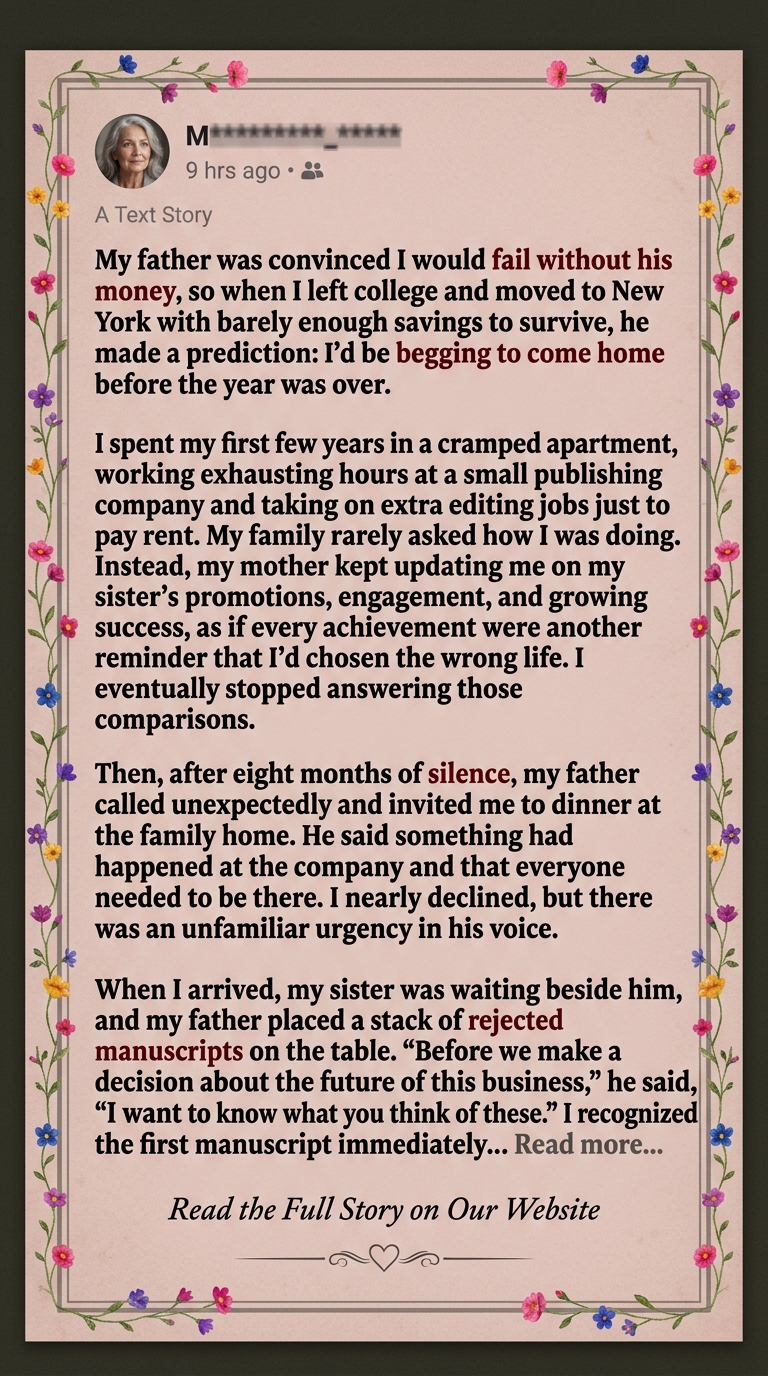
The first manuscript on the table had a blue paper cover, a crooked handwritten title, and a coffee stain across the bottom corner.
I recognized it immediately.
It was called The House at the End of Winter, written by a woman named Eleanor Voss. Three years earlier, I had discovered it buried beneath a stack of unsolicited submissions at Bellweather Press, the small publishing company where I worked in New York.
I had read the first twenty pages during my lunch break. By the end of the afternoon, I had finished the entire manuscript.
It wasn’t perfect. The middle needed tightening, two characters felt underdeveloped, and the ending arrived too quickly. But the writing had something I rarely encountered: an unmistakable voice. Eleanor wrote about ordinary people with such precision that their smallest decisions felt important.
I had recommended it to my editor.
He agreed with me, but Bellweather couldn’t afford to acquire it. We were struggling to keep our existing titles in print, and Eleanor wanted an advance we couldn’t responsibly offer.
I had sent her a kind rejection letter, explaining that the manuscript deserved another look when our financial position improved.
Now that same manuscript was lying on my father’s dining table.
I looked at the other documents. There were rejection letters from several publishers, including two national companies. Someone had marked the first pages with red pen, and a yellow sticky note was attached to the cover.
“Commercially uncertain,” it read.
My father folded his hands.
“Well?”
I looked at him.
“Where did you get this?”
“Your sister brought it to the company. The author submitted it through our general submissions address. Vanessa says it’s not suitable for publication.”
My sister sat beside him, wearing the confident expression she had perfected during years of business meetings.
“It’s beautifully written,” she said, “but beautiful writing doesn’t pay salaries. We need books that sell.”
I turned another page.
“Who read it?”
“Our editorial team.”
“All of it?”
Vanessa hesitated.
“Enough to understand the problem.”
I looked at the manuscript again.
“How many pages?”
“Three hundred and twelve.”
“And how many did your team read?”
My father frowned.
“That’s not the point.”
“It is if you’re rejecting a manuscript based on a twenty-page assessment.”
Vanessa crossed her arms.
“We have more urgent problems than arguing about one author’s novel.”
I looked at my father.
“Is that why you called me?”
He nodded toward the stack of papers.
“Mercer House is facing a serious decision. Our sales have fallen for three consecutive years. Two distributors have reduced their orders, our printing costs have increased, and the board wants to sell the company to a national group. Before we agree, I want to know whether there’s anything we’re overlooking.”
I glanced at Vanessa.
“Why me?”
“Because you work in publishing,” he replied.
It was the first time he had described my career without making it sound like a hobby.
I had left college at twenty-one with barely enough savings to survive in New York. My father had called it a foolish rebellion. He believed education was the only respectable route into business and that leaving before graduation meant I would spend my life struggling.
He had been certain I would return.
I hadn’t.
For the first year, I worked at a small bookstore and accepted temporary editorial assignments whenever I could find them. Eventually, Bellweather Press hired me as an editorial assistant. I sorted submissions, corrected proofs, prepared manuscripts for production, and learned the business from the ground up.
My family rarely asked about any of it.
My mother preferred to tell me about Vanessa’s promotions. Vanessa had joined Mercer House after graduating from a prestigious business program and quickly become its director of acquisitions. She had a company car, an office overlooking the city, and my father’s confidence.
I had a rented room, a secondhand desk, and a collection of marked-up manuscripts.
But I was learning.
And the manuscript on my father’s table was proof that I had learned something worth sharing.
I turned to the financial report beneath it.
“Before I give you an opinion, I need to understand the company’s situation.”
My father passed me a folder.
The figures were worse than I expected. Mercer House had built its reputation on regional fiction, historical novels, and educational titles. For decades, it had maintained a loyal readership and strong relationships with independent bookstores.
But the industry had changed.
The company was still acquiring books according to the tastes of its senior editors, printing large initial runs, and relying heavily on distributors to reach readers. Its warehouse was full of unsold stock. Marketing money was spread thinly across too many titles, and the company had no serious direct-to-reader strategy.
The proposed buyer wanted to acquire the publishing rights and distribution contracts but intended to close the editorial office and transfer production elsewhere.
Nearly forty employees would lose their jobs.
My father looked at me.
“Can this business be saved?”
I took a moment before answering.
“Possibly. But not by continuing to publish the same way.”
Vanessa sighed.
“We’ve already tried new marketing campaigns.”
“Advertising isn’t the same as understanding readers.”
“And what does that mean?”
I placed Eleanor’s manuscript beside the financial report.
“It means you’re treating every book as a product that needs to be sold instead of asking which readers would want it in the first place.”
My father leaned back.
“Explain.”
I told them about Bellweather’s subscription program. Instead of publishing dozens of titles and hoping bookstores would order them, we had begun building a smaller, more focused list. We identified specific reader communities, worked closely with independent bookstores, and used early reader feedback to determine which manuscripts deserved larger print runs.
We had also stopped treating a book’s first month as its only chance to succeed.
Some titles needed time. Some found their audience through book clubs, libraries, schools, or local events. A few sold modestly at first but continued generating revenue for years.
Mercer House had the advantage of an established name and decades of relationships. It also had a list of back-catalog titles that had been neglected rather than properly reintroduced.
My father listened carefully.
Vanessa did not.
“You make it sound simple,” she said. “But we can’t build a company around every manuscript someone happens to like.”
“I agree.”
“Then why are we discussing this one?”
“Because I think it’s worth publishing.”
She laughed softly.
“Based on what? Your personal taste?”
“Based on the manuscript, its likely readership, and the way it could fit into a list of carefully selected titles.”
I explained that Eleanor’s novel could appeal to readers of literary family fiction, particularly women who enjoyed emotionally grounded stories about aging, memory, and complicated relationships. It wasn’t an obvious mass-market thriller, but it had strong book-club potential.
More importantly, the author had a distinctive voice.
“Have you spoken to her?” I asked.
Vanessa shook her head.
“She sent the manuscript. That’s all.”
“Then we should speak to her before making a final decision.”
My father looked at the cover.
“Suppose we do. What would you change?”
“Not the voice. I’d work with her on the pacing, clarify two relationships, and give the ending more room. But I wouldn’t turn it into something it isn’t.”
Vanessa stood and walked toward the window.
“We’re discussing a sale that could protect the family’s investment, and you’re suggesting we spend money editing a novel that other publishers have rejected.”
“I’m suggesting we evaluate the company based on more than one disappointing sales report.”
My father tapped the financial folder.
“The buyer’s offer expires in three weeks. The board wants an answer.”
“Then give me ten days.”
Vanessa turned.
“Ten days for what?”
“To review the acquisition list, the back catalog, the distribution agreements, and the manuscripts your team has rejected over the last eighteen months. I’ll identify which titles have realistic commercial potential and what changes would be necessary to make the business viable.”
My father studied me.
“And what do you want in return?”
“Access to the records and permission to speak with department managers. I don’t want a position or a promise. I want to understand the business before anyone decides its future.”
He agreed.
Vanessa looked as though she wanted to object, but our father had already made his decision.
The following Monday, I arrived at Mercer House at eight in the morning.
The building was older than I remembered. Its front windows displayed books that had once been regional bestsellers, and the reception area smelled faintly of paper and furniture polish.
Several employees recognized me from childhood visits.
Some remembered me as the quiet daughter who used to sit in the corner reading while my father worked. Others had no idea who I was.
I spent the first two days reviewing the company’s records.
The problems were not mysterious.
Mercer House was paying to store thousands of books that were unlikely to sell. It was releasing too many titles in a single season, leaving marketing teams unable to give individual books proper attention. Its editorial department was rejecting manuscripts based on narrow assumptions about what the company’s traditional readers wanted.
I also discovered that the company had several strong authors whose books were still selling, but nobody had approached them about new projects.
On Wednesday, I met with the editorial team.
I asked them to explain how they evaluated submissions.
One senior editor described a process built around familiar categories and previous sales. If a manuscript did not resemble a title that had already performed well, it was usually rejected.
“That’s understandable when you’re protecting a limited budget,” I said. “But it also means you’re only looking for books that resemble the books you’ve already published.”
The editor frowned.
“We can’t take risks on everything.”
“We shouldn’t. But we need a better way to identify which risks are worth taking.”
I asked to see the manuscripts that had received strong editorial comments but had been rejected for commercial reasons.
There were twenty-seven.
Several were poorly developed, but six had genuine potential. Eleanor’s was the strongest.
I called her that afternoon.
She answered after the fourth ring.
“Ms. Voss? My name is Claire Bennett. I’m reviewing submissions at Mercer House.”
There was a pause.
“Have I been rejected again?”
“Not exactly. I’d like to discuss your manuscript.”
She sounded cautious.
“Which one?”
“The House at the End of Winter.”
“Oh.”
She said nothing for a moment.
“I thought that book had run out of chances.”
“I don’t think it has.”
We arranged a video meeting.
Eleanor was sixty-three and lived in a small coastal town in Maine. She had worked as a librarian for thirty years before retiring. She told me she had spent nearly a decade writing the novel, drawing inspiration from the families who visited her library and the people she had known growing up.
She wasn’t interested in becoming famous.
She wanted the book to reach readers who might recognize something of their own lives in it.
I told her what I liked and what I thought needed improvement. I was careful not to promise publication before the company had made a decision.
At the end of the call, she asked me a question.
“Are you the daughter of Richard Bennett?”
I hesitated.
“Yes.”
“I remember him. He spoke at our library association meeting years ago. He said small publishing houses couldn’t survive by being sentimental.”
I smiled faintly.
“He still believes that.”
“Then perhaps he’ll be surprised by your interest in my book.”
After the call, I returned to the office and finished my review.
By Friday, I had a proposal.
Mercer House needed to reduce its publishing schedule, discontinue unprofitable print runs, negotiate better terms with distributors, and establish a direct sales channel. It needed to create a small editorial committee that included people who understood both literary quality and commercial potential.
I also recommended acquiring six manuscripts from the rejected list, including Eleanor’s, subject to further editing and proper financial approval.
My father read the report over the weekend.
On Monday morning, he called a board meeting.
Vanessa presented the case for selling the company. She argued that the buyer’s offer was generous, that the business was losing money, and that attempting a restructuring could put the remaining assets at risk.
I presented my plan.
The board members asked difficult questions.
How much would the restructuring cost? How long before the company became profitable? What would happen if the new titles failed? Could direct sales really replace the lost distributor revenue?
I answered as honestly as I could.
I didn’t promise that every manuscript would succeed. I didn’t claim that digital sales would solve everything. I explained the risks, the expected costs, and the milestones that would tell us whether the plan was working.
Then one board member asked why I believed I could accomplish what the existing management team had not.
I looked around the room.
“Because the company hasn’t been asking the right questions. It’s been asking how to sell more copies of the books it already knows how to publish. It needs to ask which books readers haven’t been given the chance to discover.”
My father watched me without speaking.
The board postponed the sale and approved a limited restructuring period of nine months. They also agreed to establish an independent review of the company’s performance before making a final decision.
Vanessa was furious.
“You’ve convinced them to gamble the entire business on your judgment,” she said after the meeting.
“No. I’ve convinced them to test a plan before selling everything.”
“You’ve been here for two weeks.”
“I know.”
“You think you understand this company better than I do?”
“No,” I said. “I think I understand parts of the publishing business that we’ve neglected.”
She walked away.
The next several months were difficult.
I didn’t take over the company. My father appointed a restructuring director, and I worked as an external editorial and strategy consultant under a defined contract. That arrangement prevented the family from turning the process into a contest over who deserved a title.
We reduced the number of new releases, renegotiated printing arrangements, and began clearing obsolete inventory through legitimate discount channels.
The marketing department developed smaller campaigns aimed at specific reader groups instead of spending the entire budget on broad advertising.
We also launched a monthly reading program that paired new Mercer House titles with selected books from the back catalog.
Eleanor signed a publishing agreement after reviewing the revised terms with her agent.
Her manuscript went through four months of editing.
She resisted some of my suggestions, and I respected that. We disagreed about the final chapter twice before finding an ending that preserved her intention while giving the reader a more satisfying conclusion.
The book was published the following spring.
Its first week was respectable, not spectacular. It sold steadily through independent bookstores and gained attention from several book clubs. A regional newspaper reviewed it favorably, followed by a national literary magazine.
Then something unexpected happened.
A librarian in Oregon recommended it to a network of community reading groups. Within weeks, libraries across several states were ordering copies.
The book didn’t become an overnight sensation, but it kept selling.
By the end of its first year, it had become Mercer House’s strongest new release in nearly five years.
The company was still recovering, but the numbers were improving. The back-catalog program generated additional revenue, and several new authors signed contracts after hearing that Mercer House was willing to develop unusual manuscripts rather than reject them for not fitting an existing formula.
At the end of the nine-month period, the board reviewed the results.
The company had not returned to its former size, but it had stopped losing money. More importantly, it had a sustainable plan.
The buyer withdrew its offer.
My father invited me to dinner again.
This time, there were no financial reports or rejected manuscripts on the table. He had cooked too much food, as usual, and my mother had placed fresh flowers in the center of the dining room.
Vanessa arrived late.
She looked tired, and the confidence she once carried into every room had softened.
After dinner, my father asked me to walk with him into the study.
He stood beside the shelves of old Mercer House publications.
“I owe you an apology,” he said.
I waited.
“When you left college, I thought you were throwing away every opportunity I’d worked to give you.”
“I remember.”
“I believed that because I had built a successful business, I knew what success should look like for you.”
He looked toward the shelves.
“I was wrong.”
I didn’t immediately answer.
He continued.
“When you came here, I expected you to tell us how to sell books. Instead, you reminded us why we started publishing them in the first place.”
I looked at the books on the shelves.
“My point was never that the business should ignore money. It was that money isn’t the only reason a publishing company exists.”
He nodded.
“I understand that now.”
A few minutes later, Vanessa joined us.
She apologized for dismissing my experience and admitted that she had been afraid of losing the position she had spent years working toward.
“I thought if the company survived, I’d finally have proved I deserved to lead it,” she said. “Then you arrived, and everyone started listening to you.”
“I wasn’t trying to take your place.”
“I know that now.”
She had been appointed commercial director after the restructuring, while an experienced publishing executive took over as chief executive. It wasn’t the promotion she had originally expected, but she was beginning to understand the difference between managing a company and understanding every part of its business.
We didn’t become inseparable sisters overnight. But our conversations became more honest, and we stopped using professional achievements as weapons against each other.
A year later, I returned to New York.
Bellweather Press had offered me a permanent editorial leadership position, and I accepted. I also continued advising Mercer House on a limited basis, but I no longer needed to prove that I belonged in the industry.
Eleanor sent me a signed copy of her second novel when it was published.
Inside, she had written:
“To Claire, who read the pages everyone else stopped reading.”
I kept that copy on my desk.
For years, my family had treated my decision to leave college as evidence that I lacked discipline. They had assumed that because I didn’t follow the path they respected, I must have been failing.
But I had never stopped learning.
I had learned in crowded offices, in late-night editing sessions, in conversations with authors who had been rejected, and in the quiet moments when I had to decide whether a manuscript deserved another chance.
My father had invited me home because his company was in trouble.
He expected me to judge a stack of rejected books.
Instead, I had recognized the one manuscript that reminded me why I had left home in the first place.
And when my father finally understood what I had built, it wasn’t because I had returned with a degree, a title, or a fortune.
It was because I had spent years becoming good at something he had never thought I could do.