The first time I questioned my husband’s bedtime drink, I was lying in the dark with my eyes closed, listening to him breathe.
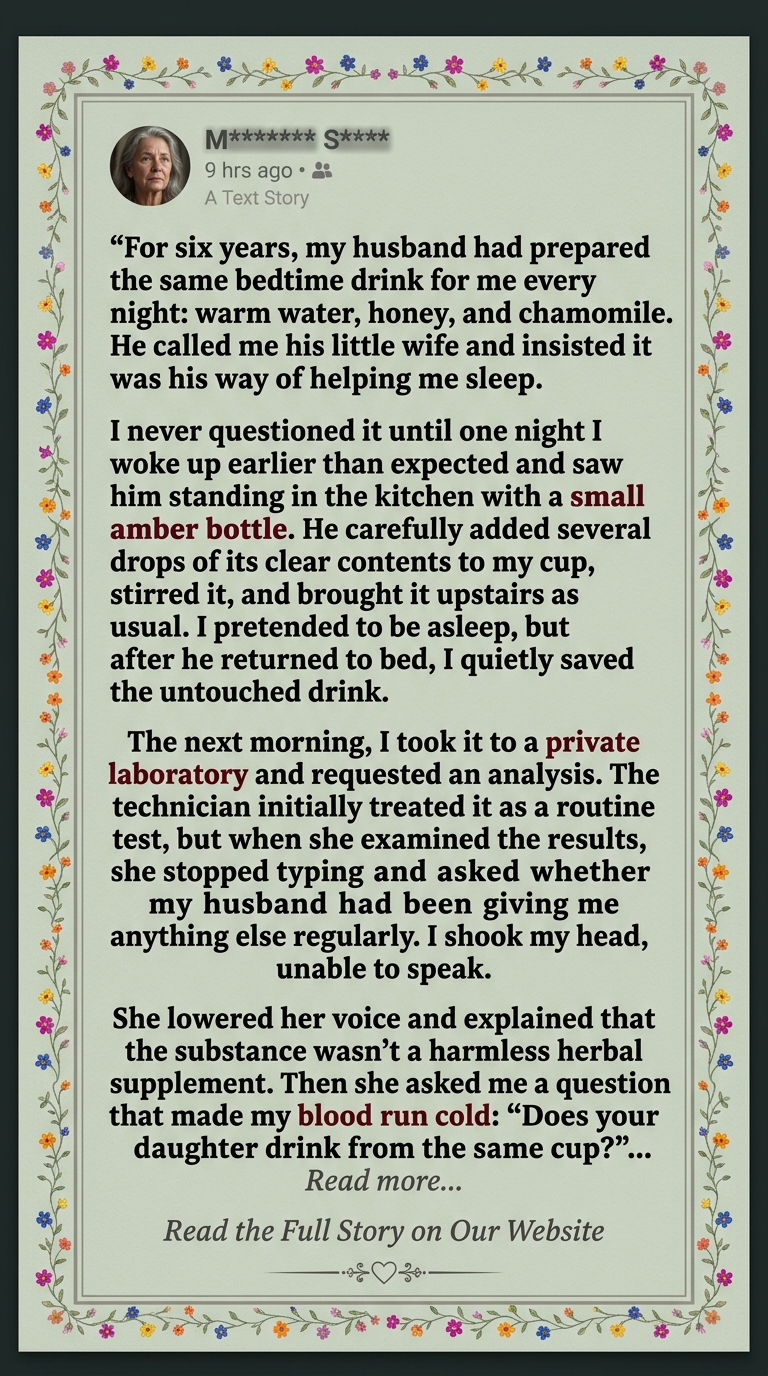
For six years, Daniel had prepared it every night without fail. Warm water, a spoonful of honey, and chamomile tea. He called me his little wife and insisted the drink helped me sleep.
It had become part of our marriage. If he traveled, he reminded me to make it myself. If I fell asleep before he brought it upstairs, he woke me gently and placed the cup on my bedside table.
I thought it was sweet.
Until the night I saw him add something from a small amber bottle.
I had woken earlier than usual because our daughter, Sophie, had been coughing in the next room. I got up to check on her, but before leaving the bedroom, I noticed the kitchen light beneath the door.
Daniel was standing at the counter.
He glanced toward the hallway, opened a drawer, and removed a small bottle. He held it close to the cup, counted several drops, then quickly returned it to the drawer. After stirring the drink, he carried it upstairs.
I hurried back to bed and closed my eyes.
“Your tea, sweetheart,” he whispered.
I pretended to wake, accepted the cup, and took a small sip. It tasted exactly as it always had.
But I didn’t drink the rest.
When Daniel fell asleep, I carried the cup downstairs and poured its contents into a clean, sealed container. I placed it in the refrigerator and waited until morning.
I told him I had a headache and needed to visit the pharmacy. Instead, I drove to a private laboratory across town.
The technician, a woman named Dr. Helen Morris, asked what I wanted tested.
“I need to know what’s in this drink,” I said. “Someone may have added something without my knowledge.”
She looked at me carefully.
“Do you know what the substance might be?”
“No.”
She labeled the container and explained that the laboratory could screen it for common medications, sedatives, and other substances. She also advised me to preserve the original container and avoid confronting the person until I had spoken with the appropriate authorities.
I agreed.
I expected the results to take several days.
They called me that afternoon.
When I returned, Dr. Morris led me into a small office. She had a printed report in front of her, but she wasn’t looking at it.
“Mrs. Carter,” she said, “I need to ask you something before I explain the results.”
My hands began to shake.
“Does your daughter drink from the same cup?”
I stared at her.
“Sophie? She’s eight. No. Daniel prepares her own bedtime drink.”
“Does he ever give her the same mixture?”
“I don’t know. Why?”
Dr. Morris lowered her voice.
“The sample contains a prescription sedative. It’s not a harmless herbal supplement, and the amount detected is significant enough to cause prolonged drowsiness in someone who hasn’t been prescribed it.”
I felt as though the room had tilted.
“Are you saying my husband has been drugging me?”
“The laboratory can identify what’s present in the sample. It cannot establish who added it or how often you’ve consumed it. But you should treat this as a serious safety concern.”
She turned the report toward me.
The substance was a medication used in certain medical circumstances, but it could cause confusion, impaired coordination, memory problems, and excessive sedation. It could also be dangerous when combined with alcohol or other medications.
I remembered the mornings when I had struggled to wake up. The times I had forgotten conversations. The occasions when I felt exhausted even after sleeping for nine hours.
Daniel always blamed my workload.
“You need to contact the police and seek medical advice,” Dr. Morris said. “Please don’t drink any more of it. And don’t give any of it to your daughter.”
I could barely speak.
Then she asked one more question.
“Have you noticed your husband behaving differently toward your daughter?”
I thought about it.
Daniel had always been affectionate with Sophie, but lately he had insisted on putting her to bed himself. He had also begun telling me that I needed more rest and should stop worrying about household responsibilities.
Sometimes, when I entered her room, she was already asleep.
I had assumed it was a sign that he was becoming a more involved father.
Now I wasn’t sure what I had been seeing.
I left the laboratory and called my older sister, Rachel. She lived twenty minutes away and was the only person I trusted to remain calm.
When I explained what had happened, she didn’t ask whether I was certain.
“Don’t go home alone,” she said. “I’ll meet you at the police station.”
We contacted the authorities and arranged for Sophie to stay with Rachel while I spoke with investigators. I also visited a doctor, who reviewed the laboratory report and arranged appropriate assessments. I was advised not to stop or start any medication without medical supervision, although I had never been prescribed the substance found in the drink.
That evening, I didn’t return home.
Daniel called six times.
On the seventh call, I answered.
“Where are you?” he demanded.
“I’m with Rachel.”
“Why? You said you were going to the pharmacy.”
“I needed to talk to someone.”
He went quiet.
“What’s wrong?”
I stared at the laboratory report on the table.
“Daniel, what’s in the amber bottle in the kitchen drawer?”
The silence lasted several seconds.
“What bottle?”
“The one you use for my tea.”
He exhaled sharply.
“It’s a sleep supplement. You know you’ve been having trouble sleeping.”
“Then why didn’t you tell me?”
“Because you worry about everything. I didn’t want you taking something you didn’t understand.”
I closed my eyes.
“That’s exactly what I want to understand.”
He became angry.
“You’re making this into something it isn’t. I’ve been looking after you for six years.”
I ended the call.
The next morning, investigators accompanied me to the house. Daniel was there, and his expression changed when he saw them.
He immediately claimed there had been a misunderstanding.
The amber bottle was still in the kitchen drawer, but it was nearly empty. Investigators collected it along with the remaining drink supplies and other relevant items.
Daniel insisted the medication was his.
He said he had been prescribed it for occasional sleep problems and had used only a few drops in my drink because he believed it would help me rest.
When asked why he had never told me, he said I would have refused.
That answer was enough to make my stomach turn.
But the question about Sophie remained.
Investigators discovered that Daniel had also prepared a bedtime drink for her on several occasions. He claimed it was only herbal tea and that he had never given her medication.
I refused to accept his word.
Sophie was examined by a pediatric specialist, who arranged the appropriate testing and reviewed her medical history. Fortunately, there was no evidence that she had received the sedative. Her recent tiredness appeared consistent with a lingering respiratory infection, and the doctor found no indication of medication exposure.
I was relieved, but the fact that Daniel had been preparing drinks for both of us made the situation even more frightening.
Over the next several days, investigators examined the bottle, Daniel’s prescription records, and the circumstances surrounding the drink.
They discovered that the medication had been prescribed to him months earlier, but his prescription was for tablets, not liquid drops. The amber bottle had no pharmacy label. He had purchased a concentrated preparation through an online seller and transferred it into the unmarked container.
Daniel claimed he had done so because the liquid was easier to measure.
The seller’s records and messages established that Daniel had specifically asked about using the substance in drinks without changing their taste.
That detail destroyed his explanation.
He had not simply made a careless decision with his own prescription. He had deliberately obtained a form of medication that could be hidden in someone else’s drink.
When investigators questioned him again, Daniel changed his story.
He admitted adding the substance to my tea, but insisted he had never intended to hurt me.
He said I had been restless, anxious, and difficult to live with. He claimed I argued with him about small things and constantly questioned his decisions. He believed that if I slept more deeply, our marriage would improve.
I listened to his explanation through my attorney.
For six years, he had presented control as kindness.
He had called me his little wife while deciding what I should drink, how long I should sleep, and whether I should be alert enough to question him.
But the investigation uncovered something else.
Daniel had recently applied for a large life insurance policy on me. The application listed him as the primary beneficiary. The policy had not yet become active because the insurer had requested additional medical information.
When questioned about it, he said he had arranged the policy for our family’s financial security.
There was no evidence that he had planned to kill me, and I refused to let anyone turn uncertainty into a claim of murder. But the combination of secret medication, an unmarked bottle, and the insurance application was deeply disturbing.
Investigators continued examining his communications and financial records.
They found messages to a friend in which Daniel complained that I had become suspicious and that he needed me to remain calm until a business loan was approved.
The loan was secured against a property we jointly owned. Daniel had submitted paperwork suggesting that I had agreed to the arrangement, although I had never authorized it.
The loan had not been completed, but the financial motive was now clearer. He wanted me sleeping through the evenings, less likely to notice his activities, and less likely to question documents he placed in front of me.
The insurance policy appeared to be part of a separate financial plan, although investigators could not establish that he intended to make a claim.
Daniel was charged in connection with administering medication without my consent and with the related financial misconduct. The case took months to move through the legal system, and I learned that proving what had happened was more complicated than I had imagined.
The laboratory results were important, but they were only one part of the evidence. The bottle, purchase records, messages, prescription information, and testimony from the people who had investigated the matter all helped establish what he had done.
During that time, Sophie and I stayed with Rachel.
I explained the separation in simple language.
“Daddy made some unsafe choices,” I told her. “The grown-ups are dealing with them. You didn’t do anything wrong, and you are safe with me.”
She asked whether her father would come home.
I held her hands.
“I don’t know what will happen later, sweetheart. But nobody will give you anything you don’t understand or need. You can always ask me questions.”
She nodded, then leaned against me.
The hardest part wasn’t explaining what had happened to her. It was accepting that I had once trusted Daniel so completely that I had never thought to question the small cup he brought me every night.
Months later, the court found Daniel guilty of administering a controlled medication without my consent and of falsifying financial documents connected to the attempted loan. He received a prison sentence and was ordered to repay the financial losses associated with his misconduct.
The insurance application was canceled.
Our marriage ended, and I obtained legal protection to keep him away from our home while the family arrangements were resolved.
I didn’t move back immediately. Rachel helped me find a smaller house near Sophie’s school, where we could begin again without passing the kitchen where the amber bottle had once sat.
For a long time, I couldn’t drink chamomile tea.
Even the smell made my stomach tighten.
Eventually, I began making it myself. I bought a new kettle, chose my own tea, and measured the honey with a spoon I kept in my desk drawer.
One evening, Sophie came into the kitchen while I was preparing two cups.
“Can I have some?” she asked.
I smiled.
“Of course. We’ll make yours without the honey.”
She watched me pour the water.
“Are you making the tea tonight?”
“Yes,” I said. “And you can watch me.”
She climbed onto a chair and helped me place the cups on the table.
We sat together, talking about her school project and the little garden she wanted to grow outside our new house.
It was an ordinary evening, and that was what made it precious.
I used to believe love meant trusting someone enough to accept the little things they did for you without question. Now I understood that real care never requires secrecy, and no one has the right to put something into another person’s body without permission.
Daniel had spent six years calling the drink his way of helping me sleep.
But the night I finally woke up early enough to see what he was doing, I also woke up to the truth about the man I had married.