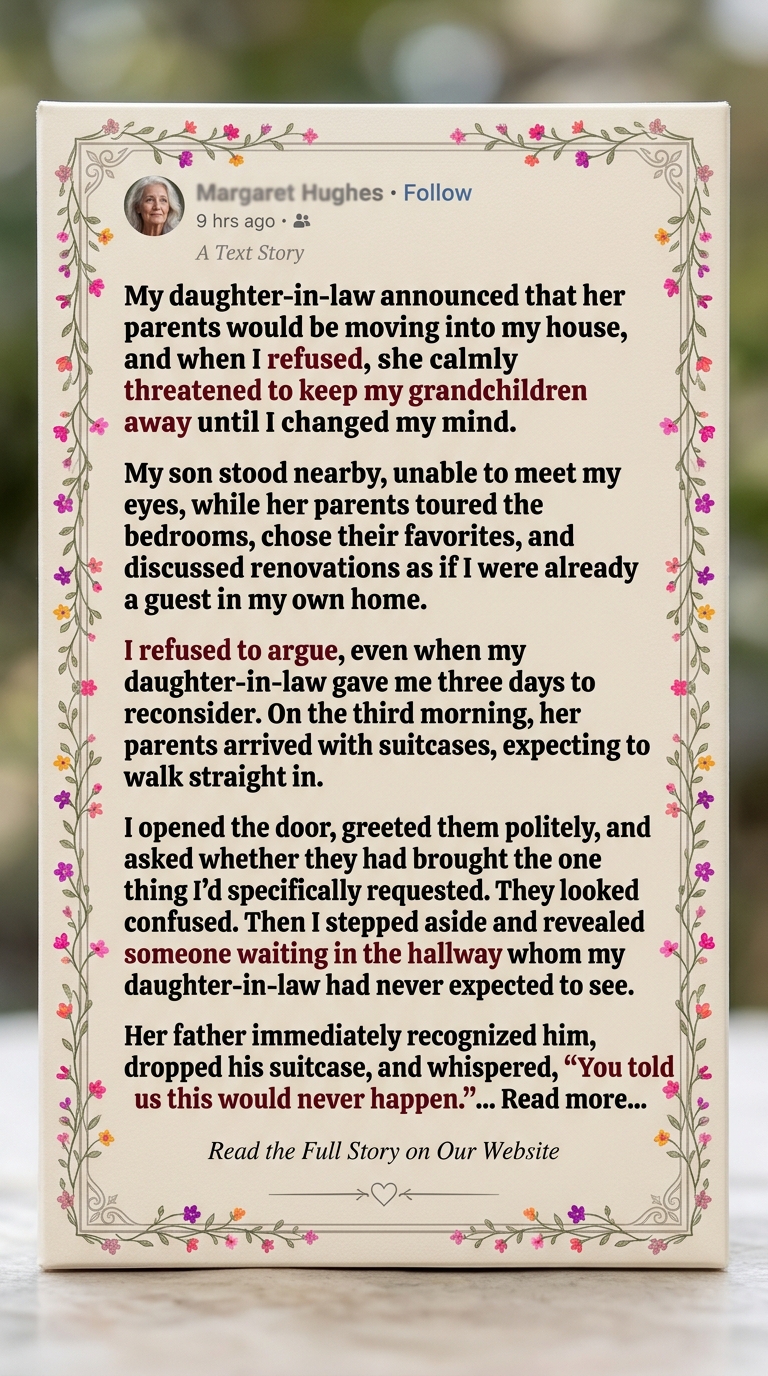
For thirty-two years, I had believed that the hardest part of raising a child was teaching him how to stand on his own. I never imagined that one day my greatest challenge would be convincing him that I was still allowed to stand on my own two feet.
My name is Margaret Ellis, and the house in question was the home my late husband, Robert, and I had bought when our son, Daniel, was barely four years old. We had spent years renovating it, saving for every improvement, and turning its four bedrooms into a place where family gatherings became traditions.
After Robert died, I kept the house. Daniel married Vanessa six years later, and they had two children, Lily and Ethan. I loved my grandchildren more than anything, and I was always happy to have them visit.
But Vanessa gradually began treating my home as though it were an extension of hers.
At first, the requests were small.
She wanted a key so she could collect the children whenever she needed. Then she began rearranging the kitchen because she thought my cupboards were inconvenient. Later, she started suggesting that I should replace the old furniture in the living room.
I tolerated most of it because I didn’t want unnecessary arguments.
Then, one Sunday afternoon, Daniel and Vanessa arrived with her parents, Richard and Patricia.
I had prepared lunch, assuming they were visiting for the usual family gathering. Instead, Vanessa placed a folder on the dining table and announced that her parents would be moving in.
I stared at her.
“I’m sorry. What did you say?”
“My parents are selling their apartment,” she explained. “They need somewhere comfortable, and this house has plenty of space.”
Richard nodded as if the matter had already been settled.
“We won’t be any trouble,” he said. “We’ll take the two bedrooms upstairs.”
I looked at Daniel.
He studied his plate.
“Did you know about this?”
He cleared his throat. “We thought it would be a good arrangement.”
“For whom?”
Vanessa sighed.
“Margaret, let’s be reasonable. You have four bedrooms, and you live here alone. My parents are getting older. It makes sense for everyone.”
“It’s my home,” I replied. “I haven’t invited anyone to move in.”
Patricia gave me a tight smile.
“We’re family now. Surely you don’t intend to make us feel unwelcome.”
“I don’t intend to share my home with people who made the decision without asking me.”
Vanessa’s expression hardened.
“Then perhaps you should think about how often you’ll see your grandchildren.”
I looked at her, waiting for her to explain.
She didn’t need to.
“If you make this difficult,” she continued, “don’t expect us to keep bringing Lily and Ethan here. Children need stability, and we won’t keep exposing them to family arguments.”
Daniel finally looked up.
“Vanessa, that’s enough.”
But he didn’t tell her the move was unacceptable. He didn’t tell her that threatening to withhold the children was wrong. He simply returned his attention to his plate.
That hurt more than anything she had said.
I stood and began clearing the dishes.
“I’ve heard what you want. My answer is no.”
Vanessa closed her folder.
“Think about it for three days.”
“I don’t need three days.”
“Then you’ll have three days to decide whether you want to make this family miserable.”
They left shortly afterward.
I spent that evening walking through the house. I looked at the photographs on the staircase, the old wooden cabinet Robert had restored, and the marks on the kitchen wall where Daniel had measured his height as a child.
This was not an empty property waiting for someone to fill it.
It was my home.
The next morning, I called my solicitor, Helen Brooks. I had known her for years, and she had helped me settle Robert’s estate.
I explained what had happened.
“Does your son have any ownership interest in the property?” she asked.
“No. Robert and I transferred everything into my name after he died.”
“Has anyone been given a right to live there?”
“No.”
“Then don’t agree to anything verbally, and don’t sign anything Vanessa or her parents bring you. I’ll review the property records and advise you on the next steps.”
I also asked Helen to contact someone she had previously represented.
His name was Martin Shaw.
Martin had worked as a property conveyancing solicitor before retiring from active practice. He was now an independent property mediator, helping families resolve complicated disputes involving shared homes, informal promises, and property interests.
I hadn’t spoken to him in several years, but I remembered a conversation we had after Robert died.
Martin had once told me that the most dangerous family disputes were often the ones in which everyone believed a verbal promise was more important than the actual ownership arrangements.
I explained Vanessa’s threat and asked whether he would be willing to attend a meeting if necessary.
He agreed.
Meanwhile, Vanessa became increasingly confident.
She sent me photographs of bedroom furniture, paint colors, and storage systems.
One message read:
My mother wants the larger upstairs room. Dad will use the smaller one. We can turn your sewing room into a sitting area for them.
I replied that nobody was moving into my house.
She sent back a laughing emoji.
The following afternoon, Richard and Patricia arrived without warning.
They walked through the hallway while Vanessa explained where they intended to put their belongings.
Patricia opened the wardrobe in my bedroom.
“This room gets the best morning light,” she said. “I think it would be ideal for Richard and me.”
I stepped into the doorway.
“That is my bedroom.”
She looked surprised, as though she had forgotten I was there.
“Oh, don’t worry. We can find somewhere else for you.”
I felt my hands tighten.
“Find somewhere else for me?”
Vanessa appeared behind her mother.
“Margaret, please don’t make this unpleasant.”
“I haven’t made anything unpleasant. You have walked into my bedroom and started deciding where I should sleep.”
Richard cleared his throat.
“We’re only trying to find a practical solution.”
“Then I suggest you find another house.”
He gave me an irritated look.
“You don’t need all this space.”
“I don’t need to justify the space I own.”
They left, but not before Vanessa reminded me that I had until the following morning.
That evening, Daniel called.
“Mom, can you please just agree to let them stay?”
“Why?”
“Because Vanessa is upset, and her parents have already started arranging things.”
“They can arrange their own home.”
He sighed.
“You know how important family is to me.”
“I do. That’s why I expected you to protect your children’s relationship with their grandmother instead of allowing your wife to use them as bargaining tools.”
He went quiet.
“Vanessa says you hate her parents.”
“I don’t hate them. I don’t want them living in my house.”
“It’s just temporary.”
“How temporary?”
He couldn’t answer.
I realized then that he had no idea what his wife had promised her parents. He had agreed to something without establishing any boundaries or even discussing how long it would last.
“Daniel,” I said gently, “you are my son. I love you. But loving you doesn’t mean giving up my home whenever someone else demands it.”
He ended the call without saying goodbye.
On the third morning, I woke early and prepared coffee.
At nine o’clock, a large vehicle pulled into the driveway.
Richard and Patricia stepped out with suitcases. Vanessa followed behind them, carrying a handbag and smiling as though she had finally won.
I opened the front door.
“Good morning.”
Vanessa walked forward.
“Perfect. We’re here.”
Richard lifted his suitcase.
“Where should we put these?”
I didn’t move.
“Did you bring the one thing I specifically requested?”
Patricia frowned.
“What thing?”
“The written confirmation that you have no intention of claiming ownership of my property.”
Vanessa rolled her eyes.
“Oh, Margaret. We’re not doing this again.”
I stepped aside.
“Then perhaps you should speak to the person waiting inside.”
Martin Shaw stood in the hallway, holding a leather folder.
Richard froze.
His suitcase slipped from his hand and struck the floor.
He stared at Martin, his face suddenly pale.
“You told us this would never happen,” he whispered.
Vanessa turned sharply.
“Dad? You know him?”
Martin looked at Richard without any expression.
“Good morning, Mr. Collins. It’s been a while.”
Richard took a step backward.
“What are you doing here?”
“I’m here because Mrs. Ellis asked me to attend a meeting about the proposed occupation of her property.”
Vanessa looked from her father to Martin.
“Why would you know him?”
Richard didn’t answer.
Martin placed his folder on the hallway table.
“Perhaps your father would like to explain.”
The silence that followed was the first moment I understood that this situation involved more than Vanessa’s unreasonable demand.
I had invited Martin because I wanted an independent professional present. I hadn’t known that he recognized Richard.
Martin turned toward me.
“May I explain why I know him?”
I nodded.
“Several years ago, I represented a group of homeowners in a dispute involving a property investment company called Northfield Residential.”
Richard looked down.
Martin continued.
“Mr. Collins was one of the company’s directors. The company approached elderly homeowners, offering to renovate their properties in exchange for a future share of the value. Some owners were told they were signing maintenance agreements. Others were presented with documents that created financial obligations they did not fully understand.”
Vanessa’s face changed.
“Dad, what is he talking about?”
Richard spoke quickly.
“That was years ago. It has nothing to do with this.”
Martin opened his folder.
“It became relevant when I received a copy of the proposal you sent Mrs. Ellis.”
He removed a printed document.
It was a draft agreement Vanessa had sent me the previous week. At the time, I had assumed it was simply a list of household arrangements. Now Martin pointed to a paragraph I had barely noticed.
The document described Richard and Patricia as long-term residents and proposed that they contribute toward improvements to the property. In exchange, they would receive an ongoing right to occupy the home.
There was also a clause allowing them to recover certain expenses from the property’s future sale proceeds.
I had never agreed to those terms.
Martin explained that the wording was not a straightforward rental arrangement. It attempted to create financial interests and occupancy rights that could become difficult to unwind if signed without proper advice.
Vanessa stared at the paper.
“I copied this from Dad’s old paperwork. He said it was a standard family arrangement.”
Richard shook his head.
“That’s not what happened.”
Martin looked at him.
“Isn’t it?”
The room became painfully quiet.
I finally understood why Richard had dropped his suitcase.
He had recognized Martin because Martin had been involved in the earlier investigation that damaged Northfield Residential. Richard had previously insisted that the company had done nothing wrong, but several homeowners had challenged the agreements, and the matter had eventually ended with a formal settlement and restrictions on the company’s activities.
Richard had told his daughter that Martin had no reason to become involved in another property dispute.
He had been wrong.
Vanessa looked at her father.
“You told us this document would protect us.”
“I was trying to help you.”
“Protect us from what?”
He looked at me.
“Mrs. Ellis, I don’t think there’s any need to make this more complicated than it is. We’re family.”
Martin closed the folder.
“Family relationships do not create property rights. Mrs. Ellis has not agreed to this arrangement, and she has independent legal representation. There is no basis for you to move in today.”
Richard’s face reddened.
“You have no authority to tell us where we can live.”
“Correct,” Martin replied. “And neither do you have authority to decide where Mrs. Ellis must live or who may occupy her property.”
Vanessa turned toward me.
“Did you invite him here just to humiliate my father?”
“No. I invited him because you threatened me, entered my home, and told me that your parents would move in whether I agreed or not.”
“You could have handled this privately.”
“I tried. You gave me three days.”
She looked toward Daniel, who had remained near the vehicle.
He had arrived with them but hadn’t come inside.
“Daniel, say something!”
He stepped through the doorway.
“Vanessa, we need to stop.”
She stared at him.
“What are you talking about? You agreed.”
“I agreed because I thought we were discussing a temporary arrangement. I didn’t know about that document.”
“You knew my parents needed somewhere to live.”
“I didn’t agree to give them rights over Mom’s house.”
Richard interrupted.
“You’re making this sound worse than it is.”
Daniel looked at him.
“Why did you tell Vanessa that Martin couldn’t get involved?”
Richard had no answer.
For the first time, my son seemed to understand that he had been caught between two versions of the same story.
Vanessa had told him her parents simply needed a place to stay. Her parents had told her the proposed arrangement was harmless. Richard had apparently given them a document that created something far more complicated.
And nobody had asked me what I wanted.
I looked at the suitcases.
“Please take those back to your vehicle.”
Patricia began crying.
“We’ve already sold our apartment.”
I hadn’t known that.
I looked at Richard.
“Is that true?”
He nodded reluctantly.
“We completed the sale last week. We thought everything was settled.”
Vanessa stepped forward.
“You can’t leave them homeless.”
“I haven’t made them homeless. I never agreed to provide them with a home.”
“You’re their only option!”
“No. I’m simply the option you decided to take without asking.”
Martin spoke quietly.
“If the sale has completed, they should contact their conveyancing solicitor immediately. Depending on the completion arrangements, they may have a short period to organize alternative accommodation. But that is a matter for them to address. It does not give them a right to enter this property.”
Richard looked at Martin with open hostility.
“You’ve done enough damage.”
Martin remained calm.
“I’ve explained the legal position. Nothing more.”
Eventually, Daniel helped his in-laws carry their suitcases back to the vehicle.
Vanessa remained on the porch.
“You’re going to regret this,” she said.
I looked at her.
“I already regret allowing you to believe that my kindness meant you could control me.”
She turned away.
Before leaving, Daniel came back inside.
“Mom, can we talk?”
I nodded.
He looked exhausted.
“I didn’t know Dad had given Vanessa that agreement.”
“I believe you.”
“I thought it was just a few months. I didn’t think she’d threaten you with the children.”
“Then why didn’t you stop her?”
He looked down.
“I was afraid of what would happen if I disagreed with her.”
I felt a sadness I couldn’t hide.
“Daniel, you are a father. Your children are watching how you handle difficult situations. If you teach them that keeping the peace means allowing someone to mistreat another person, they will carry that lesson into their own lives.”
He wiped his eyes.
“I know.”
“I love you. But I won’t accept being threatened in order to earn time with my grandchildren.”
He nodded.
For the next several weeks, communication was limited. Vanessa remained angry, and I didn’t see the children during that period. I missed them terribly, but I refused to contact her repeatedly or offer my home as a bargaining chip.
Meanwhile, Helen reviewed the proposed agreement and confirmed that it had never created any rights over my property because I had not signed it. She also advised me to keep all future communication in writing.
Martin provided a statement about the document’s unusual provisions and his previous dealings with Richard. There was no new criminal investigation involving my home, but Richard’s earlier business history explained why he had been so alarmed by Martin’s presence.
I later learned that Richard had encouraged Vanessa to use the agreement because he believed a family member would be less likely to challenge it. He had assumed that I would sign something presented as a harmless arrangement for relatives.
Vanessa had never told Daniel about the proposed financial clauses. She had shown him only the page describing the bedrooms and household expenses.
When Daniel finally confronted her, she admitted that she had wanted her parents to have long-term security. She believed that once they moved in and paid for improvements, I would never be able to ask them to leave.
That was when Daniel realized how far things had gone.
He moved into a separate apartment for a while, and he and Vanessa began marriage counseling. I didn’t tell him what decision to make about his marriage. That was his responsibility.
Several months later, he came to my house alone.
He apologized for failing to defend me and for allowing Vanessa to use the children as leverage.
“I should have told her no from the beginning,” he said.
“Yes,” I replied. “You should have.”
He asked whether he could bring Lily and Ethan to visit.
“Of course. They’re always welcome.”
The first visit was awkward. Lily ran into my arms, while Ethan showed me a drawing he had made at school. I hugged them both and tried not to let them see how much I had missed them.
Vanessa did not come.
Over time, Daniel became more involved in setting boundaries. His marriage remained uncertain, but he stopped making promises on behalf of other people and began speaking honestly about what he could and could not agree to.
Richard and Patricia found a smaller apartment closer to their daughter. They did not move into my house, and I never received another demand to sign their proposed agreement.
I still see my grandchildren regularly.
One afternoon, Lily asked why her grandparents had not moved into my house.
I thought carefully before answering.
“Because this is Grandma’s home, sweetheart. Everyone deserves a home where they feel comfortable, but nobody gets to decide that another person’s home belongs to them.”
She considered that for a moment.
“Can I still sleep over?”
I laughed.
“Whenever your parents say it’s okay.”
That evening, after the children left, I sat in Robert’s old chair and looked around the living room.
The house was quiet again, but it no longer felt threatened.
I had not won anything by embarrassing Richard, and I hadn’t needed to defeat Vanessa in an argument. I had simply refused to surrender a decision that belonged to me.
For years, I had believed that being a good mother meant making life easier for my son.
Now I understood that sometimes the best thing I could do for him was refuse to make his choices for him—or allow him to make mine.
My grandchildren still had a grandmother. My son still had a mother. And my home remained exactly what it had always been: a place I could open to the people I loved, because I chose to welcome them.
Not because anyone threatened me into it.