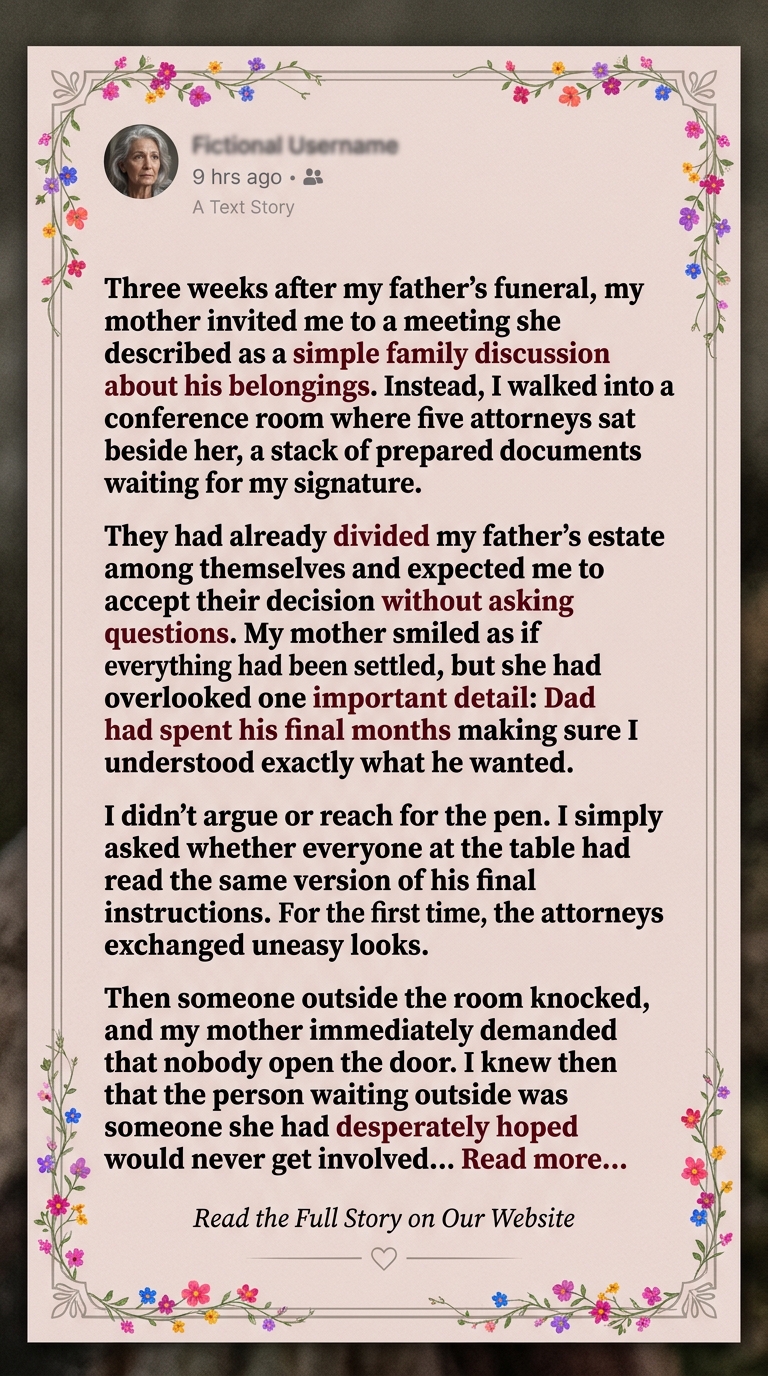
Three weeks after my father’s funeral, my mother called and asked me to attend a family meeting.
“It’s just about sorting out your father’s belongings,” she explained. “Nothing complicated. We need to make a few decisions before the estate becomes difficult to manage.”
Her voice sounded unusually warm. We hadn’t spoken much since Dad died, but I assumed grief had made her more willing to put our differences aside.
I agreed to meet her the following Thursday.
When I arrived at the address she sent, I discovered it wasn’t a family home or a solicitor’s office. It was a conference room in a downtown legal building.
My mother, Helen, sat at the head of a long table. Beside her were my older brother, Martin, my younger sister, Claire, and five attorneys.
Five.
A stack of documents had been placed in front of the empty chair opposite my mother. A fountain pen rested neatly on top.
I stopped in the doorway.
“What’s all this?”
My mother gave me a practiced smile.
“Please sit down, Anna. We have a lot to get through.”
One of the attorneys introduced himself as Mr. Caldwell, the solicitor handling my father’s estate. He explained that the meeting concerned the distribution of the family assets and that several documents needed to be signed before the transfer process could proceed.
I glanced at the papers.
The first page was titled Deed of Family Settlement. The next contained a list of properties, investments, and personal assets.
My father’s estate was worth considerably more than I had expected. He had owned two rental properties, a small commercial building, several investment accounts, and the house where my parents had lived for almost thirty years.
The documents assigned the house and most of the investments to my mother. Martin was to receive the commercial building, while Claire would receive the rental properties.
My name appeared near the bottom.
I was being offered a fixed payment of $25,000 in exchange for releasing any claim to the remaining estate.
I read the figure twice.
“Is this supposed to be my inheritance?”
My mother folded her hands.
“Your father wanted everyone to be treated fairly.”
I looked at the document again.
“Then why are Martin and Claire receiving the properties, while I’m being asked to accept twenty-five thousand dollars?”
Martin leaned back in his chair.
“You’ve always had a stable career, Anna. Claire has children, and I have been handling Dad’s business affairs for years. It makes sense.”
Claire nodded.
“We’re not trying to hurt you.”
I looked at the five attorneys.
“Did all of you prepare this arrangement?”
Mr. Caldwell answered carefully.
“The documents reflect the settlement proposed by the beneficiaries present.”
“Beneficiaries,” I repeated. “Does that mean the will has already been read?”
My mother smiled.
“We’re trying to avoid an unnecessary argument. Your father wouldn’t have wanted us fighting.”
I had heard that sentence several times during the final months of Dad’s life.
It had always been used to end conversations whenever someone questioned my mother’s decisions.
But Dad had spent those months telling me something very different.
My father, George Bennett, had been a quiet man. He wasn’t wealthy when he married my mother, and he never enjoyed discussing money. He built his business slowly, starting with a small electrical supply shop and eventually expanding into commercial property management.
Martin had worked with him for several years. Claire had helped with administrative tasks whenever she needed extra income.
I had taken a different path. I became a physical therapist and eventually managed a rehabilitation clinic.
Because I wasn’t involved in the family business, my mother often described me as the child who had chosen to leave the family behind.
That wasn’t entirely true.
I visited regularly. I helped Dad with medical appointments and spent many weekends at their house. During his final illness, I was the one who drove him to treatment, organized his medication, and stayed overnight when my mother needed rest.
Martin visited when business allowed. Claire came with her children, usually on Sundays.
I never complained. Dad understood our different responsibilities.
But during his final months, he began asking me to sit with him privately.
One afternoon, while we were waiting for a nurse, he asked whether I still had the notebook he had given me years earlier.
It was a small black notebook containing contact information for his accountant, insurance adviser, and solicitor.
I told him I did.
“Keep it somewhere safe,” he said. “And don’t sign anything anyone puts in front of you just because they tell you it’s what I wanted.”
I laughed softly.
“Dad, nobody is going to make me sign something without reading it.”
He didn’t laugh.
“Your mother is worried about what will happen when I’m gone. Martin is worried about the business. Claire is worried about money. I don’t blame them for being concerned, but I need you to understand that concern and entitlement aren’t the same thing.”
I asked what he meant.
He told me he had recently reviewed his estate arrangements with his solicitor. He had discovered that several family members had made assumptions about what they would inherit.
He didn’t want those assumptions to become arguments after his death.
“There’s a reason I’m telling you this,” he said. “I want you to know what I decided, not what someone later claims I decided.”
I asked him to explain.
He promised he would, but his condition deteriorated before we could finish that conversation.
Two days before he died, he asked me to bring the black notebook to his room.
He opened it to a page with a name and a telephone number written in his own handwriting.
“Call this person if anyone tells you the estate has already been divided,” he said.
I looked at the name.
It was Evelyn Shaw, an independent solicitor who had represented him for nearly fifteen years.
“Why would I need to call her?”
“Because she knows what I signed, and she knows why.”
He squeezed my hand.
“Don’t fight your mother, Anna. Just make sure the truth has a chance to be heard.”
Now, sitting in the conference room, I understood why he had been so insistent.
I placed the settlement document on the table.
“Before I sign anything, I’d like to see the original will and the final instructions Dad gave his solicitor.”
My mother sighed.
“We’ve already been through all that.”
“Then it should be easy to provide them.”
Mr. Caldwell adjusted his glasses.
“The will has not yet been formally admitted to probate. We are discussing a proposed family settlement intended to simplify the administration.”
“Then why does this document say I release all claims to the estate?”
“Because the settlement requires agreement from all parties.”
I turned to my mother.
“You invited me here to discuss Dad’s belongings. You didn’t tell me you wanted me to surrender my inheritance.”
Her smile disappeared.
“Don’t make this difficult.”
I looked at the five attorneys.
“Has anyone here read the same version of my father’s final instructions?”
The room fell silent.
One attorney looked toward Mr. Caldwell. Another turned a page in the folder in front of him.
My mother straightened.
“There’s no need to bring up documents that have nothing to do with this settlement.”
That was when I heard the knock.
Three firm taps against the conference-room door.
My mother immediately turned toward the nearest attorney.
“Don’t open that.”
The attorney looked confused.
“Mrs. Bennett?”
“I said don’t open it. We are in the middle of a private meeting.”
The knocking came again.
I recognized the voice outside.
“Anna? It’s Evelyn Shaw. I believe I’m expected.”
My mother stood so quickly that her chair scraped against the floor.
“No. This is a family matter.”
Mr. Caldwell looked at her.
“Mrs. Bennett, Ms. Shaw is the solicitor named in the estate file.”
My mother turned toward him.
“She has no reason to be here.”
I looked at the door.
“Actually, she has every reason.”
The attorney closest to the entrance opened it.
Evelyn Shaw stepped inside carrying a leather document case. She was in her early sixties, with short silver hair and a calm expression.
She greeted me first.
“Anna. I’m sorry we had to meet under these circumstances.”
Then she looked at my mother.
“Hello, Helen.”
My mother’s face had gone pale.
Evelyn placed her case on the table.
“I understand you’ve been discussing a family settlement.”
Mr. Caldwell stood.
“Ms. Shaw, we were not informed that you would attend.”
“I was informed that a meeting had been arranged in which my client’s daughter would be asked to sign away her rights without being provided with the complete estate documents. I felt it was appropriate to be present.”
My mother shook her head.
“This is unnecessary. George’s wishes were perfectly clear.”
Evelyn opened her case.
“Then we should have no difficulty reviewing them.”
She removed a sealed envelope and placed it in front of Mr. Caldwell.
It bore my father’s signature and the date of his final estate review.
“Mr. Bennett executed a new will four months before his death,” she explained. “It was properly witnessed and accompanied by an independent medical assessment confirming that he understood the nature and consequences of his decisions.”
Martin shifted in his chair.
“What new will?”
Evelyn looked at him.
“The will your father signed after discovering that several assumptions had been made about his estate.”
My mother reached for the envelope.
Evelyn moved it away.
“I’ll ask that you let me explain before anyone handles these documents.”
She opened the envelope and distributed copies of the will.
I read the first page.
My father had left my mother the right to live in their home for the rest of her life, along with sufficient income to maintain it. He had also left her a substantial cash provision and ownership of her personal belongings.
Martin was to receive a smaller cash inheritance, but he would not receive the commercial building. Claire would receive a separate financial provision and a fund for her children’s education.
The commercial building and both rental properties were to be placed into a managed family trust.
I was named as the trust’s first independent administrator.
I looked up.
“Why me?”
Evelyn answered.
“Your father wanted someone who was not financially dependent on the business and who would not personally benefit from selling the properties. He believed you were the person most likely to protect the long-term interests of the family.”
Martin let out a short laugh.
“She doesn’t know anything about property management.”
“That is why the trust appoints a professional property manager,” Evelyn replied. “Your role is oversight, not day-to-day management.”
She turned another page.
The trust would provide regular income for my mother’s living expenses, preserve the rental properties, and fund the education of Dad’s grandchildren.
The commercial building would continue operating as a business property, with its rental income supporting the trust.
I noticed another provision.
My father had specifically prohibited any beneficiary from using the trust’s assets as collateral for personal borrowing or transferring ownership to a private company.
I looked toward Martin.
His expression had changed.
“Why did Dad include that?” I asked.
Evelyn didn’t answer immediately.
Instead, she took out a second folder.
“Because he had discovered something concerning about the commercial building.”
My mother stood.
“This has nothing to do with the inheritance.”
“It has everything to do with the estate,” Evelyn replied.
She placed several pages on the table.
They were copies of financial statements and correspondence involving the company that managed the commercial building.
Six months before his death, my father had learned that Martin had entered negotiations with a property investment group. Martin had been discussing a long-term lease and a possible sale of the building, presenting himself as someone with authority to make decisions on behalf of the family business.
But the building was owned personally by my father, not by the company Martin managed.
Martin had no authority to sell it.
The investment group had been told that my father was too ill to manage his affairs and that the family had already agreed to the transaction.
That was not true.
My father had discovered the negotiations and immediately instructed Evelyn to review the situation.
She had sent a formal notice to the investment group confirming that Martin had no authority to transfer or encumber the property.
The proposed transaction had stopped.
I looked at my brother.
“Were you planning to sell Dad’s building?”
Martin’s face reddened.
“It was an opportunity. I was trying to improve the family’s financial position.”
“You told the buyers you had authority.”
“Dad was sick. Someone had to make decisions.”
“Dad was still capable of making his own decisions.”
Martin turned toward Evelyn.
“Why are you bringing this up now?”
“Because your father’s will specifically addresses the risk of unauthorized transactions involving his properties.”
My mother stepped in.
“Martin was only trying to help. George knew how difficult things were for him.”
Evelyn looked at her.
“Your husband knew exactly how difficult things were. That is why he changed the estate arrangements.”
Then she revealed the detail that made the five attorneys exchange uneasy looks.
The family settlement my mother had prepared was based on an earlier draft of my father’s will.
It was not the final version.
That earlier draft had been signed almost a year before his death, when he still intended to leave the commercial building to Martin and the rental properties to Claire.
But the draft had been formally revoked when the new will was executed.
The original solicitor’s office had sent written notice of the change to the estate’s nominated representatives.
Mr. Caldwell examined the correspondence.
“This letter is dated four months before Mr. Bennett’s death,” he said.
“Yes,” Evelyn replied.
He read it again.
“Why wasn’t this included in the estate file you received?”
My mother looked away.
Evelyn turned toward her.
“That is a question I would also like answered.”
My mother sat down.
“I thought George might change his mind again. He was confused by the medication sometimes.”
Evelyn’s expression remained steady.
“Your husband underwent an independent capacity assessment. He was found capable of understanding his estate decisions. He also recorded a private explanation of his wishes with my office.”
She placed a small digital recorder on the table.
My mother stared at it.
“No.”
Evelyn pressed play.
My father’s voice filled the room.
It was weaker than I remembered, but unmistakably his.
“My name is George Bennett. I’m making this recording because I want there to be no misunderstanding about my final estate arrangements.”
He explained that he had revised his will after learning about the attempted property negotiations. He said he wanted to protect my mother from financial uncertainty while preventing the family business from becoming a source of conflict.
He also explained why he had chosen me as the trust administrator.
“Anna has never asked me for money. She has never tried to influence my decisions about the business. When I became ill, she helped me because she wanted to, not because she expected anything in return.”
I felt my eyes fill.
He continued.
“I know Martin will be disappointed. I know Claire may feel that I have not given her enough. I don’t want either of them to believe that my decisions are a judgment of their worth. But I will not reward pressure or allow anyone to treat my illness as an opportunity to take control of what I built.”
The recording ended.
Nobody moved.
Then my father spoke again in a second recording.
This one was shorter.
“If my family is gathered together and someone is being asked to sign a settlement before the final will has been presented, I want Evelyn to attend. I do not want Anna pressured into accepting less than I have decided to leave her.”
My mother covered her mouth.
Martin pushed his chair back.
“This is ridiculous. Dad was being influenced.”
Evelyn closed the folder.
“Mr. Bennett’s solicitor, accountant, and independent medical assessor all documented the circumstances of the new will. If you believe it was improperly executed, you are entitled to seek legal advice and challenge it through the appropriate process. But you cannot simply substitute an earlier draft because you prefer its provisions.”
One of the attorneys at the far end of the table spoke.
“Mr. Caldwell, we need to review the engagement instructions and the documents supplied to us before this meeting.”
Mr. Caldwell nodded.
“Agreed.”
The meeting that my mother had arranged to secure my signature was effectively over.
I stood and gathered my belongings.
My mother looked at me.
“Anna, please don’t leave like this. We’re still family.”
I paused.
“Then why did you arrange a meeting where I was expected to sign away my inheritance without seeing Dad’s final will?”
She began to cry.
“I was trying to keep everything together.”
“You were trying to decide everything before I knew what Dad had actually written.”
Martin stood.
“You’re going to let some solicitor take control of the family?”
I turned toward him.
“No. Dad made the decision. Evelyn is making sure it’s respected.”
I left the conference room with her.
Outside, I asked whether the trust would be difficult to administer.
“It will require careful oversight,” she said. “Your father knew that. He selected an independent accounting firm and a professional property manager. You won’t be expected to manage everything alone.”
“Why didn’t he tell me more?”
Evelyn thought for a moment.
“He wanted you to understand your responsibilities, not spend his final months worrying about a family dispute. He also hoped the revised arrangements would prevent one.”
I looked down at the copy of the will in my hands.
“Did he know my mother would try to use the old draft?”
“He suspected she might. He didn’t want to believe she would go that far.”
The following weeks were difficult.
My mother accused Evelyn of manipulating my father. Martin threatened to challenge the will. Claire initially supported them, but after reading the complete estate documents, she began asking questions about the education fund and the rental properties.
The estate was eventually submitted for probate.
Martin did file a challenge, claiming that Dad had been under pressure when he revised the will. However, the independent medical assessment, solicitor’s notes, witness statements, and recorded explanation supported the validity of the final document.
The court accepted the will.
The proposed family settlement was withdrawn.
During the review, investigators also examined the attempted commercial property transaction. The investment group confirmed that Martin had represented himself as having authority to negotiate the sale. He had not received any payment, but his conduct had caused the company to incur legal and administrative costs.
The family business removed him from property negotiations and required independent approval for future transactions.
It was a painful consequence, but it was not the end of his life or career.
Claire eventually accepted her education provision and cash inheritance. She admitted that she had signed the original family settlement without asking to see the final will because our mother had told her Dad wanted everything divided equally.
She apologized for not questioning it.
My mother never apologized directly.
For a while, she refused to speak to me. Then, one afternoon, she called and asked whether she could visit.
I agreed.
She arrived carrying a small box of my father’s photographs. We sat at my kitchen table, and she placed the box between us.
“I found these while sorting his study,” she said.
I opened it.
There were photographs from my childhood, pictures of Dad at the electrical supply shop, and several of us together at family gatherings.
At the bottom was a photograph of Dad and me standing outside the rehabilitation clinic where I worked. He had attended its opening ceremony and looked enormously proud.
My mother touched the photograph.
“He always said you were the one who understood him.”
I didn’t answer.
She looked at me.
“I thought if we divided things before the lawyers became involved, we could avoid a long dispute.”
“You had five attorneys in the room.”
She lowered her eyes.
“I thought you would sign.”
“Why?”
“Because you were always the one who didn’t want arguments.”
I looked at her.
“That doesn’t mean I don’t deserve to know what my father wanted.”
She nodded.
For the first time, she seemed to understand that my silence in the conference room had not been weakness. It had been a decision not to let anyone rush me into surrendering something my father had deliberately entrusted to me.
“I don’t know how to make this right,” she said.
“You don’t have to make it right in one conversation. But you need to stop treating me as though asking questions means I’m attacking the family.”
She stayed for another hour.
We didn’t resolve everything, but the conversation was honest.
Over the following year, I learned how to administer the trust. The professional manager handled the properties, while an independent accountant prepared quarterly reports. I reviewed the figures, approved necessary maintenance, and ensured the education fund was distributed according to Dad’s instructions.
Martin eventually accepted that the commercial building would remain in the trust. He continued working in a different part of the family business under independent supervision. Our relationship became more distant, but we were able to speak without turning every conversation into an argument about money.
Claire’s children received the first education payments. She sent me a photograph of them holding their school acceptance letters.
My mother continued living in the family home, supported by the income Dad had provided for her. I visited occasionally, though our relationship remained cautious.
One evening, while reviewing the trust’s annual report, I found a handwritten note Evelyn had included with the original documents.
It was from my father.
Anna, if you are reading this, I hope you understand that I didn’t choose you because you were the easiest person to trust. I chose you because you never believed that loving someone meant giving them whatever they demanded.
I read it several times.
Then I placed it in the black notebook he had asked me to keep.
My father had known that his final decisions might disappoint people. He had also known that I might be pressured to undo them.
He hadn’t left me a fortune simply to make my life comfortable.
He had left me a responsibility, and he had trusted me to carry it without confusing family loyalty with blind obedience.
Three weeks after his funeral, my mother had expected me to enter a conference room, accept what others had decided, and sign my name at the bottom of a page.
Instead, I had asked one question.
It was the question my father had spent his final months teaching me to ask:
Had everyone actually read what he wanted, or were they simply counting on me never finding out?