“No. Tell Me What You Were Afraid Of.”
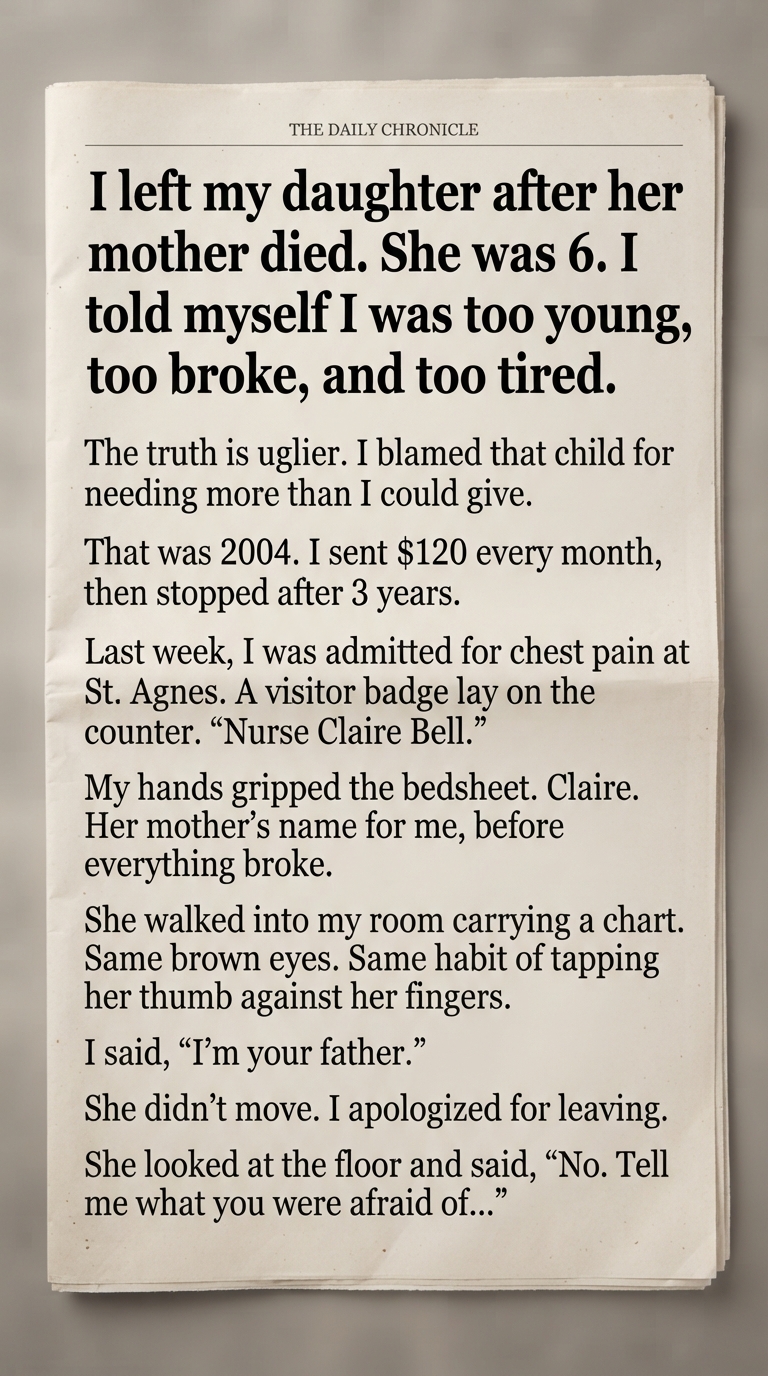
I left my daughter after her mother died.
She was six.
I told myself I was too young, too broke, and too tired.
The truth was uglier.
I blamed that child for needing more than I could give.
That was 2004.
I sent $120 every month for three years.
Then I stopped.
I never called again.
Last week, I was admitted to St. Agnes Hospital for chest pain.
A visitor badge lay on the counter.
Nurse Claire Bell.
My hands gripped the bedsheet.
Claire.
Her mother’s name for me, before everything broke.
She walked into my room carrying a chart.
Same brown eyes.
Same habit of tapping her thumb against her fingers when she was nervous.
I stared at her.
She stared at me.
For thirty-four years, I had imagined this moment.
Sometimes she was screaming.
Sometimes she was crying.
Sometimes she walked away without saying anything.
I had never imagined her wearing a nurse’s uniform.
I whispered, “I’m your father.”
She didn’t move.
I apologized for leaving.
She looked at the floor and said:
“No.”
My throat tightened.
“No?”
“Don’t apologize yet.”
She pulled the chair beside my bed closer.
“Tell me what you were afraid of.”
I couldn’t answer.
She looked at me.
“What were you afraid of, Dad?”
I swallowed.
And for the first time in my life, I told the truth.
“I was afraid that if I stayed, I’d fail you every day.”
Claire’s face didn’t change.
“So you failed me once and left?”
I closed my eyes.
“Yes.”
She nodded slowly.
“That makes more sense.”
Somehow, that hurt worse than anger would have.
Her mother, Maria, had been twenty-eight when she died.
A sudden infection.
Three days in the hospital.
Three days of doctors telling me they were trying everything.
Then one morning, a doctor came into the waiting room and asked me to sit down.
I already knew.
Maria was gone.
Claire was six.
She was asleep at her grandmother’s house.
I remember driving there afterward.
I remember standing outside the door.
I remember hearing Claire laughing inside.
Her grandmother opened the door.
“She thinks her mother is coming home tomorrow,” she said.
I couldn’t breathe.
I looked at that little girl and thought:
I can’t do this.
Not:
How do I do this?
Not:
What does she need?
Just:
I can’t.
I was twenty-nine.
I worked construction.
We were already behind on bills.
The house had a mortgage.
The car needed repairs.
Maria had been the one who organized everything.
School.
Doctors.
Groceries.
Birthdays.
Clothes.
I had been the father who came home tired and said, “Ask your mother.”
Then suddenly there was no mother to ask.
And I was terrified.
A week after Maria’s funeral, I moved into a rented room.
I told myself it was temporary.
I told myself I needed time to get stable.
I told myself Claire would be better with her grandmother.
All of those things sounded reasonable.
The real reason was simpler.
I didn’t want to be responsible for a six-year-old who needed me every minute.
So I left.
For the first three years, I sent money.
$120 every month.
Sometimes $150.
Once, when I got overtime, I sent $200.
I wrote checks.
Never letters.
Never birthday cards.
Never Christmas presents.
I told myself the money proved I hadn’t abandoned her.
It didn’t.
It only proved I knew I had.
Then, in 2007, I lost my job.
I told myself I couldn’t afford the payments anymore.
So I stopped.
And after a few months, something frightening happened.
Life became easier.
No monthly reminder.
No guilt every time I opened my bank account.
No reason to think about the little girl I’d left behind.
I started dating.
Eventually, I married again.
I built a different life.
And I became very good at pretending the first one had never happened.
Until last week.
Claire sat beside my hospital bed.
“You knew my name,” she said.
“Yes.”
“How?”
“I saw your badge.”
She nodded.
“Did you know I became a nurse?”
“No.”
“Did you know where I went to school?”
“No.”
“Did you know I got married?”
I shook my head.
“Do you know anything about me?”
I looked down.
“No.”
She was quiet.
Then she asked:
“Do you know what I remember?”
I couldn’t speak.
“I remember waiting at the window.”
My chest tightened.
“I would sit there after school.”
She rubbed her thumb against her fingers.
“Grandma told me you were working.”
I closed my eyes.
“She said you were trying to save money.”
“I was.”
Claire looked at me.
“I know.”
That surprised me.
“You do?”
“I know why people leave.”
Her voice was calm.
Too calm.
“I’ve taken care of patients who were terrified of becoming parents. I’ve taken care of people who couldn’t handle grief. I’ve watched people make terrible choices because they were scared.”
She looked at me.
“But knowing why doesn’t erase what happened.”
“I know.”
“Do you?”
“Yes.”
She leaned back.
“When I was eight, I thought you were coming back.”
I felt tears burn my eyes.
“When I was ten, I thought you had died.”
I looked at her.
“When I was twelve, I decided you didn’t want me.”
She paused.
“When I was fifteen, I stopped wondering.”
I whispered, “I’m sorry.”
She shook her head.
“You keep saying that.”
“Because I am.”
“That’s not what I asked.”
I looked at her.
She said:
“What were you afraid of?”
I stared at the ceiling.
Then finally answered.
“Being your father.”
She frowned.
“I was afraid you’d need things I couldn’t give you.”
“Like what?”
“Love.”
She stared at me.
I continued.
“Patience. Money. Stability. I was afraid you’d look at me one day and realize I wasn’t enough.”
Claire’s eyes filled.
“So you made sure I never got the chance.”
“Yes.”
She looked away.
I cried.
A grown man.
In a hospital bed.
Crying in front of the daughter I had abandoned.
And she didn’t comfort me.
She shouldn’t have.
This wasn’t about making me feel better.
After a few minutes, Claire stood.
“I have patients.”
“Of course.”
She reached the door.
“Claire?”
She stopped.
“Can I see you again?”
She didn’t turn around.
“I don’t know.”
“That’s fair.”
She nodded.
Then left.
The door closed.
I stared at it for a long time.
And for the first time since I’d arrived at the hospital, I wasn’t afraid of dying.
I was afraid of living long enough to understand what I’d done.
The next morning, Claire came back.
She didn’t enter my room immediately.
She stood in the doorway.
“You’re being discharged tomorrow.”
“I know.”
“Your tests look better.”
“Good.”
She nodded.
Then she said:
“I found something.”
My heart stopped.
“What?”
She pulled an envelope from her pocket.
It was old.
Bent at the corners.
My name was written on the front.
Dad.
I stared.
“I wrote this when I was nine.”
My hands trembled.
“I never sent it.”
“Why?”
“I didn’t know where you lived.”
I opened it carefully.
The handwriting was uneven.
Childlike.
The first sentence said:
Dear Dad, Grandma says you’re working very hard.
I had to stop reading.
Claire watched me.
“Keep going.”
I continued.
I got an A in spelling. Mom would be proud.
Then:
I don’t know why you don’t come. I think maybe you’re sad. I’m sad too.
My vision blurred.
At the bottom:
If you come back, I won’t be mad.
I couldn’t read anymore.
I pressed the letter against my chest.
Claire looked out the window.
“I carried that letter for twenty-seven years.”
“Why?”
“I don’t know.”
She turned toward me.
“Maybe I was waiting to see if I’d ever need it.”
I whispered, “Thank you.”
She nodded.
The following week, I left the hospital.
I expected never to see her again.
Instead, three days later, she called.
“Dad?”
I froze.
“Yes?”
“Are you home?”
“Yes.”
“Good.”
There was silence.
Then she said:
“I’m off Thursday.”
My heart started beating faster.
“Okay.”
“Would you like coffee?”
I smiled.
“Yes.”
“There’s a diner near the hospital.”
“I’ll be there.”
She hesitated.
“Don’t be late.”
“I won’t.”
She hung up.
I sat at my kitchen table for several minutes.
Then I laughed.
Not because anything was funny.
Because after thirty-four years, my daughter had given me an appointment.
And I was terrified of missing it.
She arrived five minutes late.
I stood when she entered.
She smiled faintly.
“Hi.”
“Hi.”
We sat across from each other.
For the first ten minutes, we talked about harmless things.
Coffee.
Traffic.
The weather.
Then Claire said:
“Do you want to know why I became a nurse?”
“Yes.”
“Because of Grandma.”
I nodded.
“She took care of me after you left.”
“I know.”
“No, you don’t.”
She looked down.
“She never made me feel abandoned.”
My throat tightened.
“She told me something when I was fourteen.”
“What?”
Claire smiled.
“She said, ‘People can fail you without deciding your worth.’”
I looked at her.
“Your grandmother was a good woman.”
“She was.”
We were quiet.
Then Claire reached across the table.
She didn’t hug me.
She didn’t forgive me.
She simply placed her hand over mine.
“I’m not ready to call you Dad every day.”
I nodded.
“But I don’t want you to disappear again.”
My eyes filled.
“I won’t.”
She squeezed my hand.
“Good.”
A year passed.
Our relationship was slow.
Painfully slow.
There were weeks when she didn’t call.
There were days when I wanted to ask questions she wasn’t ready to answer.
I learned not to push.
I learned that being her father didn’t mean demanding a place in her life.
It meant earning one.
I remembered her birthday.
I sent flowers.
She sent me a picture of them.
I asked about her job.
She told me about difficult patients.
I listened.
I didn’t try to fix everything.
I just listened.
One Christmas, she invited me to her house.
There were three generations around the table.
Claire.
Her husband.
Their little boy.
And me.
Her son was four.
He climbed onto my lap after dinner.
“Grandpa?”
I froze.
Claire looked at me from across the room.
She smiled.
I looked down at the little boy.
“Yes?”
“Can you read me a story?”
My voice broke.
“Of course.”
I opened the book.
My hands shook so badly that Claire noticed.
Afterward, she came into the kitchen.
“You okay?”
I nodded.
“Yeah.”
She leaned against the counter.
“You’re a pretty good grandfather.”
I laughed.
“I’m trying.”
She smiled.
“That’s the part that matters.”
Years later, I asked her why she had come back to my hospital room.
She was sitting beside me on the porch.
Her son was playing in the yard.
She thought for a while.
“Because you were sick.”
“That’s all?”
“No.”
She looked at me.
“Because I realized something.”
“What?”
“I spent my whole life wondering why you left.”
“And?”
“And when I saw you in that hospital bed, you looked old.”
I laughed.
“Thanks.”
She smiled.
“I realized I didn’t want my last memory of you to be a man who walked away.”
I looked at her.
“I wanted to know the man who was afraid.”
My eyes filled.
She continued:
“Not because it excuses what you did.”
“I know.”
“But because understanding someone is different from forgiving them.”
I nodded.
She squeezed my hand.
“And eventually, Dad, I did forgive you.”
I couldn’t speak.
She smiled.
“Not all at once.”
“I know.”
“But I did.”
I looked toward the yard.
Her son was now taller than I was.
Life had kept moving while I was gone.
I had missed first steps.
First words.
First day of school.
Graduation.
Her wedding.
The birth of her son.
So many moments that could never be returned.
Forgiveness hadn’t erased any of that.
It had simply allowed us to stop losing time.
Claire stood.
“Dinner’s ready.”
I smiled.
“I’ll help.”
She looked at me.
“You know, Dad…”
“Yes?”
“You don’t have to earn every moment anymore.”
I looked at my daughter.
The little six-year-old I had once abandoned.
The nurse who had walked into my hospital room.
The woman who had spent decades carrying a letter she never sent.
I nodded.
“I know.”
And I finally understood what she had been trying to teach me from the beginning.
I had spent my whole life believing that being a good father meant being strong enough to provide everything.
But children don’t need perfect fathers.
They need fathers who stay.
Who listen.
Who admit when they’re wrong.
Who come back when they fail.
I couldn’t give Claire back her childhood.
I couldn’t erase the empty chair at school plays or the birthdays when she looked toward the door.
But I could give her something I should have given her in 2004.
My presence.
Every ordinary day.
Every cup of coffee.
Every phone call.
Every family dinner.
Every moment I was still lucky enough to have.
And when Claire walked inside, she called over her shoulder:
“Dad, are you coming?”
I smiled.
“Yes.”
This time, I followed her home.