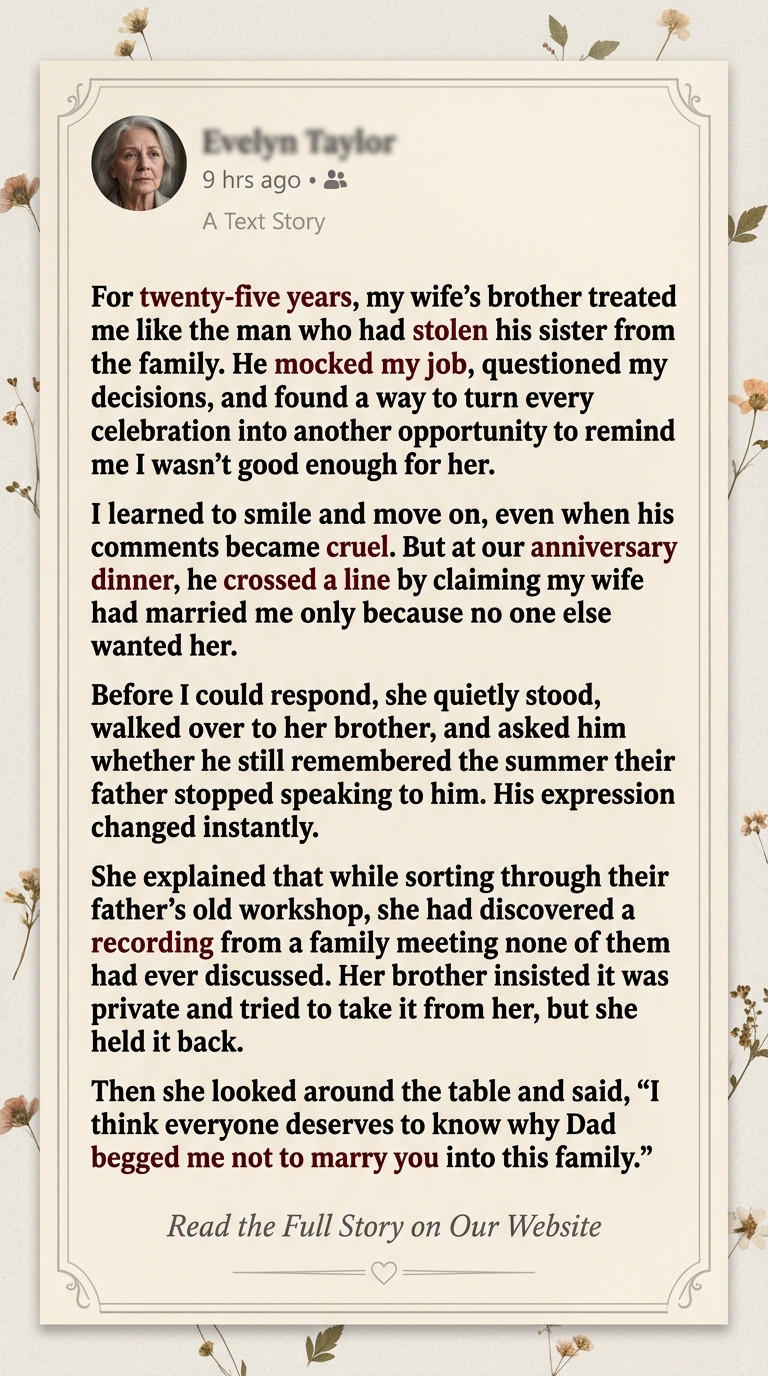
For twenty-five years, my wife’s older brother, Gregory, treated me as though I had committed some unforgivable crime by marrying his sister.
At first, I thought he simply needed time to accept me. When Laura introduced us, Gregory had been thirty-two, recently divorced, and convinced that nobody could ever be good enough for the youngest daughter of the family. I was twenty-nine, working as a maintenance supervisor at a manufacturing plant, and earning considerably less than he did as a regional sales director.
He made sure I knew the difference.
At our engagement dinner, he raised his glass and said, “Well, Laura, I suppose love really is blind.”
Everyone laughed except my wife.
At our wedding, he joked that she had traded a promising future for a man who spent his days fixing broken machines. When I was promoted, he asked whether the factory had finally run out of qualified people. When we bought our first house, he wanted to know how long it would take before we could afford a neighborhood with decent schools.
I learned to ignore him.
Laura always defended me, but she hated conflict with her brother. Their father had died when she was young, and Gregory had spent years acting as though he had become the head of the family. Their mother, Patricia, rarely challenged him. She believed keeping the peace was more important than correcting him.
So I smiled, changed the subject, and went home with my wife.
We built a good life. We raised two children, paid off our mortgage, traveled when we could, and celebrated twenty-five anniversaries together. Gregory attended most of those celebrations, and somehow managed to make each one feel like an examination I had never agreed to take.
I used to think his behavior came from jealousy or insecurity.
I was wrong about that.
The truth began to emerge on our twenty-fifth anniversary.
Laura had arranged dinner at a small private restaurant room with our children, her mother, Gregory, and a few close friends. It was supposed to be an uncomplicated evening. Our daughter had brought a framed photograph from our wedding, and our son had prepared a short toast.
For once, Gregory behaved himself during dinner.
Then the conversation turned to how quickly twenty-five years had passed.
Gregory leaned back in his chair, looked at me, and smiled.
“Honestly, I never thought you two would last this long,” he said. “Laura was always the family favorite. We expected her to marry someone with a little more ambition.”
My son lowered his glass.
Gregory continued.
“I suppose she was lucky nobody else wanted her badly enough to put up with her.”
The table went silent.
I felt my face grow hot. I had spent a quarter of a century absorbing his insults, but this one was different. He had insulted my wife in front of our children, reducing her entire life to a joke about settling for me.
I pushed my chair back.
Before I could speak, Laura stood.
She didn’t raise her voice. She didn’t look angry.
She simply walked around the table and stopped beside her brother.
“Gregory,” she said, “do you remember the summer Dad stopped speaking to you?”
His smile disappeared.
“Don’t start.”
“You remember it, don’t you?”
“Laura, sit down.”
She returned to her chair, opened her handbag, and removed a small digital recorder.
Gregory stared at it.
“Where did you get that?”
“Dad’s workshop. I found it while sorting through the old cabinets.”
He reached across the table.
“Give it to me.”
Laura moved it out of his reach.
“No.”
Their mother looked between them.
“What is this about?”
Laura placed the recorder beside the anniversary cake.
“It’s a recording of a family meeting from thirty years ago. Dad made it in his workshop because he wanted to remember exactly what was said. I found it with his old repair manuals and some documents he had kept.”
Gregory’s face had turned pale.
“That meeting was private.”
“It involved all of us,” Laura replied. “And apparently, it involved decisions that affected my entire life.”
I looked at my wife.
She had never mentioned finding a recording. She had spent several weekends cleaning out her father’s workshop after her mother decided to sell the property. I knew she had brought home old tools, photographs, and boxes of paperwork, but I hadn’t asked what else she had discovered.
“Laura,” I said gently, “what happened?”
She looked at me.
“Dad didn’t want me to marry Gregory’s friend, Martin. He didn’t want me to marry anyone Gregory chose. But that’s not what this recording is about.”
Gregory stood.
“That’s enough.”
“No,” Laura said. “You have spent twenty-five years treating my husband as if he stole me from you. I think everyone should understand why Dad once told me he was afraid of what you would do if I married someone you couldn’t control.”
She pressed play.
At first, there was only the sound of a chair moving and someone setting down a cup.
Then their father’s voice filled the room.
“Gregory, I asked you here because your sister deserves to know what you’ve been doing.”
A younger Gregory answered immediately.
“I haven’t done anything.”
Their father sighed.
“Don’t lie to me. I saw the invoices.”
A pause followed.
Then Gregory said, “Those were business expenses. You don’t understand how these things work.”
“I understand perfectly well. You used the family company account to pay for your personal debts.”
I glanced at Laura.
Her fingers were wrapped tightly around the edge of the table.
The recording continued.
Their father explained that Gregory had been working for the family’s small industrial supply business, which he had inherited from his own father. The company had been struggling, and their father had trusted Gregory to manage its finances while he recovered from a serious back injury.
Instead, Gregory had used company funds to cover personal loans, expensive holidays, and payments to a woman he had been seeing while married to his first wife.
The amounts were not small.
Their father had discovered the transactions after the company’s accountant questioned several payments that had no supporting invoices.
Gregory insisted the money was temporary borrowing.
“I was going to replace it,” he said on the recording.
“With what?” their father asked. “Another loan?”
“I had a plan.”
“You have been telling me that for eleven months.”
Then came a sound that made Patricia cover her mouth.
It was their father striking the table with his hand.
“I trusted you with this company. Your sister trusted you to help her. Your mother trusted you to keep this family together. And you’ve been using all three of us.”
Gregory’s recorded voice became quieter.
“You’re making me sound like a criminal.”
“I’m telling you what you did.”
Their father then explained that Gregory had also approached Laura’s fiancé at the time, a man named Martin, and asked him for money. Gregory had promised Martin that he would receive a position in the family business and a share of future profits if he helped cover the missing funds.
Martin had refused.
Instead, he had contacted their father and shown him the messages.
That was why their father had ended his relationship with Gregory for several months.
But the most painful part came afterward.
Gregory’s voice changed.
“You can’t tell Laura. She’ll never look at me the same way.”
Their father replied, “She deserves to know.”
“She’ll think I stole from her, too.”
“You did.”
Then Gregory said something that made everyone at the table turn toward him.
“If she marries someone outside this family, you’ll lose control of the business. You need me. If she marries someone who understands how this family works, we can keep things together.”
Their father answered slowly.
“Your sister is not a business asset, Gregory.”
The recording ended with a long silence.
Nobody spoke.
Laura switched off the recorder.
For several seconds, Gregory stood motionless. Then he reached for his jacket.
“You don’t know what you just did,” he said.
Laura looked up at him.
“I know exactly what I did.”
“You’ve embarrassed me in front of everyone.”
“You’ve embarrassed my husband in front of everyone for twenty-five years.”
“That was different.”
“How?”
He had no answer.
Patricia began to cry quietly. Our children looked stunned. I sat still, trying to understand how a disagreement that had supposedly been about my job, income, and suitability as a husband had actually begun with something much uglier.
Gregory finally turned to me.
“You should stay out of this. It has nothing to do with you.”
I looked at him.
“You made it my business every time you reminded me I wasn’t good enough for your sister.”
He opened his mouth, but Laura interrupted.
“Dad told me something else after that meeting. He said you had been trying to make me believe that every man who disagreed with you was trying to take me away from my family. He worried that one day you would use that fear to control my choices.”
Gregory shook his head.
“Dad was old-fashioned. He didn’t understand the pressure I was under.”
“Then explain the pressure,” Laura said. “Explain why you spent years telling everyone my husband was beneath me.”
Gregory looked around the table.
His eyes settled on his mother.
“Mom, tell them. You know what Dad was like. He always favored Laura.”
Patricia wiped her cheeks.
“I know your father made mistakes,” she said. “But he didn’t invent those invoices. I remember how frightened he was when he found them.”
Gregory stared at her.
“You knew?”
“I knew you had taken money. I didn’t know how much. Your father told me he had arranged for the company to recover what it could, and that you had promised to repay the rest.”
Gregory’s shoulders dropped.
For the first time that evening, he looked less angry than ashamed.
He left without saying goodbye.
The dinner ended shortly afterward. Our children helped clear the table while Laura and I sat together in the quiet restaurant room.
I finally asked the question that had been bothering me.
“Why didn’t you tell me about the recording before tonight?”
She looked down at her hands.
“Because I wanted to understand it first. I found it three weeks ago. I listened to it twice, then contacted the accountant who worked for Dad. I needed to know whether the things Gregory said were true.”
“And were they?”
“Most of them.”
She explained that her father’s old accountant, Mr. Lewis, had confirmed that Gregory had misused company funds. Their father had arranged a repayment agreement and removed him from financial control. Gregory had eventually repaid a portion of the money through a settlement, while the rest had been written off as a business loss when the company was sold.
Their father had never told Laura the full story because he feared she would feel responsible for what her brother had done.
But he had told her something else.
He had advised her not to let Gregory decide whom she loved, where she lived, or what kind of life she built.
“He said that a family should make room for the people who love you,” Laura whispered. “It shouldn’t demand that you prove your loyalty by sacrificing your happiness.”
I took her hand.
“Your father was right.”
She smiled faintly, but her eyes filled with tears.
“I wish he had been alive to say it tonight.”
Over the following weeks, Gregory tried to contact Laura several times. His first messages were angry, accusing her of humiliating him and turning their mother against him. She didn’t answer.
Eventually, he sent a longer message admitting that he had felt threatened when she married me.
He had expected her to remain close to him, to follow his advice, and to treat him as the person whose approval mattered most. When she built a life with someone who didn’t need his permission, he had felt replaced.
Instead of admitting that, he had attacked me.
His explanation did not excuse his behavior, but at least it was honest.
Laura agreed to meet him at their mother’s house.
I went with her, but waited in the garden while they spoke.
Their conversation lasted nearly two hours. I couldn’t hear every word, but I saw Gregory leave once, then return. At one point, Laura began crying. Later, Patricia came outside and sat beside me.
“They needed to say things they should have said years ago,” she told me.
When Laura finally came out, she looked exhausted.
“He apologized,” she said.
“Did you accept?”
“I told him I believed he was sorry. That doesn’t mean everything is fixed.”
She explained that she had made one condition clear: Gregory would no longer be allowed to insult me, undermine our marriage, or use family gatherings to establish his authority. If he wanted a relationship with her, he would have to treat her husband with basic respect.
Gregory agreed.
He also agreed to speak with a counselor and address the resentment he had carried for years.
The changes were not immediate. At our next family gathering, he barely spoke to me. But he didn’t make any jokes, either. A few months later, he asked whether I would help him repair an old workbench in his garage.
It was the first time he had ever asked me for help without making it sound like an insult.
We spent most of the afternoon replacing the damaged joints and sanding the surface. He didn’t suddenly become friendly, and I didn’t pretend the past hadn’t happened.
Before I left, he stood beside the workbench and said, “I owe you more than an apology.”
“Yes,” I replied. “You do.”
He nodded.
“I know.”
I didn’t offer him an easy forgiveness. Trust had to be rebuilt through behavior, not one conversation.
But I no longer felt the need to prove myself to him.
On our twenty-sixth anniversary, Laura and I celebrated quietly at home. Our children came for dinner, and Patricia brought a cake. Gregory arrived carrying a bottle of wine.
He placed it on the table and looked at me.
“I wanted to say something,” he began.
Laura raised an eyebrow.
He gave a small, uncomfortable smile.
“I’m not going to make a speech. I just want to say that I was wrong about you. I spent years blaming you for a choice my sister made freely. You didn’t steal her from anyone. She chose you, and she was happy. I should have respected that.”
I looked at Laura, then back at him.
“Thank you for saying it.”
He nodded and took his seat.
The evening continued without insults, arguments, or anyone trying to dominate the conversation.
Later, after everyone had gone, Laura and I stood together in the kitchen.
“Do you think Dad knew this would happen?” I asked.
She considered that for a moment.
“I think he knew Gregory needed to face what he had done. But I don’t think Dad wanted us to spend our lives fighting over it.”
She rested her head against my shoulder.
For twenty-five years, I had believed Gregory disliked me because he thought I wasn’t good enough for his sister.
Now I understood that he had resented me because I represented something he could never control: Laura’s freedom to choose her own life.
Our marriage had never needed his approval.
And after all those years, neither did I.