The Funeral Loan Wasn’t $8,500
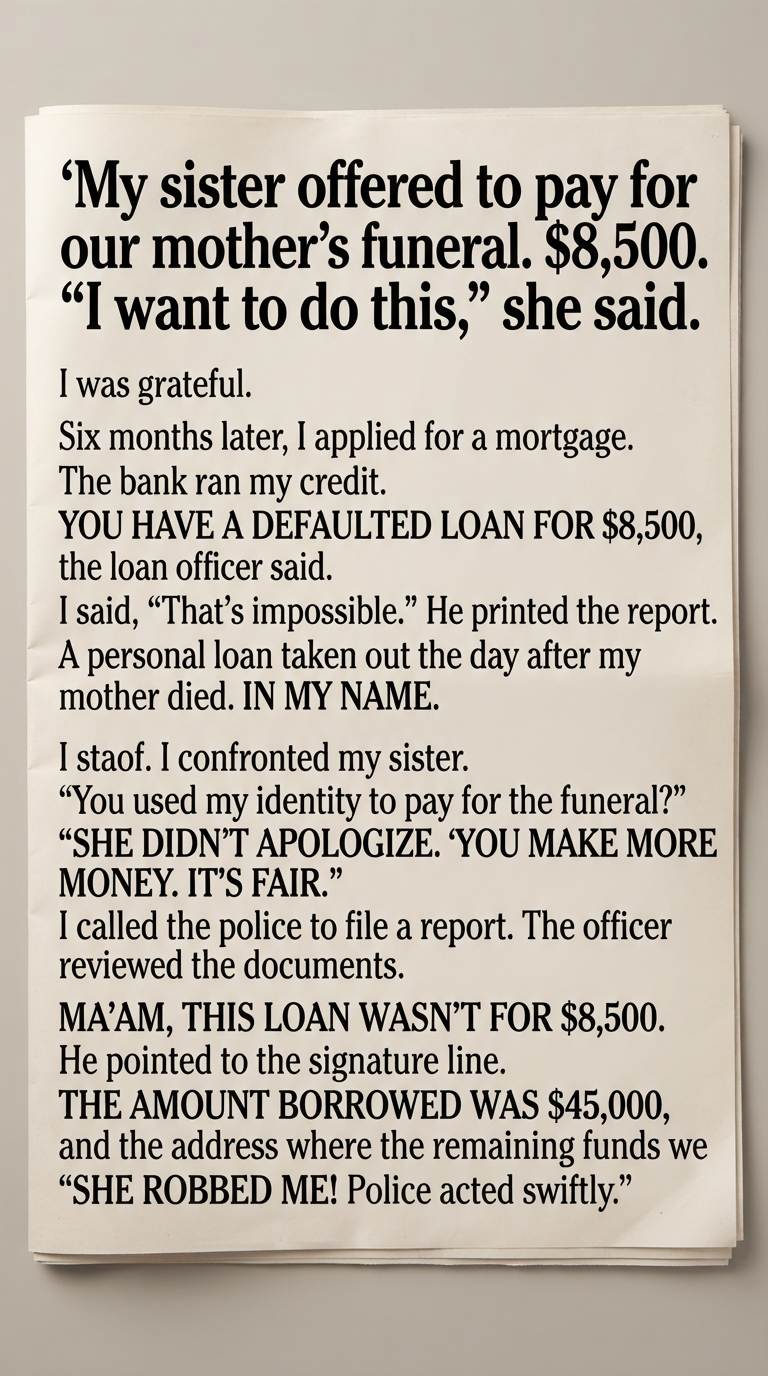
My sister offered to pay for our mother’s funeral.
“Eight thousand five hundred dollars,” she said.
“I want to do this.”
I was grateful.
At the time, I didn’t question anything.
Mom had just died.
I was exhausted, heartbroken, and barely functioning.
My sister, Rebecca, took care of the funeral home.
She chose the casket.
She arranged the flowers.
She handled the paperwork.
And when I asked how much everything cost, she simply said,
“$8,500.”
I hugged her.
“Thank you.”
She smiled.
“She’s our mother. It’s what family does.”
Six months later, I applied for a mortgage.
I’d spent years saving for a small house.
Nothing extravagant.
Just three bedrooms, a little backyard, and enough space for my daughter to have her own room.
I had excellent credit.
Or so I thought.
The loan officer looked at his computer.
Then he frowned.
He looked at me.
Then back at the screen.
“Ma’am, there’s a problem.”
“What kind of problem?”
“You have a defaulted personal loan.”
I laughed nervously.
“That can’t be right.”
He turned the monitor toward me.
The amount was:
$8,500.
My stomach tightened.
“What?”
“There’s a personal loan in your name. It’s currently in default.”
“I’ve never taken out a personal loan.”
He printed the report.
I stared at the page.
The loan had been opened the day after my mother’s funeral.
The borrower was listed as me.
My Social Security number was correct.
My date of birth was correct.
My address was correct.
And there was even a signature.
It looked like mine.
But it wasn’t.
I stared at it.
“Someone stole my identity.”
The loan officer nodded.
“You should contact the lender and file a police report.”
I left the bank shaking.
There was only one person I could think of.
Rebecca.
I drove straight to her house.
She opened the door with a smile.
“What are you doing here?”
I held up the report.
“You took out a loan in my name.”
Her smile disappeared.
“What?”
“Eight thousand five hundred dollars. The day after Mom’s funeral.”
Rebecca stared at the paper.
Then she sighed.
“I was going to tell you.”
“You used my identity to pay for the funeral?”
She crossed her arms.
“I paid for Mom’s funeral.”
“You stole my identity.”
“I didn’t steal anything.”
“You opened a loan in my name!”
She looked annoyed.
“You make more money than I do.”
I stared at her.
“What does that have to do with anything?”
“It was for Mom.”
“You could have asked me.”
“You wouldn’t have agreed.”
“Because it wasn’t my loan!”
She shrugged.
“You make more money. It’s fair.”
I couldn’t believe what I was hearing.
“Fair?”
“Yes.”
“You think stealing someone’s identity is fair?”
She rolled her eyes.
“Stop making this dramatic.”
I left.
I called the police.
An officer came to my house that evening.
I handed him the bank documents.
He examined them carefully.
Then he frowned.
“Ma’am, this loan wasn’t for $8,500.”
I stared at him.
“What?”
He pointed to the signature line.
“The original amount borrowed was $45,000.”
I couldn’t breathe.
“No.”
He turned the page.
“The $8,500 you’re seeing is what’s currently being reported on this particular account.”
“Where did the other $36,500 go?”
The officer pointed to an address on the loan application.
My blood ran cold.
It was not my address.
It wasn’t Rebecca’s either.
It was the address of a small investment property across town.
I recognized it.
My sister had mentioned it once.
She’d said it belonged to “a friend.”
I looked at the officer.
“She robbed me.”
He nodded.
“We need to investigate this immediately.”
The police acted swiftly.
They contacted the lender.
The lender provided the complete application.
It contained my information.
But the bank account receiving the money belonged to someone else.
A man named Kevin.
Kevin was Rebecca’s boyfriend.
The police searched the property.
Inside, they found furniture receipts.
Contractor invoices.
Appliance purchases.
And a folder containing copies of my driver’s license and Social Security card.
My identity.
My information.
My signature.
Everything.
But the biggest discovery was on Rebecca’s laptop.
There were emails between her and Kevin.
One read:
“She’ll never notice. Her credit is too good.”
Another said:
“Take the 45 and we’ll fix the funeral story later.”
And another:
“She thinks it was only 8,500.”
I sat in the police station reading those messages.
My hands were shaking.
It wasn’t about the funeral.
It had never been about the funeral.
The $8,500 was bait.
Rebecca had used my mother’s death as cover to steal $45,000.
The funeral was simply the explanation that would make the smaller amount seem believable.
She had counted on my grief.
She had counted on my trust.
And she had counted on me never checking.
The police arrested her and Kevin.
The lender froze the remaining accounts.
The mortgage company eventually removed the fraudulent loan from my credit report after the investigation confirmed I hadn’t authorized it.
But the damage went deeper than my credit score.
I lost my sister.
Not because she stole $45,000.
Because I finally understood that she had been willing to use our mother’s death to do it.
Months later, I attended the hearing.
Rebecca looked smaller than I remembered.
She wouldn’t look at me.
When the judge asked whether she understood the charges, she said yes.
Afterward, she approached me.
“I never meant for it to go this far.”
I looked at her.
“You used my identity.”
“I was desperate.”
“You stole $45,000.”
“I was going to pay it back.”
“You told me it was $8,500.”
She started crying.
“I didn’t know what else to do.”
I shook my head.
“You could have asked me.”
She said nothing.
I walked away.
A year later, I finally bought my house.
It wasn’t the house I’d originally planned to buy.
It was smaller.
Older.
But it had a little backyard.
And a porch.
My daughter chose the bedroom with the biggest window.
The first night we slept there, I sat outside with a cup of coffee.
I thought about Mom.
Then I thought about Rebecca.
And I realized something.
Losing my sister hurt.
But trusting her again would have hurt more.
My mother used to say,
“Money can be replaced. Trust can’t.”
I never understood how true that was until the person who betrayed me was someone who shared my childhood.
Today, I still have the funeral program from Mom’s service.
I keep it in a drawer.
The $8,500 funeral bill is in there too.
So is the police report showing the real amount:
$45,000.
Sometimes I look at those papers and think about how easily grief can make us blind.
I was so grateful that my sister had “paid for Mom’s funeral” that I never thought to ask how.
I trusted her because she was family.
But family isn’t defined by blood alone.
It’s defined by what someone does when you’re at your most vulnerable.
My sister saw my grief.
And instead of protecting me, she saw an opportunity.
That was the real theft.
She didn’t just steal $45,000.
She stole the last bit of trust I had in her.
And that was something no court could ever give back.