Maybe Now You’ll Obey
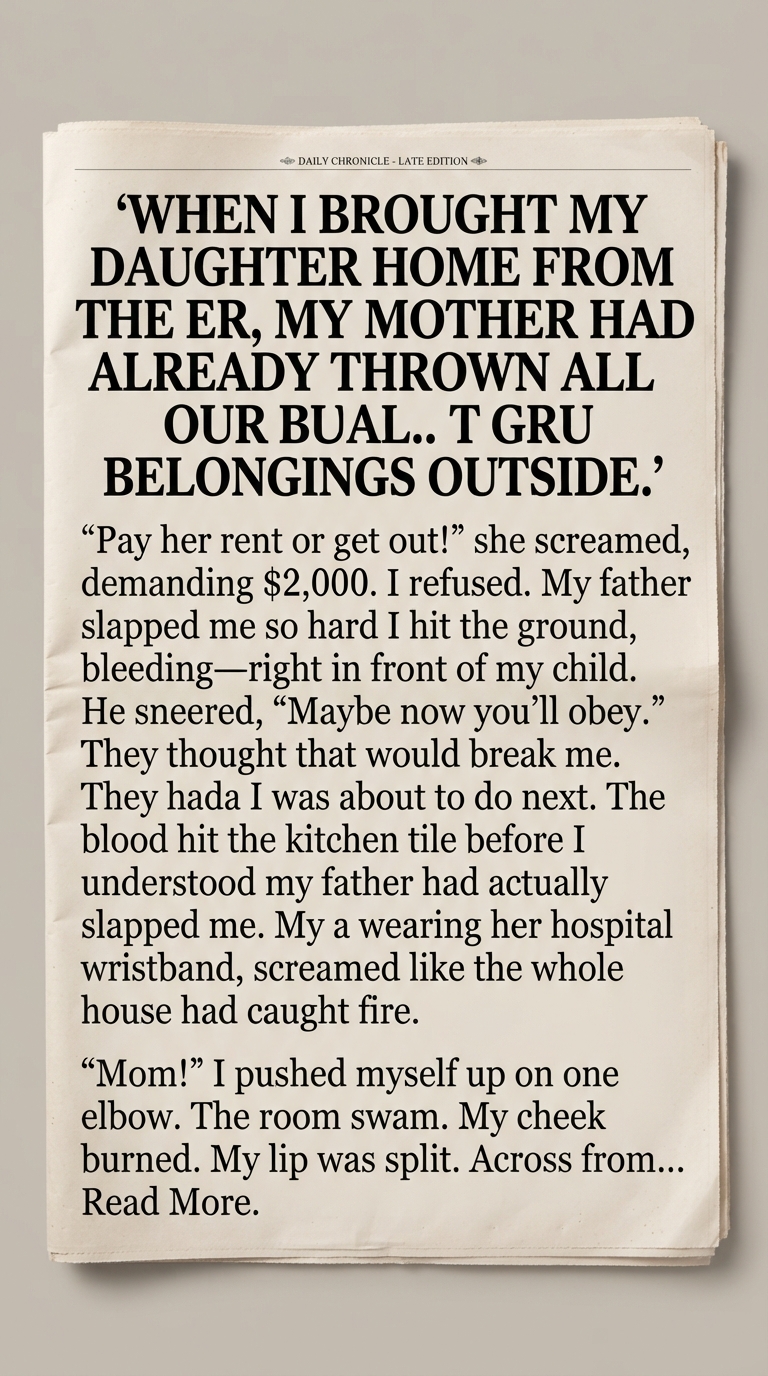
The blood hit the kitchen tile before I understood that my father had actually slapped me.
My daughter, still wearing her hospital wristband, screamed like the whole house had caught fire.
“Mom!”
I pushed myself up on one elbow.
The room swam.
My cheek burned.
My lip was split.
Across from me, my father stood with his hand still raised.
My mother stood beside him, arms crossed.
And behind them, our belongings were scattered across the front porch.
Clothes.
Toys.
My daughter’s school backpack.
The small suitcase we’d packed for the hospital.
Even the framed photograph of my late husband had been thrown onto the grass.
My father looked down at me without a trace of regret.
“Maybe now you’ll obey.”
My daughter ran toward me.
“Mommy!”
I pulled her against my chest.
“I’m okay, sweetheart.”
I wasn’t.
But she didn’t need to know that.
My mother pointed toward the door.
“I told you three times. Pay me the $2,000 you owe for rent, or get out.”
I stared at her.
“Mom, I’ve paid you every month.”
“Not enough.”
“I paid $900 last week.”
“That doesn’t count.”
“How doesn’t it count?”
“Because I raised you,” she snapped. “You owe this family more than money.”
I looked at my father.
“Dad?”
He shrugged.
“You heard your mother.”
Something inside me went very still.
Not broken.
Not defeated.
Still.
I looked around the kitchen where I’d grown up.
The same yellow cabinets.
The same refrigerator.
The same little crack in the tile near the sink.
I’d spent my entire childhood believing this was home.
Then I looked at my daughter.
She was seven years old.
She had been in the emergency room that afternoon after collapsing at school.
I’d spent six hours beside her hospital bed.
I had been terrified.
And when the doctor finally said she was stable and could go home, all I wanted was to bring her somewhere safe.
Instead, my parents had thrown us out.
And my father had hit me in front of her.
I wiped the blood from my mouth.
My mother pointed toward the porch.
“You have ten minutes.”
I didn’t answer.
I picked up my daughter.
Then I walked outside.
We sat on the curb beside our suitcases.
She was crying.
“Mom, are we homeless?”
I held her tighter.
“No.”
“Where are we going?”
I looked back at the house.
“For the first time in my life?”
I took a breath.
“Somewhere they can’t hurt us.”
That night, I booked a cheap motel.
I cleaned my daughter’s scraped knees.
I put ice against my cheek.
And after she fell asleep, I sat alone in the bathroom and looked at myself in the mirror.
My face was swollen.
There was blood on my collar.
But the worst part wasn’t the pain.
It was the realization that I’d spent years trying to earn love from people who had decided I owed them everything simply because they were my parents.
At 2:13 a.m., I opened my phone.
There was one message from my mother.
You should apologize to your father.
I stared at it.
Then another.
If you come back tomorrow and pay what you owe, maybe we’ll let you stay.
I laughed.
Quietly.
Because suddenly, I remembered something.
Something my parents had forgotten.
Three months earlier, Dad had asked me to sign some papers.
He’d said they were “just household documents.”
I’d signed them because I trusted him.
But I had never read them carefully.
The next morning, while my daughter slept, I called the attorney who had handled my husband’s estate.
“Mr. Harris?”
“Yes?”
“I need you to look something up for me.”
“What’s wrong?”
“I think my parents have been lying to me about the house.”
There was a pause.
“Which house?”
“My parents’ house.”
He asked for the address.
I gave it to him.
There was silence.
Then:
“Emily, how long have your parents been telling you that they own that property?”
“Forever.”
“They don’t.”
My heart stopped.
“What?”
“The deed was transferred eighteen months ago.”
“To whom?”
He hesitated.
“To you.”
I couldn’t breathe.
“What?”
“Your father transferred the property into your name.”
I stared at the motel wall.
“Why?”
“I don’t know. But I have the recorded documents.”
My hands started shaking.
Then he said something that made everything suddenly click.
“Emily, did your father ever ask you to sign anything regarding the property?”
“Yes.”
“Do you still have copies?”
“No.”
“Then come to my office.”
I arrived two hours later.
Mr. Harris placed a thick folder on the desk.
Inside was the deed.
My name was on it.
The entire property.
The house.
The land.
Everything.
Transferred eighteen months earlier.
There was another document.
A handwritten letter from my father.
I read it twice.
Then a third time.
It said:
“Emily,
I know you think this house belongs to us.
It doesn’t.
I’m putting it in your name because you are the one who has kept this family together.
Your mother doesn’t know.
I wanted you to have a place that could never be taken away from you.”
I looked up.
“My father wrote this?”
Mr. Harris nodded.
“There’s more.”
He handed me another page.
It was a property agreement.
My parents had been allowed to remain in the house as long as they didn’t sell it, refinance it, or interfere with my ownership.
But there was one condition they had violated.
They could not use the property to financially exploit me or my child.
My father had included it himself.
I stared at the paper.
My father had known exactly who my mother was.
He had known exactly what they were capable of.
And yet, he’d still let them believe they controlled everything.
“Why?” I whispered.
Mr. Harris looked at me.
“Because sometimes people reveal themselves when they think they have power.”
I thought about the slap.
The $2,000.
The belongings on the lawn.
My daughter crying.
Then I understood.
Dad had given me the house.
But he’d also left me something else.
Proof.
That afternoon, I drove back to my parents’ house.
My mother opened the door.
Her face hardened when she saw me.
“Did you bring the money?”
“No.”
She rolled her eyes.
“Then leave.”
I stepped onto the porch.
“No.”
She stared at me.
“You don’t tell me no in my own house.”
I smiled.
“Actually, Mom, you should probably look at the deed.”
My father came into the hallway.
“What deed?”
I handed him the copy.
He read the first page.
Then the second.
His face changed.
Mom snatched it from him.
“What is this?”
“The truth.”
She looked at my father.
“You said we owned this.”
He didn’t answer.
“Frank!”
My father lowered his head.
“I transferred it.”
“When?”
“Eighteen months ago.”
My mother looked at me.
“You knew?”
“No.”
She looked furious.
“You tricked us!”
I shook my head.
“You threw me and my sick daughter onto the street.”
“I was angry!”
“You demanded $2,000 after I had already paid you.”
“You owe us!”
“And Dad hit me.”
Silence.
My daughter stood behind me.
She was holding my hand.
I looked at my father.
“You hit me in front of your granddaughter.”
His eyes dropped.
Then my daughter spoke.
“Grandpa, why did you hurt Mommy?”
My father couldn’t answer.
That was the first time I’d ever seen him ashamed.
I took a breath.
“I’m not here to punish you.”
My mother laughed.
“Then why are you here?”
“To tell you that you have thirty days to move out.”
Her mouth fell open.
“This is our home!”
“No.”
I held up the deed.
“It’s mine.”
She screamed.
My father tried to calm her.
But she kept yelling.
She called me ungrateful.
Selfish.
A terrible daughter.
She said she’d raised me.
She said I owed her.
And for the first time, none of it worked.
Because I finally understood the difference between gratitude and surrender.
I could appreciate what my parents had done for me as a child without allowing them to abuse me as an adult.
I left.
Thirty days later, they were gone.
My daughter and I moved back into the house.
I painted her bedroom pink.
We put her stuffed animals on the shelves.
I hung my husband’s photograph above the fireplace.
And for the first time, the house felt like ours.
Not theirs.
Ours.
A week after we moved in, my father came to the door.
He stood there alone.
No anger.
No shouting.
Just an old man with his hands in his pockets.
“Can I see her?”
I knew who he meant.
I let my daughter decide.
She walked into the hallway.
My father crouched down.
“I owe you and your mom an apology.”
My daughter looked at him.
“You shouldn’t hit Mommy.”
He nodded.
“I know.”
“Are you sorry?”
He swallowed.
“Yes.”
She thought for a moment.
Then she hugged him.
I watched them.
I wasn’t ready to forgive him completely.
Maybe I never would be.
But I didn’t want my daughter to inherit my anger.
She deserved better.
As my father left, he turned toward me.
“I thought if I gave you the house, you’d always have somewhere to come back to.”
I looked at him.
“You gave me the house.”
He nodded.
“But you gave me something more important.”
“What?”
I touched the fading bruise on my cheek.
“The courage to stop calling a place home just because my parents lived there.”
He lowered his head.
And walked away.
That night, my daughter and I ate pizza on the living room floor.
She looked around.
“Mom?”
“Yeah?”
“Are we safe now?”
I smiled.
“Yes, sweetheart.”
She leaned against me.
“Good.”
I held her close.
Because that was the promise I’d been trying to make all along.
Not that I’d never be hurt.
Not that life would always be fair.
But that my daughter would never grow up believing love meant accepting pain.
My parents thought the slap would make me obey.
They were wrong.
It made me stop begging.
And sometimes, the moment you stop begging people to treat you like family…
is the moment you finally become free.