My Father Had Two Wills. My Brother Filed the First One—Then We Found the Second in the Garage
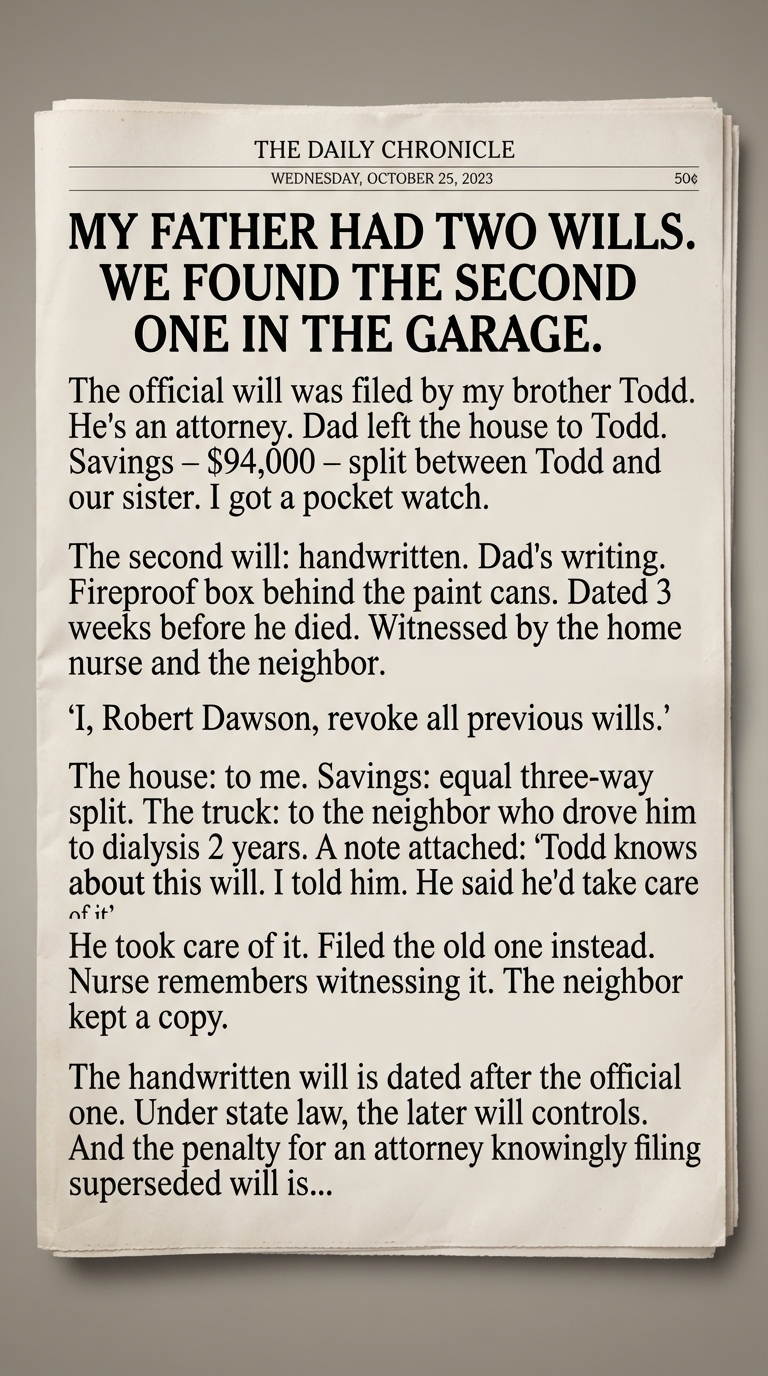
My father had two wills.
We didn’t know that when he died.
At least, that’s what my brother Todd wanted everyone to believe.
Dad’s name was Robert Dawson.
He wasn’t rich.
But he had worked hard his entire life.
He owned a modest three-bedroom house, had about $94,000 in savings, and drove an old pickup truck that he refused to replace because, as he always said, “It still starts.”
My brother Todd was an attorney.
My sister Melissa worked in finance.
And then there was me.
I wasn’t a lawyer.
I wasn’t wealthy.
I was just Dad’s daughter.
And, according to the will Todd presented to the family, I was apparently worth one pocket watch.
That was it.
The official will divided Dad’s savings between Todd and Melissa.
The house went to Todd.
And I received Dad’s old pocket watch.
I remember staring at the document.
“That’s all?”
Todd sighed.
“Dad’s wishes were clear.”
I looked at him.
“Are you sure?”
He gave me the look he’d been giving everyone since Dad died.
The professional look.
The lawyer look.
The look that said the conversation was already over.
“It’s legally executed,” he said.
“I understand.”
“No, you don’t.”
He tapped the document.
“This is Dad’s final will.”
Those words stayed with me.
Final will.
I didn’t argue.
I didn’t accuse my brother of anything.
I simply took the pocket watch.
It was scratched.
The leather strap was cracked.
And on the back, Dad had engraved my initials when I was eighteen.
I held it tightly.
Maybe Todd was right.
Maybe that was all Dad had wanted me to have.
Then, three days later, we went to clean out the garage.
That’s when Melissa found the fireproof box.
It was hidden behind several old paint cans.
“What’s this?” she asked.
Todd immediately looked up.
I noticed something strange.
His face changed.
Just for a second.
Then he smiled.
“Probably old paperwork.”
Melissa pulled it out.
The box was locked.
But Dad had always kept the key taped beneath the workbench.
We found it.
Inside were tax records.
Property papers.
Insurance documents.
And one folded piece of paper.
Melissa picked it up.
Then stopped.
“Guys…”
I looked over.
Her voice was barely a whisper.
“This is a will.”
Todd stood completely still.
I unfolded it.
The handwriting was unmistakable.
Dad’s.
At the top was a date.
Three weeks before he died.
I read the first line.
“I, Robert Dawson, revoke all previous wills.”
My heart began pounding.
I looked at Todd.
He didn’t say anything.
I continued reading.
The house…
To me.
The savings…
Divided equally among the three children.
And Dad’s truck?
To his neighbor, Frank, who had driven him to dialysis for two years.
At the bottom were two signatures.
One belonged to Dad.
The other belonged to the home nurse who had cared for him during his final months.
And the third belonged to Frank.
The neighbor.
I looked at Melissa.
“Did you know about this?”
She shook her head.
“No.”
Then a folded note fell from inside the envelope.
I opened it.
My father’s handwriting again.
Only one sentence.
“Todd knows about this will. I told him. He said he’d take care of it.”
The garage suddenly felt very small.
I looked at my brother.
“Todd?”
He didn’t answer.
“Todd, Dad told you about this.”
Nothing.
“You knew.”
His jaw tightened.
“I knew Dad had drafted something.”
“You knew?”
“I didn’t know whether it was valid.”
“You filed the old one.”
He finally looked at me.
“I filed the will we had.”
“No.”
I held up Dad’s handwritten will.
“You filed the will that benefited you.”
Todd’s face hardened.
“You don’t understand probate.”
“Then explain it.”
He didn’t.
Melissa stepped forward.
“You told us there was only one will.”
Todd looked at her.
“I was trying to protect the estate.”
“From what?”
He had no answer.
Then Frank spoke.
“I can answer that.”
We turned.
He had been standing in the garage doorway.
He looked uncomfortable.
But determined.
“I have a copy.”
Todd’s face went white.
Frank reached into his coat and pulled out a clear plastic folder.
Inside was another copy of Dad’s handwritten will.
“I was there when Robert signed it.”
Todd shook his head.
“This proves nothing.”
Frank looked at him.
“I drove him to the lawyer’s office two weeks before that.”
Todd went silent.
“The nurse was there too.”
I stared at him.
“The nurse remembers?”
Frank nodded.
“She told me she would testify.”
Todd sat down on an old wooden chair.
For the first time, he didn’t look like an attorney.
He looked like my brother.
And he looked terrified.
The next morning, we hired an independent probate attorney.
Not Todd.
Someone who had never met him.
Someone who had nothing to gain from the outcome.
We brought the original handwritten will.
The nurse gave a sworn statement.
Frank gave his copy.
The dates were verified.
The handwriting was confirmed.
And then something even more important happened.
The probate attorney examined the filing history.
Todd had submitted the earlier will after Dad died.
But the later will existed.
And Dad had specifically revoked all previous wills.
The attorney looked at me.
“If this document is authentic and meets your state’s execution requirements, this changes everything.”
I nodded.
“What happens to the first will?”
“It may be superseded.”
“And Todd?”
The attorney paused.
“That depends on what he knew, what he did, and what can be proven.”
I thought about Dad’s note.
Todd knows about this will.
There was no ambiguity.
No misunderstanding.
No accident.
Dad had told him.
And Todd had promised to “take care of it.”
He had.
Just not the way Dad intended.
The probate hearing came six weeks later.
Todd arrived wearing an expensive suit.
He looked confident again.
Until the judge asked him one question.
“Counselor, when did you first learn of this later will?”
Todd hesitated.
“I don’t recall exactly.”
The judge looked down at the evidence.
“You don’t recall?”
“No, Your Honor.”
Then the nurse testified.
She told the court exactly when Dad signed the document.
She described Dad reading every page.
She described him saying that he wanted his children treated equally.
Then Frank testified.
He confirmed that Dad had given him a copy.
And then the judge saw the note.
Dad’s handwritten sentence.
“Todd knows about this will. I told him. He said he’d take care of it.”
The courtroom became silent.
Todd stared at the floor.
The judge looked at him.
“You were aware of this document before filing the earlier will?”
Todd swallowed.
“Yes.”
That single word changed everything.
His own attorney closed his eyes.
Todd had finally admitted it.
The judge didn’t immediately issue a final ruling.
Instead, the court ordered the later will admitted for consideration and referred the conduct to the appropriate professional authorities.
Todd’s face collapsed.
Not because he had lost the house.
Not because he had lost the money.
Because he had finally realized something.
His law degree couldn’t protect him from his own actions.
The estate was eventually distributed according to Dad’s final wishes.
The house came to me.
The $94,000 in savings was divided three ways.
And Frank received Dad’s truck.
When I handed him the keys, he cried.
“I don’t deserve this.”
I smiled.
“Dad thought you did.”
Frank shook his head.
“I would’ve driven him to dialysis for free.”
“I know.”
He looked at the truck.
“That’s why he wanted you to have it.”
I kept the house.
Not because it was worth a fortune.
It wasn’t.
I kept it because it was Dad’s.
The kitchen still smelled faintly like his coffee.
His old chair was still by the window.
And on the wall was a photograph of the three of us as children.
Todd.
Melissa.
Me.
All smiling.
Before money had taught us to measure one another.
Todd’s life changed after that.
He was no longer the confident attorney everyone had trusted.
His professional conduct was investigated.
He faced disciplinary consequences related to his handling of the probate matter.
He also had to deal with the financial consequences of trying to claim property under the wrong will.
I won’t pretend I enjoyed watching my brother fall.
I didn’t.
He was still my brother.
But forgiveness doesn’t require pretending nothing happened.
Months later, Todd came to the house.
He stood on the porch.
“Can I come in?”
I let him.
He sat at the kitchen table.
The same table where Dad used to eat breakfast.
“I was wrong,” he said.
I said nothing.
“I thought Dad was being unfair.”
“How?”
“He gave you the house because he knew you’d keep it.”
I looked at him.
“And you thought you deserved it?”
“I thought I deserved more.”
I nodded slowly.
“That was the problem.”
He looked down.
“I could have lost everything.”
“You almost did.”
He swallowed.
“Do you hate me?”
I looked at my father’s pocket watch sitting on the table.
“No.”
Todd looked surprised.
“I hate what you did.”
He nodded.
“That makes sense.”
I picked up the watch.
“Dad didn’t leave me this because it was all I was worth.”
Todd looked at me.
“He left it because he knew I’d understand what it meant.”
“What did it mean?”
I opened the back.
Dad’s initials were still there.
I smiled.
“It meant time.”
Todd frowned.
“What?”
“Dad knew time would eventually tell the truth.”
He looked away.
And for the first time, neither of us had anything else to say.
I still have the pocket watch.
It doesn’t work anymore.
The hands stopped at 4:17.
But I keep it wound anyway.
Because every time I look at it, I remember something Dad taught me without ever saying it directly:
Money can be divided.
Property can be transferred.
Documents can be manipulated.
But eventually, the truth finds its way into the light.
My father had two wills.
My brother thought he had made sure only one would matter.
He forgot that Dad had left something more powerful than a legal document.
He left witnesses.
He left evidence.
And most importantly…
He left the truth.
And the final will wasn’t the one Todd wanted us to believe was final.
It was the one Dad wrote three weeks before he died.