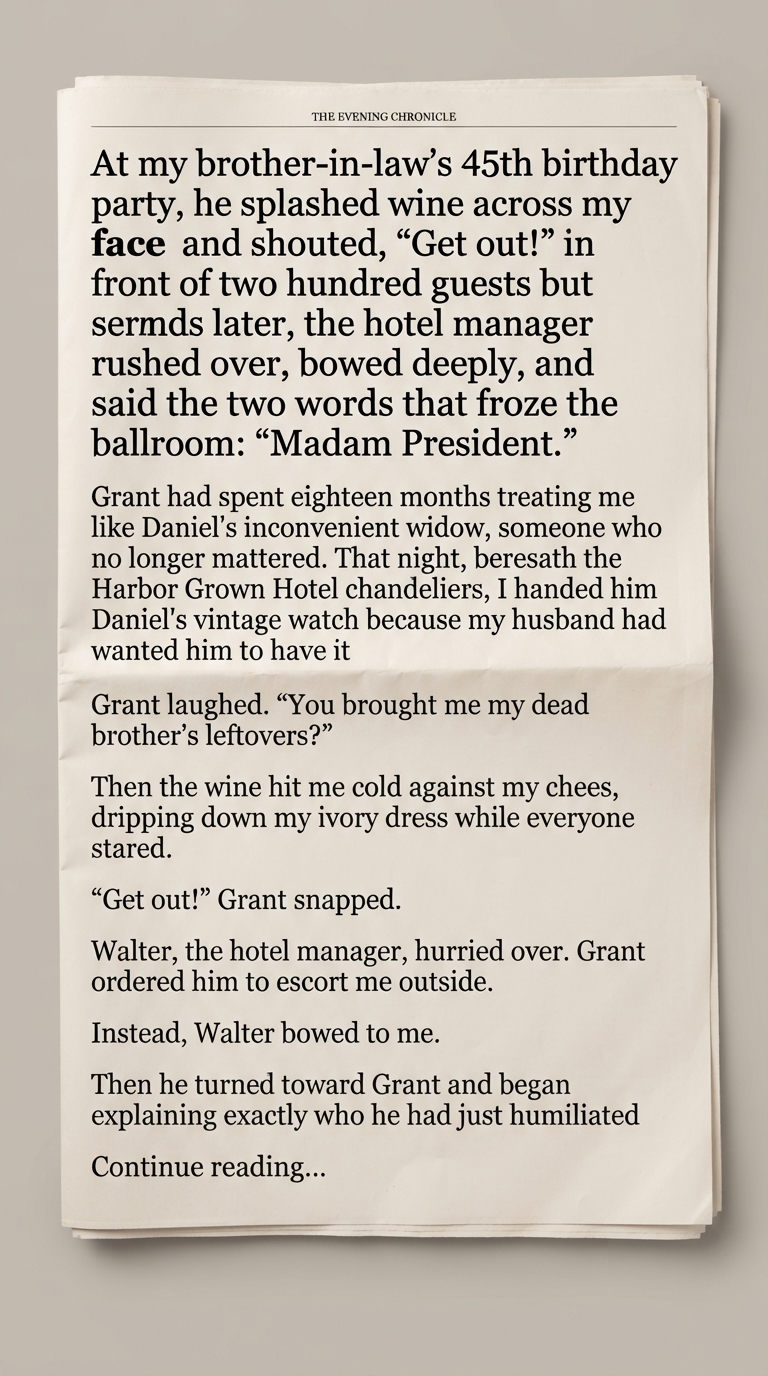
At my brother-in-law’s 45th birthday party, he splashed wine across my face and shouted, “Get out!” in front of two hundred guests.
Seconds later, the hotel manager rushed over, bowed deeply, and said the two words that froze the ballroom:
“Madam President.”
Grant had spent eighteen months treating me like Daniel’s inconvenient widow, someone who no longer mattered.
That night, beneath the Harbor Crown Hotel chandeliers, I handed him Daniel’s vintage watch because my husband had wanted him to have it.
Grant laughed.
“You brought me my dead brother’s leftovers?”
Then the wine hit me.
Cold against my cheek.
Dripping down my ivory dress.
The ballroom went silent.
“Get out!” Grant snapped.
Walter, the hotel manager, hurried toward us.
Grant pointed at me.
“Escort her outside.”
Walter stopped.
He looked at me.
Then he bowed deeply.
“Madam President.”
Two words.
Two words that changed the entire room.
Grant’s expression froze.
The conversations around us disappeared.
Someone dropped a fork.
Another guest whispered,
“President?”
Walter turned toward Grant.
His voice was calm.
“Mr. Grant Mercer, you have just publicly humiliated the owner of this hotel.”
Grant stared at him.
“What?”
Walter straightened.
“She is not Daniel’s widow.”
He glanced at me.
“She is President Eleanor Bennett.”
The ballroom erupted into whispers.
Grant laughed nervously.
“That’s impossible.”
Walter didn’t blink.
“President Bennett is the majority owner of Harbor Crown Hospitality.”
Grant turned toward me.
I simply stood there, wine dripping from my hair onto my dress.
He stared at me as if seeing me for the first time.
Which, in a way, he was.
For eighteen months, Grant had treated me like a widow whose usefulness had ended the moment Daniel died.
He had never once asked what I did.
Never asked about my company.
Never asked why senior executives from five states occasionally came to my home.
He knew only what he had decided to know.
I had been Daniel’s wife.
That was all.
He had no idea who Daniel had married.
And he had definitely never imagined that the quiet woman sitting at the edge of his family gatherings was the woman who owned the hotel where he was celebrating his birthday.
I looked at the watch still lying on the gift table.
Daniel’s vintage gold watch.
The one he had worn every Sunday.
The one he’d told me to give to Grant if anything ever happened to him.
I had carried it across three states because Daniel had believed his brother was better than the man I had come to know.
I had wanted to honor him.
Instead, Grant had thrown wine in my face.
Walter turned toward me.
“Mrs. Bennett, should I have security clear the ballroom?”
I wiped my cheek.
“No.”
Grant exhaled.
For one second, relief crossed his face.
Then I said,
“No one needs to leave.”
I looked around the ballroom.
“Because tonight isn’t about who leaves.”
My eyes returned to Grant.
“It’s about who stays long enough to hear the truth.”
Grant’s smile disappeared.
Walter quietly stepped beside me.
“Would you like the microphone?”
I nodded.
He handed it to me.
The ballroom fell completely silent.
I looked at the two hundred guests.
“I’m sorry you had to witness that.”
Nobody spoke.
Then I looked at Grant.
“Especially because I came here tonight intending to give you something important.”
I picked up the vintage watch.
Grant stared at it.
“Daniel wanted you to have this.”
His jaw tightened.
“You said that already.”
“I did.”
I turned the watch over.
On the back was a small engraving.
To Grant — my brother, always. — Daniel
I held it up.
“This was the last thing my husband asked me to give you.”
Grant looked away.
“He always thought the best of you.”
Something flickered across Grant’s face.
Guilt.
Maybe.
But it vanished quickly.
“Whatever this is,” he said, “I don’t need your pity.”
“This isn’t pity.”
I lowered the watch.
“It was forgiveness.”
Grant frowned.
“For what?”
I looked at him.
“For everything you did after Daniel died.”
The room grew tense.
Grant scoffed.
“What exactly did I do?”
I smiled sadly.
“You’ll find out.”
I handed the microphone to Walter.
Then I stepped toward the hotel manager.
“Please bring up the first presentation.”
Walter nodded.
A large screen behind the stage came alive.
The first image appeared.
A corporate organizational chart.
At the top:
BENNETT HOSPITALITY GROUP
Underneath were dozens of properties.
Harbor Crown Hotel.
Three resort chains.
Two conference centers.
Fourteen restaurants.
Twenty-seven commercial properties.
Grant stared at the screen.
Then at me.
“What is this?”
I answered.
“My company.”
His face went pale.
Someone in the audience whispered,
“She owns all of it?”
Walter nodded.
“Eighty-four percent controlling interest.”
Grant shook his head.
“You never told us.”
“You never asked.”
The room was silent.
Grant suddenly looked angry.
“Daniel never said anything.”
“He tried.”
I glanced at the screen.
“He talked about the company constantly.”
I paused.
“But you weren’t interested in my life.”
Grant opened his mouth.
Nothing came out.
I continued.
“After Daniel died, you told me I needed to stay out of the family business.”
Grant’s cheeks reddened.
“You were grieving.”
“I was.”
“You weren’t thinking clearly.”
“I was thinking very clearly.”
I turned toward the audience.
“For eighteen months, Grant has told employees that Daniel’s widow has no authority.”
A few executives exchanged uncomfortable glances.
“He told managers that my ownership stake was temporary.”
Grant immediately protested.
“That’s not true.”
I looked toward Walter.
“Show them.”
The screen changed.
Emails appeared.
Messages.
Internal memos.
One from Grant:
Keep Eleanor out of operations. She’ll eventually sell her shares.
Another:
She doesn’t understand the business.
Another:
Daniel left no real leadership structure. We need to take control before she realizes what she’s sitting on.
The room became painfully quiet.
Grant looked at the screen.
Then at me.
“Those are private communications.”
“Yes.”
“You had no right to—”
“I had every right.”
I let the silence sit.
“You wrote them on company equipment using company accounts.”
He said nothing.
I continued.
“But the worst part wasn’t what you said about me.”
The screen changed again.
A spreadsheet appeared.
Transaction records.
Payments.
Property acquisitions.
Transfers.
Grant’s face changed.
Walter said quietly,
“This concerns approximately $4.2 million in unauthorized company expenditures.”
A collective gasp moved through the room.
Grant stepped forward.
“That’s not what it looks like.”
I looked at him.
“It looks like you diverted company money to three shell companies.”
“They were consulting companies.”
“Owned by your college roommate.”
Grant said nothing.
“And your cousin.”
Nothing.
“And the third?”
Walter answered.
“Registered to Mr. Mercer’s former accountant.”
The ballroom erupted in whispers.
Grant’s face had gone gray.
He looked at his parents.
His mother was staring at him in horror.
His father whispered,
“Grant, what did you do?”
Grant looked around desperately.
“This is a misunderstanding.”
I shook my head.
“No.”
I stepped closer.
“This is an audit.”
He stared at me.
“You’ve been investigating me?”
“For eighteen months.”
His eyes widened.
“Why didn’t you say anything?”
“Because Daniel taught me something.”
I paused.
“He used to say, ‘Never interrupt a man who’s busy revealing himself.’”
A few people looked down.
Grant clenched his fists.
“You set me up.”
“No.”
I held up the watch.
“Daniel did one thing right.”
Grant looked confused.
“What?”
“He trusted you.”
I swallowed.
“And I wanted to believe he had been right.”
The anger left Grant’s face.
For the first time that night, he looked genuinely ashamed.
But I wasn’t finished.
I looked toward the audience.
“There is one more thing you need to know.”
The screen went black.
Then a single document appeared.
A signed letter.
Daniel’s handwriting.
Grant recognized it immediately.
“No.”
I read the first line aloud.
“Dear Eleanor, if you’re reading this, Grant has probably convinced everyone that you don’t belong here.”
Grant closed his eyes.
“Turn it off.”
I kept reading.
“Don’t let him.”
The room was silent.
“Grant has always wanted control. He thinks leadership means taking from people before they realize what he’s doing.”
Grant’s shoulders dropped.
I continued.
“I’ve spent years trying to keep him from destroying this company.”
Someone in the audience gasped.
“Daniel knew?”
I nodded.
“Yes.”
The letter continued.
“Eleanor, if I die before Grant changes, do not trust him with the company. And do not let him make you feel like an outsider in something we built together.”
My voice shook.
I paused.
Then read the final paragraph.
“And if he ever treats you like you’re only Daniel’s widow, remind him of this: he is standing inside the house his brother built with the woman who owns it.”
The ballroom went silent.
I lowered the paper.
Grant stared at me.
“He wrote that?”
“Yes.”
He looked at the watch.
I placed it in his hand.
“You know what makes tonight so sad?”
He looked up.
“You were supposed to receive this as a brother.”
His eyes filled with tears.
“But you chose to behave like an enemy.”
He stared at the watch.
For a moment, he looked like the younger brother Daniel must have known.
Not the arrogant executive.
Not the man who had stolen money.
Just a grieving brother.
Then he whispered,
“Why didn’t you fire me?”
I looked at him.
“Because Daniel asked me not to give up on you.”
Grant’s eyes closed.
“I tried.”
“I know.”
“Then why?”
“Because eventually forgiveness without consequences becomes permission.”
Walter quietly stepped forward.
“Security is ready.”
Grant looked at him.
“Am I being removed?”
I shook my head.
“No.”
He seemed surprised.
“I am.”
The room stirred.
I turned to the guests.
“I came here tonight because this was supposed to be Daniel’s family’s celebration.”
I looked at the watch.
“And despite everything, I wanted to keep one promise to my husband.”
I handed Grant a small envelope.
He opened it.
Inside was a copy of the company’s ownership agreement.
His name was still listed as a minority executive.
For now.
“But tomorrow morning,” I said, “the board will meet.”
Grant swallowed.
“You’re removing me.”
“Yes.”
His shoulders fell.
“Will you prosecute me?”
I didn’t answer immediately.
Then I said,
“I won’t decide that.”
He looked confused.
“The auditors will.”
I turned toward Walter.
“Please secure all company records tonight.”
Walter nodded.
“And contact counsel.”
He nodded again.
Grant handed the watch back.
I refused it.
“No.”
He looked at me.
“Daniel wanted you to have it.”
“I don’t deserve it.”
“That isn’t your decision anymore.”
I pushed the watch back into his palm.
“Keep it.”
He stared at it.
“Why?”
“Because maybe one day you’ll become the brother Daniel believed you could be.”
Grant began crying.
He turned away from the crowd.
And for the first time since I’d known him, he looked small.
The investigation lasted months.
The auditors confirmed the unauthorized transactions.
The board removed Grant from his executive position.
The shell companies were investigated.
Some money was recovered.
Some wasn’t.
Legal proceedings followed.
But the story people remembered wasn’t the money.
It was the wine.
It was the moment Grant had thrown that glass into my face believing I was powerless.
And then the hotel manager had bowed and said:
“Madam President.”
The phrase became something of a legend among our employees.
But I never liked the attention.
Because titles didn’t make me powerful.
Money didn’t make me powerful.
The company didn’t make me powerful.
What made me powerful was the decision not to become cruel just because someone had been cruel to me.
A year later, I held a memorial ceremony for Daniel at the Harbor Crown.
No cameras.
No press.
Just family, employees, and the people who had loved him.
I stood beneath the same chandeliers.
The same ones that had been above me the night Grant threw the wine.
But this time, there was no shouting.
No humiliation.
Only silence.
I placed Daniel’s photograph beside a small arrangement of white roses.
Then I whispered:
“You were right about one thing.”
I smiled through my tears.
“Your brother wasn’t beyond saving.”
I looked across the ballroom.
“But he had to choose to save himself.”
Then I walked away.
Not as a widow.
Not as a daughter-in-law.
Not as the woman Grant believed no longer mattered.
I walked away as the woman Daniel had always known.
His wife.
His partner.
And the president of everything they had built together.
The next morning, Walter greeted me at the entrance.
He smiled.
“Good morning, Madam President.”
I laughed.
“You know, Walter, you don’t have to bow every time you see me.”
He smiled.
“Perhaps not.”
Then he added,
“But after what happened that night, I think you’ve earned the title.”
I looked toward the ballroom.
Then at the watch on my wrist.
Daniel’s watch.
I had taken it back from Grant after he voluntarily surrendered it months later.
I smiled.
“Titles don’t matter.”
Walter asked,
“Then what does?”
I thought about Daniel.
About the wine.
About the humiliation.
About the folder of evidence.
About the moment the truth had finally spoken.
“Character,” I said.
And I walked into the hotel.
Because some people only recognize your value after they humiliate you.
The right people recognize it long before.