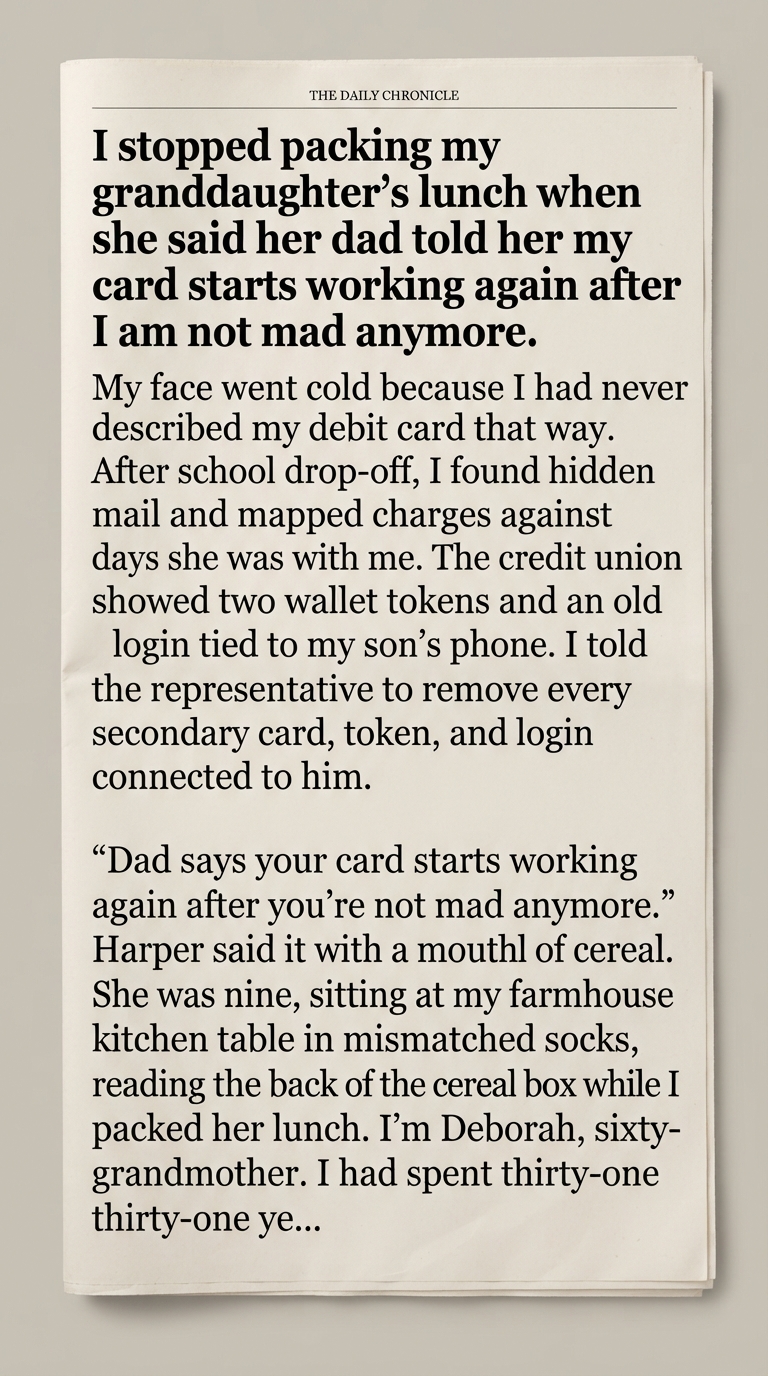
I stopped packing my granddaughter’s lunch when she said her dad told her my card starts working again after I am not mad anymore.
My face went cold.
Because I had never described my debit card that way.
Not once.
“Dad says your card starts working again after you’re not mad anymore.”
Harper said it with a mouthful of cereal.
She was nine, sitting at my farmhouse kitchen table in mismatched socks, reading the back of the cereal box while I packed her lunch.
I’m Deborah, sixty-four.
For thirty-one years, I had worked, saved, paid my bills on time, raised my son, and built a life that was modest but secure.
And for the last three years, I had been raising Harper during the week.
Her mother was gone.
Her father—my son, Ryan—had joint custody.
But because of his work schedule, Harper spent most school nights with me.
I loved every minute of it.
I knew which cereal she hated.
Which vegetables she’d pretend to eat.
Which socks made her feet “feel lucky.”
I knew she wanted apple slices cut into stars.
I knew she liked peanut butter sandwiches but only if the crusts were removed.
And I knew one other thing.
Harper never lied to me.
Children sometimes misunderstand.
They sometimes repeat things incorrectly.
But Harper had never invented something like that.
I slowly put down the sandwich knife.
“What card, sweetheart?”
She looked up.
“Your card.”
“My debit card?”
She nodded.
“Dad said you got mad and made the card stop working.”
My stomach tightened.
“Did he say why?”
“He said you don’t let him use it when you’re mad.”
I stared at her.
“When does Dad use my card?”
She shrugged.
“I don’t know. He said it starts working again when you stop being mad.”
I forced myself to smile.
“Okay.”
Harper went back to her cereal.
I finished packing her lunch.
But I didn’t breathe normally again until she left for school.
After I dropped her off, I drove straight home.
I didn’t call Ryan.
I didn’t text him.
I didn’t accuse him of anything.
I opened my desk drawer.
My bank card was exactly where I had left it.
In my wallet.
My phone was beside it.
I opened my credit union app.
The balance looked normal.
But when I opened the transaction history, something didn’t.
There were purchases I didn’t recognize.
A gas station fifteen miles away.
A hardware store.
A grocery store.
A restaurant I’d never visited.
Then I noticed the dates.
Almost every charge had occurred on days Harper had been staying with me.
My hand tightened around my phone.
I opened my calendar.
Monday.
Harper with me.
Tuesday.
Harper with me.
Thursday.
Harper with me.
Saturday.
Harper with me.
The charges lined up almost perfectly.
I pulled out a notebook.
Then I started writing.
Date.
Merchant.
Amount.
Harper’s location.
Time.
I went back six months.
The pattern became impossible to ignore.
Ryan hadn’t simply used my card once.
Someone had been using my financial information repeatedly.
And then I remembered Harper’s exact words.
“Dad says your card starts working again after you’re not mad anymore.”
He hadn’t said:
“Grandma’s card.”
He had said:
“Your card.”
As if he knew I was the one controlling it.
As if someone had explained its limits to him.
I called my credit union.
A representative named Melissa answered.
“I need help securing my account.”
“Of course. What happened?”
“I think someone has been using my card information without my permission.”
She asked me several security questions.
Then she said,
“I can see a few things on the account that we should review.”
“Like what?”
“There are two digital wallet tokens associated with your card.”
I frowned.
“What does that mean?”
“Your card information has been added to two mobile wallets.”
“I don’t use a mobile wallet.”
There was a pause.
“Are you sure?”
“Yes.”
“Then we should remove them immediately.”
“Please do.”
She continued.
“There is also an older login associated with your online banking profile.”
“What login?”
“It appears to be a device registered several years ago.”
“Whose device?”
“We can’t identify the person from here.”
I already knew.
“My son.”
She paused.
“Was he ever authorized to access the account?”
“Years ago.”
“That could explain the old login.”
“No,” I said.
“It doesn’t.”
Melissa waited.
“What would you like me to do?”
I took a breath.
“Remove every secondary card, wallet token, and login connected to him.”
“Absolutely.”
“And change everything else.”
“Of course.”
I changed my password.
My security questions.
My email password.
My phone passcode.
My debit card.
Everything.
Then Melissa said something that made my stomach drop.
“There’s one more thing.”
“What?”
“The transactions you’re disputing aren’t all coming from the same device.”
I sat down.
“How many?”
“Two primary devices.”
“Could one be mine?”
“Yes.”
“And the other?”
“I can’t tell you who owns it.”
I looked through the kitchen window.
Harper’s bicycle was leaning against the porch.
Suddenly, the entire situation felt much bigger.
Someone wasn’t simply stealing money.
Someone had access to my card through more than one digital wallet.
And my granddaughter knew something.
Maybe she didn’t understand what it meant.
But she knew her father believed my card could be turned on and off.
I called my attorney.
Her name was Susan Miller.
I told her everything.
She didn’t interrupt.
When I finished, she said:
“Don’t confront Ryan yet.”
“I wasn’t planning to.”
“Good.”
“I want to know how deep this goes.”
“Then document everything.”
“I already am.”
“Keep doing that.”
She told me to preserve bank statements, transaction records, text messages, emails, and anything Harper said about the card.
Then she asked:
“Deborah, one question.”
“What?”
“Have you ever given Ryan access to any of your financial accounts?”
“Yes.”
“When?”
“About seven years ago.”
“Why?”
“He helped me set up online banking after my husband died.”
“Did you ever remove his access?”
“I thought I did.”
She went quiet.
“Then that’s where I’d start.”
I sat there staring at my laptop.
Ryan had helped me set everything up after his father died.
He had told me:
“Mom, I’ll make sure you don’t have to worry about this stuff.”
At the time, it had sounded loving.
Now it sounded different.
I searched my old emails.
There was an account notification from seven years earlier.
New authorized device registered.
I opened it.
The device name made my heart stop.
RYAN’S IPHONE.
I had forgotten.
Or maybe I had trusted him too much to remember.
I checked the date.
Two days after the notification, the first suspicious transaction had occurred.
Only $23.
Then $41.
Then $67.
Nothing dramatic.
Nothing that would immediately trigger suspicion.
It was almost as though whoever had been using my account understood exactly how not to get caught.
I kept scrolling.
The amounts slowly increased.
$84.
$112.
$176.
$263.
And eventually, hundreds at a time.
Over six years, the total reached nearly $18,000.
I stared at the number.
Eighteen thousand dollars.
That wasn’t an accident.
That was a pattern.
I printed everything.
Then I placed it in a folder.
A blue folder.
Not because I knew what I would do with it.
But because I needed everything in one place.
That evening, Ryan came to pick up Harper.
He walked into the kitchen smiling.
“Hey, Mom.”
I looked at him.
“Hey.”
He kissed my cheek.
“Everything okay?”
“Fine.”
He looked at the counter.
“What are you doing?”
“Paperwork.”
He nodded.
“Busy as always.”
Harper ran into the room.
“Dad!”
He hugged her.
Then she whispered something to him.
His eyes flicked toward me.
Just for a second.
But I saw it.
He was checking my reaction.
Ryan smiled.
“Ready?”
Harper nodded.
As they walked toward the door, she turned.
“Grandma?”
“Yes?”
“Is your card working now?”
Ryan stopped.
I looked at him.
Then I smiled at Harper.
“Yes, sweetheart.”
She grinned.
“Dad said it would.”
Ryan’s face went blank.
I didn’t say another word.
After they left, I locked the door.
Then I called Susan.
“He knows I know something.”
She was quiet.
“What makes you think that?”
“Harper asked if my card was working again.”
Susan exhaled.
“Then don’t confront him.”
“I won’t.”
“Let him believe you’re still unaware.”
That was exactly what I did.
For the next two weeks, I acted normally.
I packed Harper’s lunches.
I made dinner.
I smiled at Ryan.
And I watched.
The suspicious transactions stopped.
Completely.
Not one unauthorized charge.
That told me everything.
Whoever was using my account knew the card had been changed.
And whoever it was knew I had been angry.
Because Harper had been right.
My card really had “stopped working.”
But there was more.
One night, while Harper was doing homework at the kitchen table, she asked:
“Grandma, why don’t you give Dad money anymore?”
I kept my eyes on her workbook.
“What makes you think I don’t?”
“He said you’re mad at him.”
I looked up.
“When did he say that?”
“Yesterday.”
“What else did he say?”
She shrugged.
“He said you used to help him with everything.”
That sentence hurt.
Because it was true.
I’d paid his college tuition.
Helped with his first apartment.
Covered his car repair.
Loaned him money when he started his business.
Given him access to accounts when he said he needed help.
And over the years, I had quietly given him more than $70,000.
I had never kept score.
He had.
That night, after Harper went to bed, I checked something I hadn’t checked before.
My investment account.
There was an attempted transfer.
$12,000.
It hadn’t gone through.
My trust account had blocked it.
My heart pounded.
I called Susan.
She told me to contact the financial institution immediately.
I did.
The next morning, the representative told me someone had attempted to initiate a transfer using my credentials.
“Was the transfer from my son’s device?”
“We can’t confirm that yet.”
“But someone tried.”
“Yes.”
I sat in silence.
Then I asked:
“What happens if they try again?”
“We’ll flag the account.”
“Please do.”
“And Ms. Carter?”
“Yes?”
“You should consider filing an identity theft report.”
I knew what that meant.
This was no longer a family argument.
It was financial fraud.
I filed the report.
Then Susan called me.
“Deborah, I have something you need to see.”
She emailed me a document.
It was a copy of an old power-of-attorney form.
My name.
Ryan’s name.
My signature.
I stared at it.
“I never signed this.”
Susan was silent.
“What?”
“I had the original scanned years ago.”
“This signature isn’t mine.”
She zoomed in.
“You’re right.”
My heart dropped.
“So someone forged my signature.”
“Yes.”
“And Ryan had this document?”
“He was listed as your agent.”
I closed my eyes.
Everything suddenly came together.
The old login.
The wallet tokens.
The card.
The attempted transfer.
The forged document.
And Harper’s sentence.
I finally understood why Ryan had been so comfortable telling his daughter that my card would “start working again.”
He didn’t think he was borrowing money.
He thought he had control.
Because someone had convinced him that being my son meant he was entitled to my finances.
But there was something I hadn’t considered.
Why did he need the money?
Susan found the answer.
A week later, she called me.
“We traced some of the money.”
“Where did it go?”
“Several places.”
“Like what?”
“Credit cards. Personal debts. A business account.”
“And?”
She hesitated.
“There are also payments to a private school.”
I froze.
“Whose?”
“Harper’s.”
I couldn’t breathe.
For years, I had believed Ryan was struggling financially.
He had told me he couldn’t afford Harper’s activities.
He had told me he was behind on some bills.
He had told me he needed occasional help.
But he had been secretly using my money to pay for his daughter’s expenses.
Then I found the second account.
A savings account in Harper’s name.
The deposits were almost entirely funded from transfers that had originated with my account.
I stared at it for several minutes.
Part of me was angry.
Part of me was heartbroken.
But another part understood something important.
Ryan had not only stolen from me.
He had been using my granddaughter to make himself feel justified.
He could tell himself:
It’s for Harper.
Mom loves Harper.
She would help anyway.
That wasn’t permission.
That was manipulation.
Susan told me the next step.
“Bring everything to the investigator.”
So I did.
The investigation took months.
The credit union preserved the access records.
The unauthorized wallet tokens were traced.
The old login was tied to Ryan’s phone.
The attempted transfer was documented.
The forged power-of-attorney form was examined.
And then came the piece that changed the entire family.
An investigator found messages between Ryan and his friend.
One message said:
Mom won’t notice another few hundred. She always helps when Harper needs something.
Another said:
If she gets mad, just tell Harper Grandma isn’t letting Dad use the card anymore. She’ll soften.
I read that message three times.
My eyes filled with tears.
Not because he had stolen money.
Because he had used my granddaughter’s love for me as a tool.
I didn’t confront him immediately.
I waited until Susan said we had enough evidence.
Then I invited him to dinner.
Just him.
No Harper.
He arrived at seven.
“What’s this about?”
I put the blue folder on the table.
He stared at it.
“Mom?”
I opened it.
“The card.”
His face changed.
“What card?”
“My card.”
He looked away.
I placed the bank records on the table.
Then the wallet token report.
Then the old login.
Then the attempted transfer.
Finally, I put down the forged power-of-attorney form.
Ryan stared at it.
His face went white.
“I didn’t—”
“You don’t have to explain.”
“Mom, listen—”
“No.”
He sat down.
“You’re misunderstanding.”
“Am I?”
“I was going to pay it back.”
“How much?”
He didn’t answer.
“How much?”
“Most of it.”
“That’s not what I asked.”
He looked down.
“Eighteen thousand.”
I nodded.
“And the attempted $12,000 transfer?”
He closed his eyes.
“That was for Harper.”
I felt my chest tighten.
“You used her name to justify stealing from me.”
“I wasn’t stealing.”
“What would you call it?”
“I was borrowing.”
“For six years?”
Silence.
“Without telling me?”
Nothing.
“With forged paperwork?”
His face collapsed.
“I didn’t forge it.”
I slid the report toward him.
“Then who did?”
He stared at the table.
I already knew the answer.
“It was your friend, wasn’t it?”
He whispered,
“Yes.”
I leaned back.
“Why?”
He started crying.
“I was drowning.”
I didn’t speak.
“I had debts.”
“I know.”
“I thought you’d help.”
“I did.”
“I needed more.”
“And you decided I owed it to you?”
“No.”
“You told Harper I would turn the card back on when I stopped being angry.”
He covered his face.
“I didn’t mean for her to hear that.”
“But she did.”
“I was desperate.”
I looked at my son.
My baby.
The boy I’d once carried in my arms.
The teenager I had driven to soccer practice in snow.
The young man I had helped start his life.
Now he sat across from me admitting he’d used my trust, my money, and my granddaughter.
I said quietly:
“You could have asked.”
“I was ashamed.”
“You should have been honest.”
“I was afraid you’d say no.”
“And?”
He looked at me.
I shook my head.
“Then you should have let me say no.”
He cried harder.
I didn’t.
I had cried enough.
The legal consequences came afterward.
Ryan was required to repay the money.
The fraudulent documents were turned over to investigators.
His access to my finances was permanently removed.
I changed every lock, password, beneficiary designation, and emergency contact.
But I did something else.
I created a separate education fund for Harper.
Not controlled by Ryan.
Not linked to my checking account.
Not available to anyone except through an independent administrator for Harper’s benefit.
Because she had never done anything wrong.
She had only repeated what the adults around her had told her.
Months later, I sat with Harper at the same kitchen table where the whole thing had begun.
She was eating cereal.
Still reading the back of the box.
Still wearing mismatched socks.
She looked up.
“Grandma?”
“Yes?”
“Are you still mad at Dad?”
I took a breath.
“Yes.”
She frowned.
“Does that mean his card doesn’t work?”
I smiled gently.
“No, sweetheart.”
“Then what?”
“Sometimes adults make mistakes that have consequences.”
She thought about that.
“Is Dad going to be okay?”
I reached across the table and took her hand.
“Yes.”
“Are you?”
I smiled.
“Yes.”
She nodded.
Then she returned to her cereal.
And I looked around the kitchen.
The same kitchen.
The same table.
The same little girl.
But I was different.
I had learned something I should have learned years earlier.
Helping someone doesn’t mean giving them unlimited access to you.
Being someone’s mother doesn’t mean becoming their bank.
And loving your child doesn’t mean protecting them from every consequence of their choices.
A year later, Ryan had paid back every dollar.
Our relationship was different.
More distant.
More honest.
He could visit Harper.
He could call me.
But he no longer had access to my accounts, my passwords, my property, or my trust without boundaries.
One afternoon, he stood in my kitchen and said:
“You were right.”
I didn’t ask what he meant.
He looked at the debit card sitting on the counter.
“I thought because you were Mom, you’d always rescue me.”
I looked at him.
“I’ll always love you.”
He nodded.
“But I’ll never again confuse love with rescue.”
He wiped his eyes.
“I understand.”
After he left, Harper came running into the kitchen.
“Grandma!”
“What?”
“Can we make star sandwiches?”
I laughed.
“Yes.”
She climbed into her chair.
As I cut the bread into stars, I realized the most important thing that little sentence had done.
It hadn’t merely exposed a stolen card.
It had forced me to see my son clearly.
And it had reminded me why I had to protect myself.
Because someday Harper would be grown.
And when she faced a difficult choice, I wanted her to know something I wished I had learned sooner:
Family should be where you find love.
Not where you surrender your boundaries.
I packed her lunch.
Apple slices.
Star sandwiches.
Her favorite crackers.
Then I slipped a note inside.
Grandma loves you. Always.
She found it at school and texted me a picture.
Underneath, she had written:
Love you too. ❤️
I stared at the message for a long time.
The card had stopped working.
The secrets had ended.
The money had been recovered.
But somehow, the most valuable thing I got back wasn’t a dollar.
It was trust.
Not my trust in my son.
That would take time.
It was trust in myself.
The trust that the next time something felt wrong, I would listen.
And the next time someone said I owed them access to what I had worked for, I would remember the little girl at my kitchen table saying the sentence that changed everything:
“Dad says your card starts working again after you’re not mad anymore.”
Sometimes children don’t know they’re telling you the truth.
They just repeat what they’ve heard.
And sometimes…
that’s all the truth needs to come home.