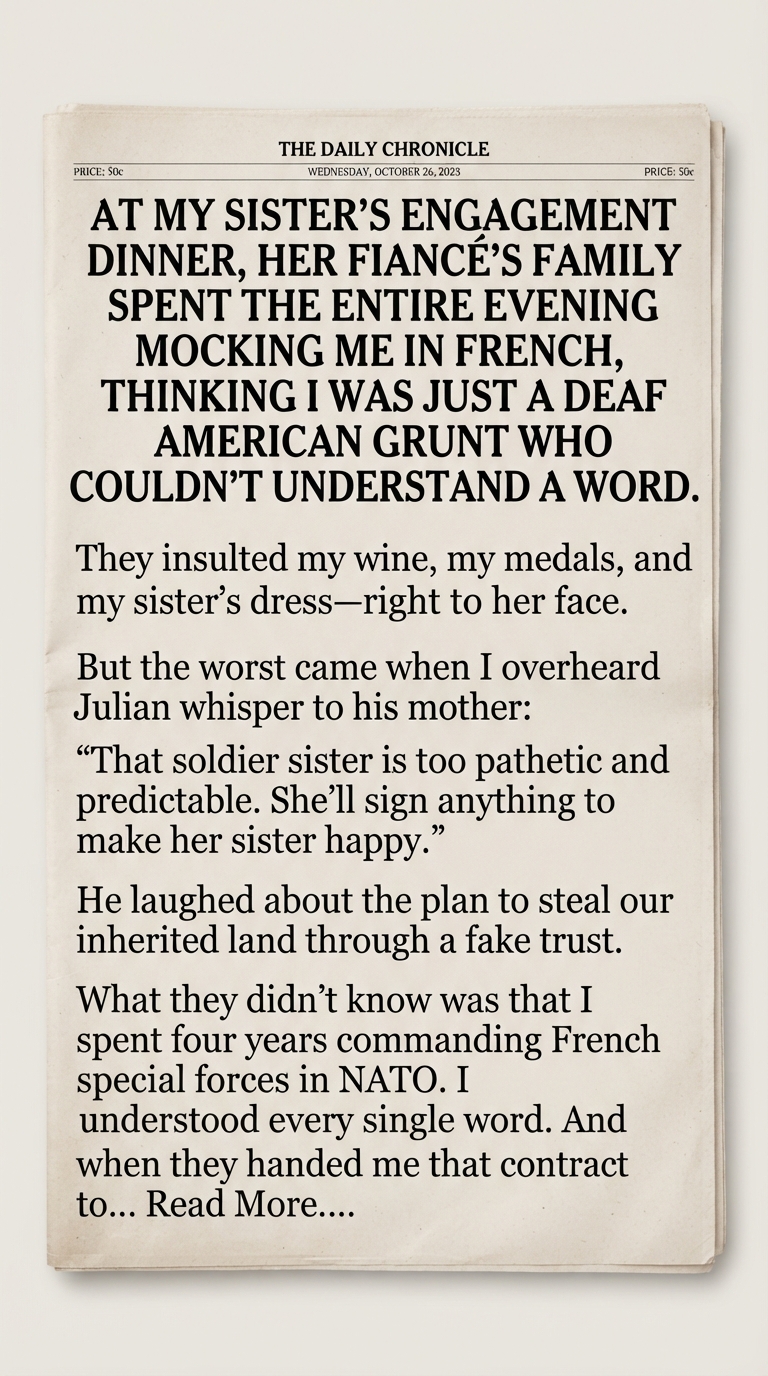
At my sister’s engagement dinner, her fiancé’s family spent the entire evening mocking me in French, thinking I was just a deaf American grunt who couldn’t understand a word.
They insulted my wine.
My medals.
My clothes.
Even the way I carried myself.
They insulted my sister’s dress right to her face while pretending she couldn’t understand them either.
My sister, Claire, kept smiling nervously.
Julian, her fiancé, sat beside her with one hand resting possessively on the back of her chair.
He was charming in English.
Smooth.
Polished.
Almost painfully polite.
But when he spoke French to his family, his voice changed.
That was when I heard the real Julian.
The first insult came during the appetizers.
His mother lifted her wineglass, tasted it, and whispered in French:
“Cheap.”
His aunt laughed.
Then she looked at my military medals displayed on a small shelf in my sister’s dining room.
“She’s decorated for pretending to be important.”
I kept eating.
I didn’t react.
Because I understood every word.
I wasn’t deaf.
And I wasn’t some “grunt.”
I’d spent four years commanding a French special-forces liaison unit through NATO operations.
I’d negotiated with French officers.
Briefed generals in French.
Read operational documents in French.
Argued in French.
And understood exactly what people said when they assumed nobody could understand them.
But my family didn’t know that.
Claire’s future in-laws certainly didn’t.
They thought my service had made me socially awkward.
They thought my hearing loss was severe enough that I couldn’t follow conversation.
It wasn’t.
I’d lost some hearing in an explosion overseas.
Enough to make crowded rooms difficult.
Not enough to make me helpless.
I let them believe otherwise.
For one reason.
My sister.
Claire was twenty-eight.
She had met Julian two years earlier.
She was completely in love with him.
And I wanted to like him.
I really did.
But there had always been something about him that made my instincts uncomfortable.
Too polished.
Too quick.
Too interested in our family’s property.
Our parents had died when Claire and I were young.
They left us a large tract of land in northern Vermont.
It had been in our family for generations.
Timberland.
A lake.
Several acres of farmland.
A stone house.
And mineral rights that had recently made the property surprisingly valuable.
Claire and I had always agreed that neither of us would sell without the other’s written approval.
It was one of the last promises we’d made to our parents.
Julian had started asking questions about the land almost immediately after he proposed.
How much was it worth?
Who controlled it?
Was there a trust?
Could it be developed?
I thought he was curious.
That night, I discovered he was much more than curious.
Dinner continued.
Julian’s mother pointed at my medals.
“Does she ever talk about anything besides war?”
His aunt laughed.
“She probably doesn’t know how to do anything else.”
Julian smiled.
Then, in French, he said:
“She’s exactly what I expected.”
His mother asked,
“What do you mean?”
“She thinks she’s protecting Claire.”
His mother laughed.
“And Claire?”
“She’ll do anything to keep her sister happy.”
Then Julian leaned closer to his mother.
His voice dropped.
I heard every word.
“That soldier sister is too pathetic and predictable. She’ll sign anything to make her sister happy.”
His mother laughed.
“And the land?”
“Once Claire signs the trust documents, half of it moves under the family structure.”
“What if the sister refuses?”
Julian smiled.
“She won’t understand what she’s signing.”
His mother raised an eyebrow.
“And Claire?”
“She’ll be too embarrassed to admit she doesn’t understand the legal language.”
They both laughed.
My fork stopped halfway to my mouth.
So that’s what this was.
Not an engagement.
A takeover.
I glanced at Claire.
She was smiling at Julian.
She had no idea.
My heart broke for her.
Then Julian continued.
“The lawyer has the documents ready.”
His mother whispered,
“And the military sister?”
Julian laughed.
“She’ll probably sign first.”
I set down my fork.
Nobody noticed.
I had spent years commanding people in situations where one bad decision could cost lives.
You learn something in those environments.
You learn never to move simply because you’re angry.
You move when the timing is right.
So I waited.
After dinner, Julian approached me with the contract.
“Claire mentioned you’re protective of her.”
I smiled.
“I am.”
He laughed.
“You don’t have to worry. We’re family now.”
Then he handed me a thick folder.
“This is just the trust arrangement for the family property.”
I looked at the folder.
“What’s my role?”
“Very minor.”
He smiled.
“You just need to sign acknowledging Claire’s interest.”
I opened it.
The first page looked harmless.
The second page wasn’t.
The third made my stomach tighten.
By the fourth, I knew exactly what they were attempting.
The “family trust” transferred control of the land to a new entity.
Claire would receive income.
Julian’s family would control the trust.
And the voting structure gave Julian’s family effective control over every major decision.
Including the ability to sell.
I turned another page.
There was a clause requiring my signature to acknowledge a transfer of my inherited interest.
It was buried under six pages of language designed to make a tired person stop reading.
Julian smiled.
“Just sign at the bottom.”
I looked up.
“For Claire.”
He nodded.
“For Claire.”
That was when I decided to stop pretending.
I closed the folder.
“Before I sign, could you explain section twelve?”
Julian froze.
“What?”
“Section twelve.”
His mother looked at me.
Julian’s expression changed.
“You can read it.”
“I did.”
He looked uncomfortable.
“What about it?”
“It transfers voting control of the trust to the managing members.”
Silence.
I continued.
“Which, conveniently, would be you and your family.”
His mother looked at Julian.
He started laughing.
“You misunderstood.”
“No.”
I switched to French.
“Je n’ai rien mal compris.”
I understood everything.
The smile vanished from his face.
His mother stared at me.
I continued in French.
“J’ai compris chaque mot que vous avez dit ce soir.”
I understood every word you said tonight.
The room went silent.
Claire looked at me.
“What did you say?”
I looked at Julian.
Then at his mother.
“They’ve been speaking French all night because they thought I couldn’t understand them.”
Julian’s face went white.
His mother whispered,
“Impossible.”
I smiled.
“Not impossible.”
I switched back to English.
“Just embarrassing.”
Claire looked confused.
“What are they talking about?”
I placed the folder in front of her.
“Your fiancé has been planning to put our inherited land under a trust controlled by his family.”
Julian immediately protested.
“That’s not what this is.”
“It absolutely is.”
He turned to Claire.
“She’s misunderstanding the document.”
I slid another page toward her.
“Read section twelve.”
Claire read it.
Her eyes widened.
“Julian?”
He stepped toward her.
“You have to understand the language is complicated.”
Claire looked at me.
“Is he right?”
“No.”
I pointed at the signature page.
“You would surrender control.”
She kept reading.
Then her hands started shaking.
“You told me this trust was only for taxes.”
Julian swallowed.
“It is.”
“Then why would your family control it?”
He had no answer.
His mother stepped in.
“Claire, these structures are complicated.”
I looked at her.
“Not this complicated.”
Then I pulled another document from my bag.
A land survey.
And a recent appraisal.
Julian stared at it.
“You already had that?”
“I’ve had it for months.”
His expression changed.
“Why?”
“Because I don’t sign documents involving family property without independent review.”
His mother laughed nervously.
“You’re being paranoid.”
“No.”
I looked directly at her.
“I’m being responsible.”
Julian’s face had become rigid.
“Who reviewed the document?”
“My attorney.”
His smile vanished.
“Which attorney?”
“The attorney who handles my family’s land trust.”
Claire stared at me.
“You knew?”
“I suspected.”
“When?”
“Before tonight.”
She looked hurt.
“Why didn’t you tell me?”
“Because I needed you to see his behavior yourself.”
Julian stepped closer.
“You’re destroying our engagement over a misunderstanding.”
I looked at Claire.
“Ask him one question.”
“What?”
“Why did he tell his mother you would sign anything?”
Julian’s face drained of color.
Claire turned toward him.
“What did you say?”
He looked away.
“You’re twisting my words.”
I switched to French again.
“Tu lui as dit qu’elle signerait n’importe quoi.”
Claire doesn’t speak French fluently, but she understood enough.
Her face changed.
Julian stepped backward.
“You can speak French?”
I nodded.
“I commanded French special forces in NATO.”
His mother sat down.
“That’s impossible.”
“No.”
I looked at her.
“You just never bothered to ask.”
Claire’s eyes filled with tears.
“You lied to me.”
Julian reached for her.
She pulled away.
“You lied about the trust.”
“No.”
“You lied about my sister.”
“No.”
“You lied about the land.”
“I was trying to protect our future.”
I laughed softly.
“By stealing her family’s property?”
He snapped,
“It wasn’t stealing!”
“Then why did you hide it?”
Silence.
No one had an answer.
I opened my phone.
“I recorded the conversation.”
Julian’s face went white.
His mother stood.
“You recorded us?”
“Legally in this setting.”
I wasn’t bluffing.
I had been trained to document.
Not provoke.
Not threaten.
Document.
The recording captured everything.
The insults.
The discussion about Claire.
The plan to move the property.
Julian’s admission that I would “sign anything.”
And because it involved a major property transfer, my attorney had already advised me to preserve every conversation related to the transaction.
Julian looked at Claire.
“Please.”
She was crying.
“How long?”
He hesitated.
“How long have you been planning this?”
He finally whispered,
“Six months.”
She closed her eyes.
Six months.
Half their relationship built around the idea of taking something from her.
I put my hand on her shoulder.
“You don’t have to decide anything tonight.”
She nodded.
Then she looked at Julian.
“Leave.”
He stared at her.
“Claire…”
“Leave.”
His mother stood.
“This is ridiculous.”
Claire turned toward her.
“You knew.”
She didn’t answer.
“You both knew.”
Her mother-in-law looked away.
Claire pointed toward the door.
“Leave.”
They did.
The next morning, Claire called off the engagement.
Julian tried to contact her repeatedly.
She blocked him.
His parents sent messages.
She blocked them too.
Then his attorney contacted us.
A demand.
They claimed Claire had breached an “understanding” about the property.
My attorney laughed when he read it.
The trust document they had prepared wasn’t enforceable as they had intended because it had never been properly executed, and Claire had never consented to the actual transfer.
More importantly, the version they had presented to us had omitted several required disclosures.
Once authorities and counsel began examining the transaction, more problems appeared.
The attorney who drafted the document had represented Julian’s family before becoming involved in the proposed trust.
There were undisclosed conflicts.
His family had already been negotiating with a developer about the land.
They planned to borrow against the property’s value.
They had even prepared a preliminary sales package.
Julian hadn’t been planning a life with Claire.
He had been planning a financial acquisition.
And he had underestimated the one person he thought was too “pathetic and predictable” to notice.
Me.
A month later, Claire and I drove to Vermont.
We stood at the edge of the lake where our parents had taken us as children.
She looked across the water.
“I can’t believe I almost signed it.”
“You didn’t.”
“Because of you.”
“No.”
I looked at her.
“Because you stopped.”
She was quiet.
Then she asked,
“Were you really a French special-forces commander?”
I smiled.
“No.”
She blinked.
“No?”
“I commanded a NATO special-forces liaison unit involving French personnel.”
She laughed through her tears.
“You let them think you were deaf.”
“I let them think I couldn’t understand them.”
“Why?”
“Because people reveal things when they think they’re smarter than you.”
She smiled.
“Dad used to say that.”
“I know.”
We stood there for a while.
Then Claire looked at me.
“Do you think I’ll ever trust someone again?”
I thought about it.
“Yes.”
“When?”
“When you meet someone who isn’t interested in what you own.”
She nodded.
“I thought Julian loved me.”
“Maybe he loved the version of your future he imagined.”
She looked at the water.
“That’s worse.”
“Sometimes the truth hurts because it removes something you wanted to believe.”
She leaned against me.
“Thank you for not signing.”
I laughed.
“That was never going to happen.”
She smiled.
“Yeah.”
She looked toward the farmhouse.
“Do you remember Mom telling us to protect this place?”
“I do.”
Claire took my hand.
“Then let’s keep it.”
“We will.”
A year later, the old property was placed under a new trust.
This time, the documents were drafted by an independent attorney chosen by both sisters.
Neither husband nor fiancé had unilateral control.
The property remained in the family.
And Claire began a new life.
No mansion.
No flashy wedding.
No wealthy in-laws.
Just a quiet relationship with a schoolteacher she’d met at a community fundraiser.
He knew about the land.
He knew about her family.
And when she once joked that she came with “way too much paperwork,” he laughed and said:
“Then we’ll read it together.”
She knew immediately.
That was the difference.
The right person doesn’t ask you to sign quickly.
The right person isn’t threatened when you ask questions.
And the right person never needs you to misunderstand a document in order to love them.
As for Julian, the land deal collapsed.
His family’s financial problems eventually became public.
Several business relationships ended.
The trust scheme disappeared.
And the engagement dinner that was supposed to celebrate his future became the night his plans came apart.
But I never thought of it as revenge.
I thought of it as a correction.
They had mistaken silence for weakness.
They had mistaken military service for ignorance.
They had mistaken kindness for stupidity.
And most of all, they had mistaken my love for my sister as something they could exploit.
They were wrong.
Years later, Claire would joke about that dinner.
She’d tell people:
“My sister spent the entire evening pretending she couldn’t understand French.”
Then she’d point at me.
“And then she read the contract.”
I’d laugh.
Because that was the moment everything changed.
Not when I spoke French.
Not when I revealed my military background.
Not when I exposed Julian.
It changed when I looked at the final signature line and realized exactly what they wanted from my sister.
A signature.
One little signature that could have changed our family’s future forever.
I picked up the pen.
Turned the contract over.
And handed it back.
“I don’t sign what I haven’t read.”
Julian thought that made me difficult.
His mother thought it made me paranoid.
His family thought it made me predictable.
They were wrong.
It made me a soldier.
And soldiers learn something very early:
Before you commit to a battle, understand the terrain.
That night, I understood everything.
And when they handed me the contract…
I handed them back the lie.