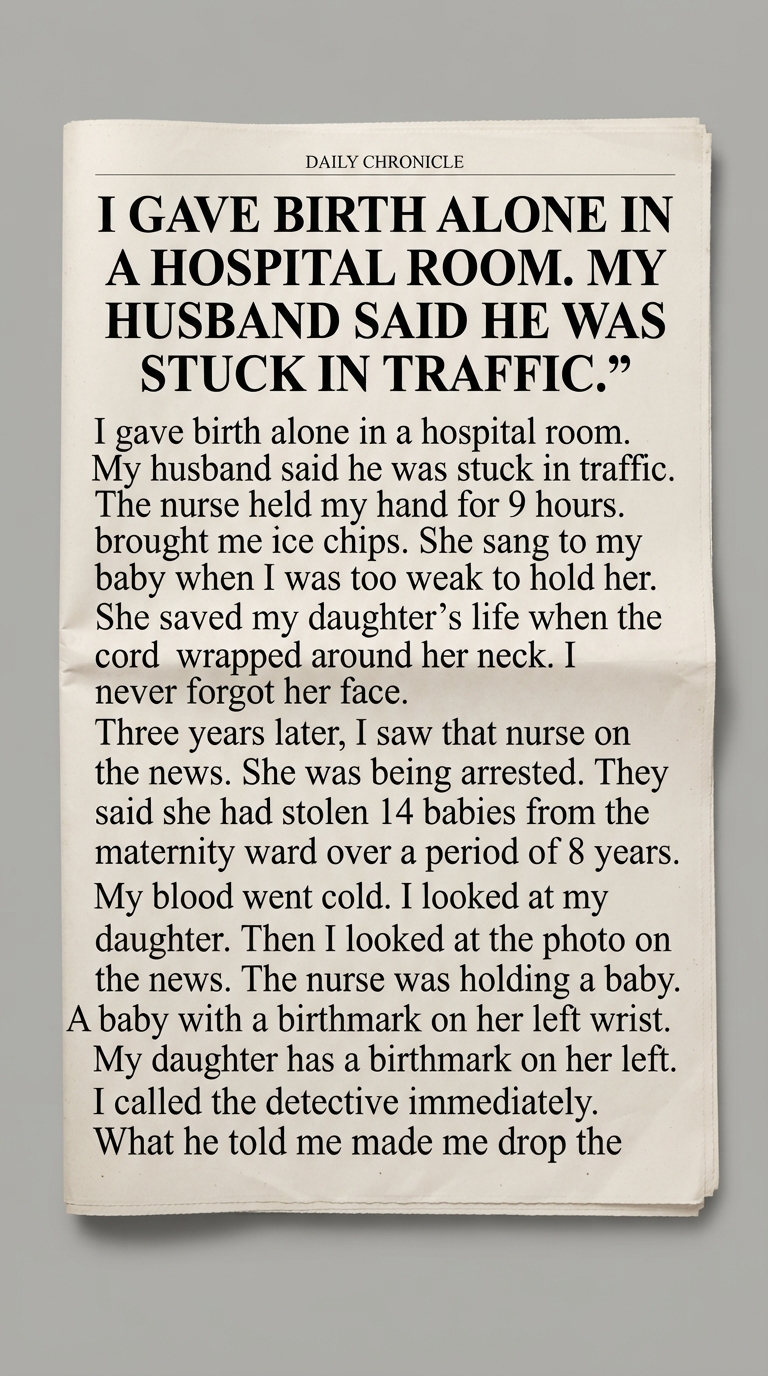
I gave birth alone in a hospital room.
My husband said he was stuck in traffic.
I believed him.
At least, I believed him for the first few hours.
Then the contractions became unbearable.
Then the monitor alarms started.
Then the nurse came into the room and took my hand.
“I’m here,” she said.
Her name was Elena.
I still remember her face.
For nine hours, Elena never left me alone.
She brought me ice chips.
Wiped the sweat from my forehead.
Helped me breathe through contractions.
When I became too weak to hold my daughter after delivery, Elena held the baby against her chest and softly sang to her.
But what I remember most happened at 4:13 in the morning.
The fetal monitor suddenly screamed.
Elena’s expression changed.
“The cord’s wrapped around her neck.”
Everything happened at once.
Doctors rushed in.
Nurses moved around me.
Someone told me to push.
I couldn’t.
I was exhausted.
Terrified.
Then Elena leaned close to me.
“Look at me.”
I did.
“You’re going to do this.”
“I can’t.”
“Yes, you can.”
She squeezed my hand.
“One more.”
I pushed.
My daughter came into the world silent.
For two terrifying seconds, there was no cry.
Then Elena lifted her.
The baby gasped.
And finally cried.
I sobbed.
Elena smiled.
“She’s here.”
I remember her holding my daughter’s tiny hand.
“Beautiful.”
Then she noticed a small reddish birthmark on the baby’s left wrist.
“Look.”
I was too exhausted to focus.
“What?”
“This.”
She gently touched it.
“Unique little mark.”
I smiled.
“I’ll never forget it.”
Neither did I.
Three years later, I was making breakfast when the television interrupted the morning news.
I almost ignored it.
Then I heard a familiar name.
“Elena Marquez…”
My hands froze.
The reporter continued.
“A former maternity nurse is facing multiple charges after investigators uncovered evidence that she allegedly removed fourteen newborns from a hospital maternity ward over an eight-year period.”
The mug slipped from my hand.
It shattered on the kitchen floor.
I didn’t notice.
I was staring at the television.
A photograph appeared.
A woman being escorted by police.
Elena.
My nurse.
The woman who had held my hand for nine hours.
The woman who had saved my daughter’s life.
I felt sick.
Then the news showed another image.
A photograph recovered from the investigation.
Elena was holding a newborn baby.
I looked closer.
There was a birthmark.
On the baby’s left wrist.
My breathing stopped.
I turned toward my daughter.
She was sitting at the kitchen table eating cereal.
Her little wrist was resting beside the bowl.
The same birthmark.
I grabbed my phone.
I called the detective whose number appeared beneath the broadcast.
He answered after several rings.
“This is Detective Harris.”
“My name is Amanda Reed.”
He listened as I explained.
Then I said:
“My daughter has a birthmark on her left wrist.”
The line went silent.
Then he said:
“Mrs. Reed, don’t tell anyone else about that yet.”
My stomach dropped.
“Why?”
“Because the birthmark you’re describing is part of the evidence we’re currently investigating.”
I sat down.
“What does that mean?”
“I need you and your daughter at the station.”
“Is she in danger?”
“We don’t know.”
I looked at my little girl.
“Then tell me.”
The detective exhaled.
“We believe some of the babies may have been illegally transferred through falsified records.”
My heart stopped.
“Transferred where?”
“We’re still determining that.”
He paused.
“But one photograph recovered from Elena’s home may be connected to your daughter.”
I could barely speak.
“What photograph?”
“The one you saw on the news.”
I stared at the television.
“The baby in that photograph may not be your daughter.”
My heart pounded.
“What?”
“Mrs. Reed, Elena took photographs of many newborns.”
“Then why did you tell me about the birthmark?”
“Because the birthmarks were deliberately documented.”
I felt dizzy.
“Why?”
“We don’t know yet.”
I looked at my daughter.
She was three.
She had my husband’s dark hair.
My eyes.
His crooked smile.
Everything about her felt like mine.
But suddenly I needed certainty.
The detective continued.
“There’s something else.”
“What?”
“Your husband.”
My blood went cold.
“What about him?”
“We need to talk about what he told hospital investigators.”
My voice dropped.
“What did he say?”
“That he wasn’t at the hospital when your daughter was born.”
I closed my eyes.
“I know.”
“He said he was stuck in traffic.”
“Yes.”
“He also told investigators he had never met Nurse Marquez.”
I opened my eyes.
“That isn’t true.”
“What?”
“My husband met her.”
“When?”
“Before I went into labor.”
The detective became quiet.
“What exactly happened?”
I remembered.
Three years earlier.
Just before my labor intensified, my husband had stepped into the hallway.
I remembered seeing him talking to Elena.
They spoke for several minutes.
When he returned, he had seemed strangely calm.
I had forgotten about it.
Until now.
“I saw them together,” I whispered.
The detective said:
“Mrs. Reed, don’t contact your husband.”
“Why?”
“We believe he may be connected to the investigation.”
The room seemed to tilt.
My husband.
The man who said he had been stuck in traffic.
The man who missed the birth of his daughter.
The man who had spent three years telling me it was the worst night of his life because he couldn’t get to the hospital.
Could he have known?
Could he have been involved?
I looked at my daughter.
And suddenly every memory of that night felt different.
I went to the police station with my daughter.
They took a photograph of her wrist.
They collected the original hospital records I’d kept.
Then the detective asked me something unexpected.
“Do you still have the bracelet?”
“What bracelet?”
“The newborn identification bracelet.”
I nodded.
“It might still be in her baby book.”
When I got home, I searched through the box where I’d kept her hospital memories.
There it was.
A tiny plastic bracelet.
My daughter’s name.
Birth date.
Medical number.
I gave it to the detectives.
Two hours later, Harris called.
“Mrs. Reed.”
“Yes?”
“We found something.”
My heart stopped.
“What?”
“The medical number on your daughter’s original bracelet doesn’t match the number in one of the hospital’s electronic records.”
I couldn’t breathe.
“What does that mean?”
“It means someone changed the record.”
I sat down.
“Are you saying my daughter was switched?”
“We don’t know yet.”
He continued carefully.
“But the record alteration happened the same night she was born.”
My hands were shaking.
“Who changed it?”
“That is the question we’re trying to answer.”
Two days later, investigators searched Elena’s old storage unit.
They found boxes.
Photographs.
Copies of medical forms.
Baby bracelets.
And handwritten notes.
Fourteen names.
Fourteen birth dates.
Fourteen babies.
My daughter’s name was not on the list.
I thought that was good news.
It wasn’t.
Harris called again.
“There’s another folder.”
“What does it say?”
He hesitated.
“Family placement.”
“What’s inside?”
“Adoption records.”
My heart stopped.
“From the same hospital?”
“Yes.”
“And?”
“One file contains a photograph of a baby with the same birthmark as your daughter.”
I couldn’t speak.
“Where is that baby now?”
The detective was silent.
Then he said:
“In another state.”
I closed my eyes.
“No.”
“We’re verifying DNA.”
“I have my daughter.”
“We understand.”
“No.”
My voice cracked.
“You don’t understand.”
She wasn’t a file.
She wasn’t a photograph.
She was my little girl.
I had spent three years raising her.
Teaching her to walk.
Comforting her nightmares.
Knowing which song helped her sleep.
She called me Mommy.
How could anyone tell me that she wasn’t mine?
Harris said:
“I know this is devastating.”
“What does the DNA say?”
“We’re waiting.”
The results came back three days later.
I sat across from the detective.
My attorney was beside me.
Harris placed two envelopes on the table.
“The first test compares you with your daughter.”
I opened it.
The result was clear.
I was her biological mother.
I began crying.
I didn’t know whether it was relief or pain.
“She’s mine.”
Harris nodded.
“Yes.”
I looked up.
“And the other baby?”
“We are still investigating.”
I stared at him.
“Then why was the record changed?”
He opened the second folder.
Inside was a set of hospital documents.
One signature had been forged.
My husband’s.
I looked at it.
“I know that signature.”
“So do we.”
I felt sick.
“Where is he?”
“We can’t tell you yet.”
My attorney touched my arm.
“Don’t contact him.”
I nodded.
But there was another question burning inside me.
“Why?”
Harris slid another document across the table.
A financial transfer.
My husband’s name.
A private adoption agency.
A payment made three years earlier.
The date was two days before my daughter was born.
I stared at it.
“What was he paying for?”
Harris said quietly:
“We believe your husband had arranged a private adoption of an infant.”
My entire body went cold.
“Why?”
“We don’t know.”
I looked at the document again.
“He wanted another child?”
“No.”
Harris looked at me.
“We think he was trying to hide a debt.”
I didn’t understand.
Then he showed me the emails.
My husband had been deep in debt.
He owed people money.
He had been threatened.
And according to the messages, someone had offered him a way out.
A newborn.
A false adoption.
A payment.
Then a line that made me physically sick:
Nobody will suspect the mother.
I covered my mouth.
“What does this mean?”
“We believe your husband may have entered an arrangement involving another infant.”
“But my daughter?”
“We’re still investigating whether he intended to take your daughter or use her medical information to facilitate the transaction.”
I stood abruptly.
“My daughter was never supposed to be involved in this.”
“No.”
Harris looked at me.
“You may have saved her without even knowing it.”
A week later, Elena finally agreed to speak.
Not to the media.
To investigators.
She told them everything.
She had been taking photographs of babies because she was working with people who falsified medical records.
But then she made a decision.
She began secretly documenting what was happening.
The photographs weren’t evidence of stolen babies.
They were evidence she had preserved because she knew the scheme would eventually be exposed.
The birthmarks were important because they helped investigators identify babies when records had been altered.
She had saved copies.
Bracelets.
Photographs.
Names.
Medical details.
Everything.
Then came the final revelation.
Elena had never stolen my daughter.
She had protected her.
When the emergency happened during my labor, another nurse had attempted to move my daughter to a different room.
Elena stopped her.
She recognized the birthmark.
She knew there was something suspicious in the baby’s chart.
So she stayed.
She made sure my daughter never left my room.
She held her.
She watched her.
She sang to her.
She stayed until I was strong enough to hold my own child.
The woman I had feared for three years had actually been the one person standing between my daughter and a criminal scheme.
I cried when Harris told me.
“What about the other babies?”
“Some were located.”
“Some?”
“Fourteen children were identified as victims in the broader investigation, but the circumstances weren’t identical.”
I closed my eyes.
“And Elena?”
“She will face charges related to her role, but her cooperation is significant.”
I nodded.
Then I said:
“She saved my daughter.”
“Yes.”
My husband was arrested two weeks later.
He admitted he had been desperate.
He admitted he had contacted people connected to the illegal adoption network.
But he claimed he never intended our daughter to be harmed.
That wasn’t enough.
You don’t get to gamble with a child’s identity and call it desperation.
Our marriage ended.
Not because he missed the birth.
Not because he lied about traffic.
Because I discovered he had been willing to put our child into a situation where she could have disappeared forever.
Our divorce was final the following year.
He lost custody while the court reviewed the evidence.
I never let my daughter hear the worst details.
She knew only that her father had made very bad choices.
One day, when she was old enough, I would tell her the whole truth.
But not yet.
For now, she deserved to be a child.
Three years after that morning on the news, I returned to the hospital.
Elena had completed her legal process.
She wasn’t working there anymore.
But I found her.
She was living quietly.
When she opened the door, she looked surprised to see me.
Then she saw my daughter.
My little girl ran forward.
“Mommy!”
I smiled.
Then I turned toward Elena.
For a moment, neither of us spoke.
Finally, I said:
“You saved her.”
Elena began crying.
“I tried.”
I shook my head.
“No.”
I pointed gently toward my daughter.
“You did.”
My daughter held up her wrist.
“Look!”
The birthmark was still there.
Elena smiled through her tears.
“I remember that.”
“I do too.”
Then my daughter asked:
“Who is she?”
I looked at Elena.
Then at my daughter.
“She was one of the people who helped bring you safely into this world.”
My daughter smiled.
“Thank you.”
Elena covered her mouth.
She couldn’t speak.
I hugged her.
For nine hours, she had held my hand.
For three years, I had remembered her face with suspicion and fear.
And all along, that face belonged to the woman who had protected my child when I was too exhausted to protect her myself.
Before we left, Elena touched my daughter’s wrist gently.
“Keep your little mark safe.”
My daughter nodded.
“I will.”
Years later, my daughter would ask about the birthmark.
I’d tell her:
“That little mark saved your life twice.”
She would laugh.
“How?”
“First, it helped someone know exactly who you were.”
“And second?”
“It helped your mother find the truth.”
She’d smile.
Then she’d ask:
“Was I always yours?”
I’d take her hand.
“Yes.”
“Always?”
“Always.”
Because DNA had proved something the fear had tried to take away.
My daughter was mine.
Not because of paperwork.
Not because of a hospital bracelet.
Not because of a birth certificate.
Because I had carried her.
Loved her.
Raised her.
And never stopped searching for the truth when something felt wrong.
I used to think the nurse who held my hand for nine hours was a haunting memory from the worst night of my life.
Now I understand.
She wasn’t the person I needed to fear.
She was one of the reasons my daughter came home with me.
And every time I look at that tiny birthmark on my daughter’s wrist, I remember one lesson I will never forget:
Sometimes the person you are warned to fear is the person who was quietly protecting you all along.