The Letter Under My Jacket
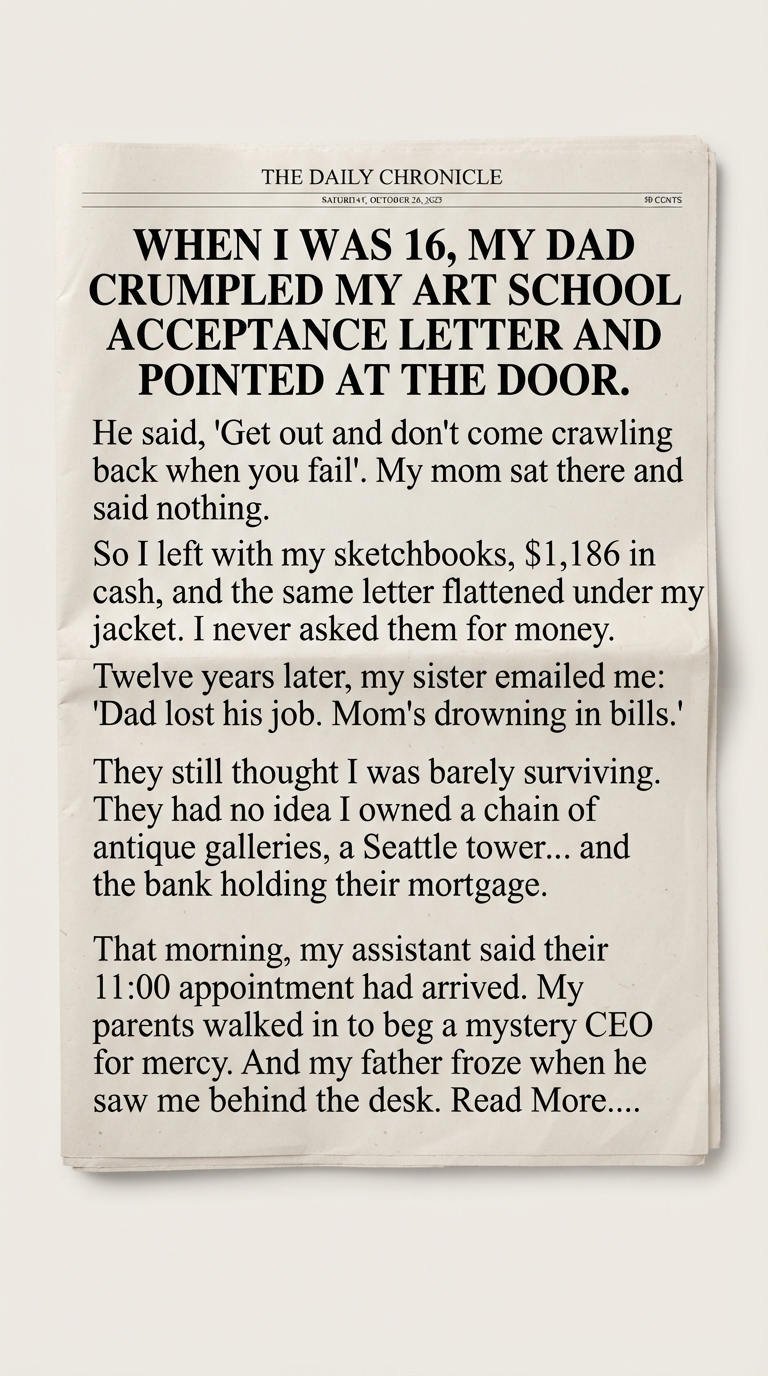
I still remember the sound the paper made when my father crushed it in his fist—that acceptance letter from Pratt, the one I’d checked the mailbox for every day for three weeks. He didn’t even read it twice. Just looked at the return address, looked at me, and threw it at my chest like it was something contaminated.
“Art school,” he said, like the words tasted rotten. “Get out. And don’t come crawling back when you fail.”
My mother sat at the kitchen table, hands wrapped around a mug of coffee that had long gone cold, and said nothing. She didn’t look up. That silence taught me more that night than sixteen years of living under their roof ever had.
I picked the letter up off the floor, smoothed it flat against my knee, and put it inside my jacket, against my chest, like armor. I packed two sketchbooks, a set of charcoal pencils I’d saved four months to buy, and $1,186 in cash from two years of mowing lawns and selling caricatures at the county fair. Then I walked out the door and didn’t look back, because I’d already learned that looking back only gave people another chance to hurt you.
I won’t pretend the next few years were easy. I slept in a friend’s car for two months. I worked mornings at a print shop and nights washing dishes, and I drew every single day, because drawing was the only thing that had never once told me I wasn’t enough. A gallery owner in Portland noticed my sketches taped up behind the print shop counter and offered me wall space for a weekend show. That weekend changed everything. Buyers came. Word spread. One show became three galleries, then a partnership, then a chain of antique and fine art galleries stretching from Seattle to San Francisco. Along the way I started investing—in property, in a small regional bank that needed capital, in things my father would have called impractical if he’d known any of it was happening.
I never told them. Not out of cruelty. Out of self-preservation. I had built a life with my own hands, and I wasn’t going to hand them the satisfaction of taking credit for it, or the opportunity to tell me it wasn’t real.
Twelve years passed. Then my sister, Renee—the only one who’d ever texted me on birthdays—sent an email. Dad lost his job. Mom’s drowning in bills. I didn’t know who else to tell.
I didn’t respond right away. I sat with it for a long time, staring at the cursor, remembering the sound of paper crumpling.
Then, three weeks later, my assistant buzzed my office. “Your eleven o’clock is here. A Mr. and Mrs. Hargrove. They said it’s about a mortgage restructuring appeal.”
I hadn’t made the connection until the door opened.
My parents walked in, older than I remembered, my father’s shoulders rounded in a way they’d never been when he was crushing letters in his fist. He was clutching a manila folder of paperwork like it might save him. My mother’s eyes were red-rimmed, the kind of tired that comes from months of sleepless math.
They were here to beg a bank executive for mercy on a mortgage that was, unbeknownst to them, held by a holding company I owned outright.
My father looked up from the folder to introduce himself to the CEO he’d been told would be reviewing their case.
He froze.
The folder slipped slightly in his hands. My mother’s mouth opened, and nothing came out—the same nothing she’d offered me twelve years earlier at that kitchen table.
“Dad,” I said quietly, gesturing to the chairs across from my desk. “Mom. Please, sit down.”
I didn’t say anything about the letter. I didn’t need to. It was framed on the wall behind me, flattened under glass, exactly the way I’d carried it out of that house—the one thing I’d never let go of, because it reminded me every single day what I was capable of building when no one believed in me.
“I heard you’re having some trouble with the house,” I said. “Let’s talk about what we can do.”
My father’s eyes moved slowly from my face to the frame on the wall, and I watched twelve years of certainty drain out of him all at once.