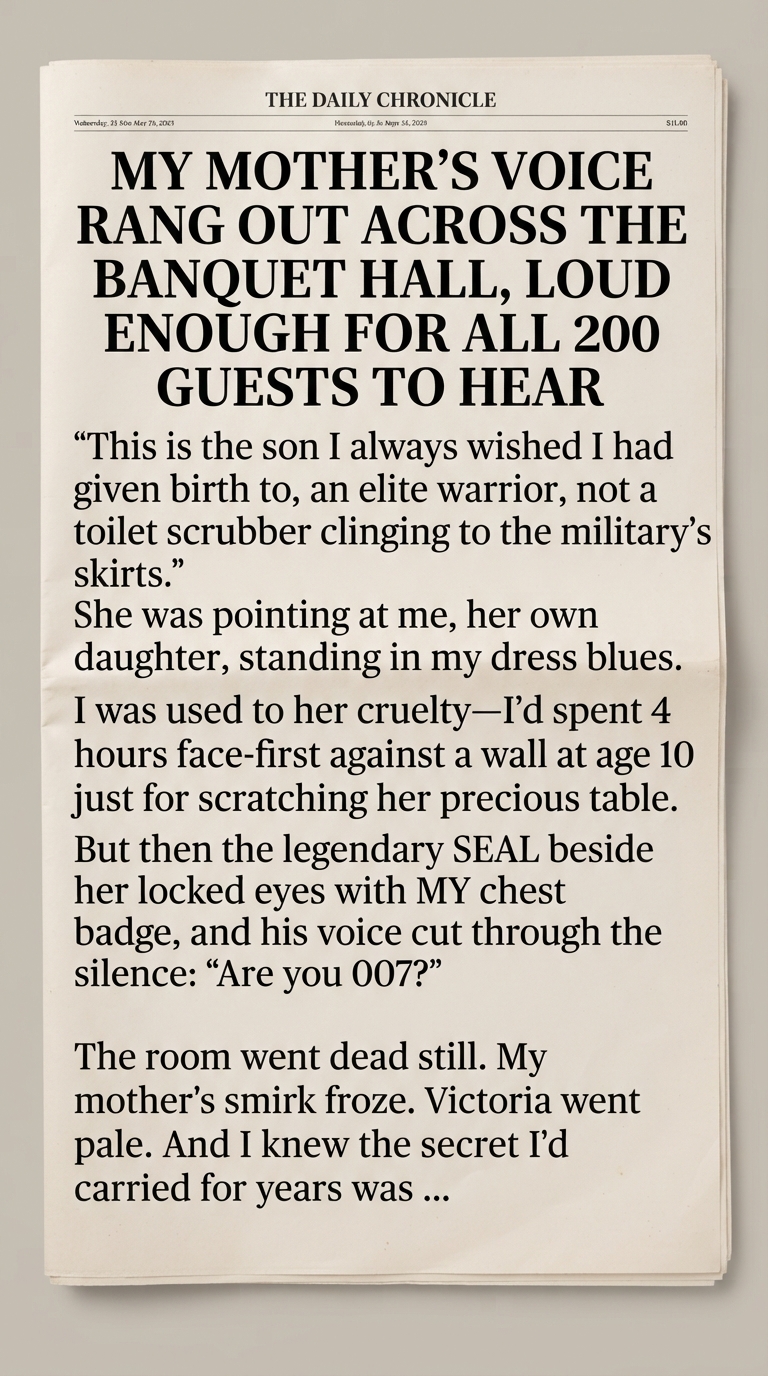
My mother’s voice rang out across the banquet hall, loud enough for all two hundred guests to hear.
“This is the son I always wished I had given birth to—an elite warrior, not a toilet scrubber clinging to the military’s skirts.”
She was pointing at me.
Her own daughter.
I stood beneath the chandeliers in my dress blues, my posture straight, my hands folded calmly behind my back.
I had learned long ago not to react when my mother wanted an audience.
Still, those words hurt.
Not because they were new.
Because they were familiar.
I had spent my entire childhood learning how to become invisible around her.
At ten years old, she had once made me stand face-first against a wall for four hours because I’d accidentally scratched an antique dining table.
At fourteen, she told relatives I was “slow” because I preferred books to parties.
At seventeen, when I enlisted, she told me I was “running away because I wasn’t good enough for college.”
And now, at thirty-four, after years of military service, she still found a way to reduce everything I’d accomplished to an insult.
“Victoria,” my younger brother said awkwardly.
My mother waved him off.
“I’m just telling the truth.”
Then she turned toward the man beside her.
The room had been waiting for him all evening.
Commander Gabriel Kane.
Retired SEAL.
Decorated veteran.
Living legend in certain military circles.
I’d seen his name in official briefings.
I’d read articles about the operations he had participated in.
He was the kind of person people spoke about carefully.
My mother had been bragging about him for an hour.
“Gabriel has done more for this country than anyone in this room,” she said.
Then she looked at me.
“Unlike some people.”
The room went quiet.
Gabriel didn’t laugh.
He didn’t even look at my mother.
He was staring at my chest.
More specifically, at the small badge above my ribbons.
His expression changed.
He took one step toward me.
Then another.
Finally, he stopped directly in front of me.
He looked at my badge.
Then at my face.
“Are you 007?”
The room went completely dead still.
My mother’s smirk disappeared.
Victoria went pale.
Someone near the champagne table whispered,
“007?”
I said nothing.
Gabriel stared at me.
“Ma’am?”
My mother’s face had gone from smug to confused.
“What are you talking about?”
Gabriel didn’t look at her.
He looked at me.
I gave him the smallest nod.
His jaw tightened.
“Oh my God.”
My mother laughed nervously.
“This is ridiculous.”
Gabriel finally turned toward her.
“Do you know who you’re insulting?”
She blinked.
“She’s my daughter.”
“Yes.”
He looked back at me.
“And you have no idea who your daughter is.”
The room seemed to shrink.
My mother shook her head.
“She works in the military.”
Gabriel’s voice was quiet.
“She commanded classified operations.”
A murmur moved through the room.
My brother stared at me.
“What?”
My mother looked at me.
“You?”
I didn’t answer.
Gabriel continued.
“She wasn’t a toilet scrubber.”
He glanced at my ribbons.
“She was the person we called when other people couldn’t complete the mission.”
I felt every eye in the room on me.
For years, I’d kept my work separate from my family.
I never discussed classified assignments.
Never showed photographs.
Never told stories.
I’d simply let my mother believe I had a minor administrative role.
That was easier.
Safer.
And after a while, I’d almost convinced myself that maybe I deserved the way she treated me.
Gabriel destroyed that illusion in less than a minute.
He pointed toward my chest.
“Do you know what that badge means?”
My mother said nothing.
“It means she wasn’t simply assigned to military operations.”
He paused.
“It means she led them.”
Someone at the table whispered,
“Special operations?”
Gabriel nodded.
“More than that.”
He looked at me.
“She was 007.”
The words sounded almost unreal.
My younger brother stared.
“What does 007 mean?”
I finally spoke.
“It isn’t a nickname.”
Gabriel smiled faintly.
“No.”
His eyes moved around the room.
“It’s a call sign.”
My mother suddenly looked frightened.
“A call sign for what?”
I answered this time.
“For an interagency special operations task group.”
Gabriel nodded.
“She operated under multiple commands.”
My mother shook her head.
“You’re making this up.”
Gabriel looked almost offended.
“I trained with her.”
He turned toward the audience.
“I saw her walk into situations most people never knew existed.”
Then he looked at me again.
“She saved lives that will never be publicly credited to her.”
Silence.
I could hear the orchestra’s air-conditioning system.
Nothing else.
My mother looked at my ribbons.
Then my rank.
Then my face.
“Why didn’t you tell us?”
I almost laughed.
“You never asked.”
She stared at me.
“You made me believe…”
“I know.”
“You let me think you were…”
“A disappointment?”
She looked away.
I swallowed.
“You taught me to become small.”
The sentence landed harder than any military recognition ever could.
My mother opened her mouth.
No sound came.
I looked around the ballroom.
Two hundred people were watching.
Some looked embarrassed.
Some looked shocked.
A few looked at my mother with something close to disgust.
But I wasn’t interested in humiliating her.
I’d had enough of that.
Instead, I turned toward the stage.
The event was supposed to be a military charity banquet.
There were donors.
Officers.
Veterans.
Government officials.
And people who had spent years supporting military families.
The host suddenly walked toward me.
“Ma’am,” he said quietly, “would you like to say something?”
I shook my head.
“No speech.”
Gabriel smiled.
“She doesn’t need one.”
He turned toward my mother.
“You owe her something.”
My mother looked at him.
“What?”
“Respect.”
She began crying.
“I didn’t know.”
I looked at her.
“That was always the problem.”
After the banquet, my mother followed me into the parking area.
“Wait.”
I stopped.
She stood there alone.
No audience.
No microphone.
No performance.
Just my mother.
“You really did all of that?”
I nodded.
“For how long?”
“Fourteen years.”
She stared at me.
“Fourteen?”
“Yes.”
She looked down.
“Why didn’t you tell me?”
I finally said what I’d wanted to say since I was ten.
“Because every time I did something difficult, you found a way to make it sound small.”
She began crying.
“I thought you hated me.”
I shook my head.
“No.”
“Then why?”
“Because I kept hoping you’d become the mother I needed.”
She covered her face.
I waited.
“I was wrong.”
That sentence was painful.
But strangely freeing.
She looked at me.
“Can you forgive me?”
I thought about the wall.
The table.
The insults.
The years of being compared to my brother.
The countless dinners where I had been introduced as the daughter who “worked for the military.”
Then I thought about something else.
My own life.
Everything I’d built.
Everything she’d failed to see.
“I don’t know yet.”
She nodded.
“That is fair.”
Then she asked:
“Are you proud of yourself?”
The question caught me off guard.
I looked down at my uniform.
For the first time, I didn’t see it through my mother’s eyes.
I saw what it represented.
Years of training.
Losses.
Long nights.
People I couldn’t save.
People I did.
A life built from discipline.
I looked at her.
“Yes.”
Her eyes filled with tears.
“I’m proud of you too.”
I believed she meant it.
But forgiveness doesn’t erase history.
A few weeks later, I received a letter from Gabriel.
He wrote:
You don’t need anyone in your family to validate what you did.
Then:
But I’m glad they finally saw it.
I smiled.
He had been one of the few people who knew how difficult those years had been.
There was a final sentence.
You were never 007 because you were fearless. You were 007 because you kept moving while you were afraid.
I folded the letter.
Put it in a drawer.
And went back to work.
Months passed.
My mother began changing.
Not dramatically.
Quietly.
She stopped making jokes about my career.
Stopped comparing me to my brother.
Stopped introducing me as “the daughter who works for the military.”
Instead, when people asked about me, she said:
“My daughter served her country.”
Sometimes she got the details wrong.
Sometimes she still didn’t understand what I’d actually done.
But she was trying.
And for the first time, I didn’t need her understanding to feel proud.
One evening, she called.
“Can I ask you something?”
“Sure.”
“What does 007 actually mean?”
I laughed.
“You really want to know?”
“Yes.”
“No.”
She laughed.
“Why not?”
“Because some things are better left classified.”
There was a pause.
Then she said:
“I deserved that.”
I smiled.
“Maybe.”
She grew quiet.
Then:
“I have something for you.”
“What?”
“A box.”
I frowned.
“What kind of box?”
“You’ll see.”
A week later, a package arrived.
Inside was the antique table I’d supposedly damaged when I was ten.
My mother had restored it.
On the bottom, she had carved something herself.
For my daughter, who survived being underestimated.
I stared at it for a long time.
Then I cried.
Not because the past had disappeared.
It hadn’t.
But because sometimes people don’t apologize with words first.
Sometimes they finally admit, in small ways, that they were wrong.
Years later, I attended another military banquet.
This time, I was the keynote speaker.
Hundreds of people filled the ballroom.
My mother sat in the front row.
She was wearing the same proud expression she once reserved for my brother.
The host introduced me.
“Colonel—”
I held up a hand.
“Just call me by my name.”
The audience laughed.
I stepped onto the stage.
I looked at my mother.
Then at the room.
And I said:
“I spent years believing that strength meant never letting anyone see you hurt.”
I paused.
“I was wrong.”
The room became quiet.
“Strength is knowing who you are even when someone else insists on telling you you’re worthless.”
My mother wiped her eyes.
I continued.
“Some people will spend your entire life trying to define you by the worst thing they believe about you.”
I smiled.
“Don’t let them.”
The applause started slowly.
Then grew.
I looked toward my mother.
She stood.
And clapped harder than anyone.
After the speech, Gabriel came over.
He shook my hand.
“007.”
I laughed.
“I thought that was classified.”
“Not anymore.”
I looked at my mother.
She smiled.
Then Gabriel asked:
“Do you know why everyone froze when I said it?”
I thought for a moment.
“Because they knew the truth?”
He shook his head.
“Because for once, your mother was forced to see you through someone else’s eyes.”
That stayed with me.
For most of my life, I’d waited for my mother to tell me I was enough.
I finally understood.
That had never been her job.
And it certainly wasn’t mine to earn.
I had been enough at ten.
Enough at seventeen.
Enough in uniform.
Enough without the uniform.
Enough when nobody was applauding.
Enough before anyone knew my call sign.
My mother had spent years calling me a disappointment.
One night, two words changed the room.
“Are you 007?”
But the greatest secret wasn’t the identity behind the call sign.
It was this:
The woman my mother thought she had broken had never been broken at all.
She had simply been learning how to stand without her mother’s approval.
And once I finally learned how…
I never stood back down.