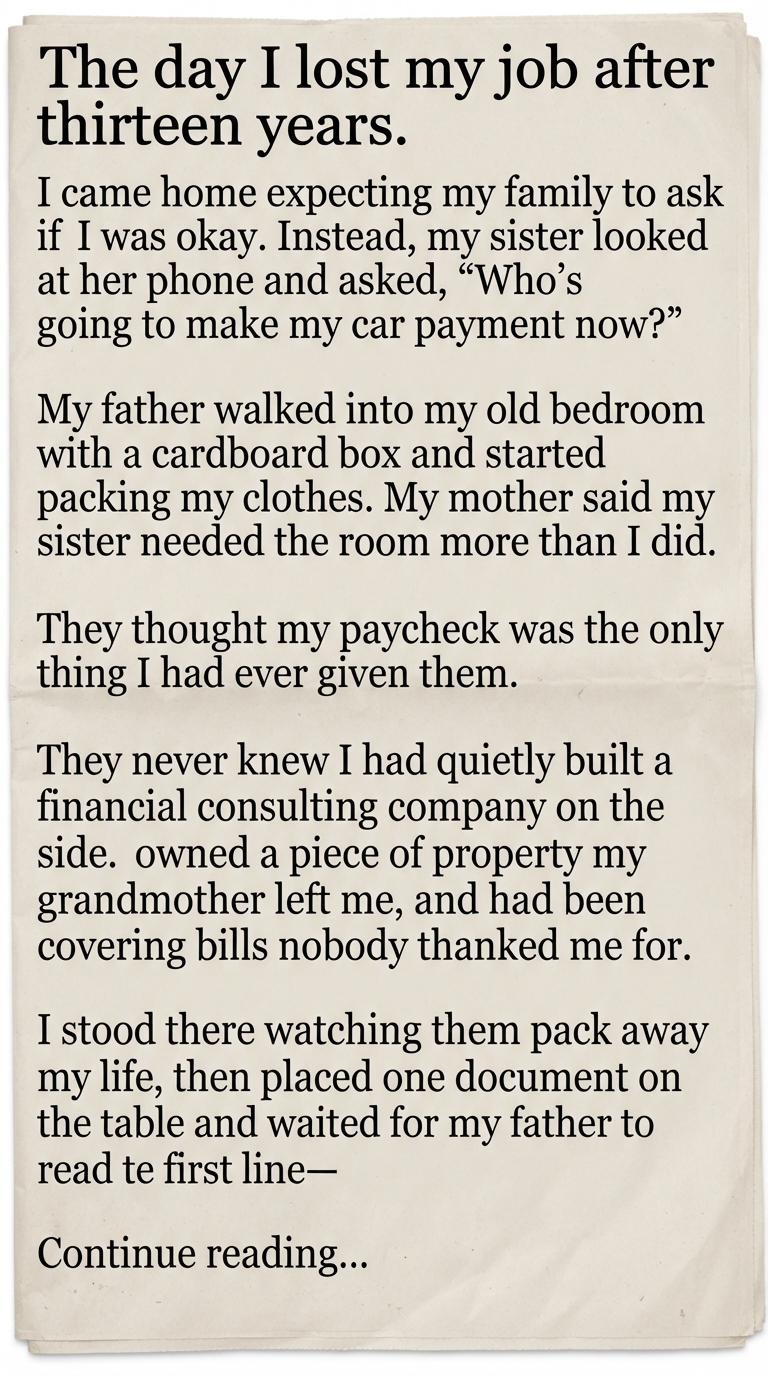
The day I lost my job after thirteen years, I came home expecting my family to ask if I was okay.
Instead, my sister looked at her phone and asked:
“Who’s going to make my car payment now?”
I stood in the doorway.
For thirteen years, I’d worked at the same company.
Thirteen years of early mornings.
Late nights.
Missed birthdays.
Weekend calls.
Promotions that came with more responsibility but not nearly enough sleep.
And when the company finally downsized, my position was eliminated.
I drove home feeling numb.
Not because I didn’t know I’d eventually find another job.
I was good at what I did.
I had savings.
I had a plan.
What hurt was imagining telling my family.
I thought my mother would hug me.
I thought my father would tell me we’d figure it out.
I thought my sister would at least ask whether I was okay.
Instead, she looked at her phone.
“Who’s going to make my car payment now?”
I stared at her.
“What?”
She sighed.
“My payment is due Friday.”
I looked toward my mother.
“Mom?”
She avoided my eyes.
My father walked down the hallway carrying a cardboard box.
He stopped at my bedroom door.
“Where should we put this?”
I frowned.
“What are you doing?”
He opened my closet.
“Packing your things.”
I laughed because I thought it was a joke.
“You’re packing my things?”
My father didn’t laugh.
“Your sister needs this room.”
I stared at him.
“She has a room.”
“She needs the bigger one.”
I looked at my mother.
“What is happening?”
She sighed.
“You aren’t working now.”
I waited.
“So?”
“So we have to make practical decisions.”
My sister folded her arms.
“She’ll be okay.”
My father pulled a stack of my clothes from the closet.
I stepped forward.
“Put those down.”
He didn’t.
“This is my house.”
I stared at him.
“No.”
He stopped.
“What?”
“This is not your house.”
He laughed.
“It absolutely is.”
I didn’t argue.
Not yet.
Because they didn’t know.
They didn’t know about the company.
They didn’t know about the property.
And they certainly didn’t know how much money I’d been quietly using to keep this family afloat.
For years, they’d looked at my paycheck and assumed that was the source of everything.
They never wondered what happened to the rest of my life.
I had kept my side business private.
Partly because I didn’t want my family asking for more.
And partly because my grandmother had taught me something important:
“Never let everyone know where the floor beneath you ends.”
She had left me a small commercial property seven years earlier.
A two-story building in a growing neighborhood.
At the time, it wasn’t worth much.
I rented the storefront.
Used the upstairs office.
And started a small financial consulting company.
At first, it was just me.
One client.
Then three.
Then ten.
Eventually, I had a real business.
Not enormous.
But profitable.
Very profitable.
I had reinvested almost everything.
My family knew none of it.
They thought I was simply a salaried employee.
They had no idea I had built something of my own.
And now my father was packing my clothes into a cardboard box.
My sister was worried about her car payment.
My mother was deciding who deserved my bedroom.
I watched them.
Then I walked into the kitchen.
I opened my purse.
Pulled out one document.
And placed it on the table.
My father walked over.
“What is this?”
“Read the first line.”
He did.
His face changed.
The room went silent.
The first line said:
NOTICE OF TRANSFER OF OWNERSHIP — BENNETT FAMILY PROPERTY LLC
Underneath was the legal description of the house.
My house.
The house my parents had lived in for twenty-two years.
The house they had always called “the family home.”
My name was the only name on the ownership document.
My father stared at it.
“This isn’t real.”
“It is.”
My mother came closer.
“Where did you get this?”
“I bought the house from Grandma’s estate.”
My father shook his head.
“She left the house to all of us.”
“No.”
I pointed toward the second page.
“She left the property to me.”
My father’s face went pale.
“You never told us.”
“You never asked.”
My sister laughed nervously.
“You can’t kick us out.”
I looked at her.
“I’m not kicking anyone out.”
“Then what does this mean?”
I picked up another document.
“The mortgage.”
My mother stared.
“The mortgage is in my name.”
Silence.
My father looked at me.
“You’ve been paying for this house?”
“Yes.”
“How long?”
“Six years.”
My sister’s face changed.
“You paid the mortgage?”
“Yes.”
“The taxes?”
“Yes.”
“Insurance?”
“Yes.”
She looked at my mother.
My mother sat down.
I continued.
“I also paid your car insurance.”
I looked at my sister.
“And your car payment.”
She opened her mouth.
“And Dad’s medical premiums.”
My father looked shocked.
“And the credit card you’ve been carrying.”
My mother covered her mouth.
I pulled another page from the folder.
“A list of recurring payments.”
I placed it on the table.
Groceries.
Utilities.
Property taxes.
Car payment.
Insurance.
Medical bills.
School expenses.
Every month.
For years.
No one had thanked me.
They had simply assumed the money appeared.
My father sat down.
“Why didn’t you tell us?”
I looked at him.
“Because you never asked.”
My sister started crying.
“I thought you were doing fine.”
“I was.”
“Then why didn’t you just tell us you had money?”
“Because every time you knew I had something, you needed something.”
She looked away.
That was true.
Then my father asked the question I had been waiting for.
“What does the property company have to do with this?”
I smiled faintly.
“That company is mine too.”
He frowned.
“What company?”
I pulled out another document.
Bennett Financial Advisory LLC.
Under “Managing Member” was my name.
Under annual revenue?
A number large enough to make my father’s jaw drop.
My mother whispered:
“How long?”
“Five years.”
My father looked at me.
“You built this while working full-time?”
“Yes.”
“And you never told us?”
“No.”
“Why?”
I looked around the room.
“Because I knew what would happen.”
Nobody spoke.
I continued.
“You would ask for help.”
“We did,” my sister whispered.
“Yes.”
“But you already knew.”
“I did.”
“Then why keep helping us?”
I looked at her.
“Because I loved you.”
That shut everyone up.
The next morning, I met with my attorney.
I didn’t want revenge.
I wanted boundaries.
The first thing we did was formally separate my finances from my family’s.
The second was to create a repayment schedule for the money I’d been covering.
Not because I expected to get every dollar back.
Because I needed everyone to understand that support was a choice.
Not an obligation.
Then I made one more decision.
I gave my parents sixty days to decide whether they wanted to rent the house from me.
At market rate.
Or move.
My father was furious.
“You’re charging us rent?”
“Yes.”
“You’re our daughter.”
“And you’re adults.”
My mother cried.
“You’d really make us leave?”
“No.”
I pointed toward the lease.
“I’d give you a fair option.”
My sister stared at me.
“And me?”
“You’ll handle your own car payment.”
She started crying again.
“I can’t afford it.”
“You can sell the car.”
“I don’t want to.”
“I understand.”
She looked at me.
“Why are you doing this?”
I answered honestly.
“Because you didn’t ask how I was doing when I lost my job.”
She was silent.
“You asked who was going to pay your bill.”
Her face collapsed.
For the next few months, everything changed.
My parents signed the lease.
They stayed in the house.
But now they paid rent.
My sister sold her expensive car and bought a used one.
My father began managing his own medical bills.
My mother started tracking her spending.
And I stopped automatically fixing things.
At first, everyone was angry.
Then something unexpected happened.
They started becoming independent.
My father learned how to manage the online banking I’d always handled.
My mother began cooking more instead of ordering delivery.
My sister found a job.
Not a glamorous one.
But her own.
And slowly, the resentment began fading.
One Sunday, my father called me.
“I have something to tell you.”
“What?”
“I paid the electricity bill myself.”
I laughed.
“Congratulations.”
He laughed too.
“It felt strange.”
“Good strange?”
“Very.”
Then he became quiet.
“I think I understand what you were trying to tell us.”
“What?”
“We weren’t treating you like family.”
I didn’t answer.
“We were treating you like a resource.”
That sentence hurt.
Because it was true.
A year after I lost my job, my consulting company had grown significantly.
I hired two employees.
Then five.
Then eight.
My grandmother’s property was now worth more than anyone in my family had imagined.
I still didn’t flaunt it.
I still drove an ordinary car.
I still wore the same watch I’d had for years.
But my life had changed.
Not because I had more money.
Because I no longer felt responsible for carrying everyone.
One evening, my sister came to see me.
She brought a small box.
“What’s that?”
She handed it to me.
Inside was a framed photograph.
The four of us.
Me.
Mom.
Dad.
My sister.
Taken years before.
On the back she’d written:
You were our safety net before we realized you were a person. I’m sorry.
I stared at it.
“You don’t have to apologize.”
“Yes, I do.”
She sat down.
“I thought you owed us because you had more.”
“I never owed you.”
“I know.”
She wiped her eyes.
“I just never asked myself what your life cost you.”
I nodded.
“Most people don’t.”
She looked at me.
“Are we okay?”
I smiled.
“We’re getting there.”
Six months later, my father did something I never expected.
He called a family meeting.
Everyone sat around the dining room table.
He cleared his throat.
“I owe my daughter an apology.”
I looked at him.
He continued.
“The day she lost her job, I thought she had lost everything.”
My mother looked down.
“But she was the only person in the house who actually had a plan.”
He laughed softly.
“She had a business.”
My sister smiled.
“She had property.”
“And she had been paying our bills.”
He looked at me.
“We never knew.”
I said quietly:
“That’s because you never asked.”
He nodded.
“I know.”
Then he stood.
“I want to thank you.”
I shook my head.
“You don’t owe me thanks.”
He smiled.
“Maybe not.”
“But we owe you respect.”
I looked around the table.
That meant more.
Two years later, I sold my grandmother’s property.
The profit was substantial.
I used part of it to expand my company.
I invested the rest.
And I bought myself a house.
Not for my parents.
Not for my sister.
Not for anyone else.
Mine.
A small place with a large kitchen and a backyard full of trees.
The first night I slept there, I sat outside with a glass of wine.
I thought about the cardboard box my father had carried into my old bedroom.
He had thought he was packing away my life.
He hadn’t realized I had already built another one.
A better one.
A life that didn’t depend on a paycheck.
A life that didn’t depend on my family’s approval.
A life where helping people was something I chose instead of something expected.
My father had once told me:
“You don’t need that much money.”
He was right.
I didn’t.
What I needed was the freedom to decide what happened to it.
My sister had once asked:
“Who’s going to make my car payment now?”
I never answered that question.
Because it was never supposed to be my responsibility.
And perhaps that was the most important lesson of all.
I had spent years believing that being a good daughter meant making sure everyone else was comfortable.
I finally realized that being a good daughter, sister, and person also meant knowing when to stop rescuing people who had never learned to stand on their own.
They thought my paycheck was all I had ever given them.
They were wrong.
My paycheck was only the part they could see.
What they couldn’t see was the business I built quietly.
The property my grandmother left me.
The savings I’d protected.
The investments I’d made.
The sacrifices I’d never mentioned.
And the fact that I had been financially independent long before I was emotionally ready to be.
The cardboard box they carried into my bedroom was supposed to symbolize my loss.
Instead, it became the moment I finally understood how much I had.
Not money.
Not property.
Not a company.
Choice.
And once you realize nobody can take that from you…
you stop being afraid of losing everything.