The Thing My Mother Hid Before She Died
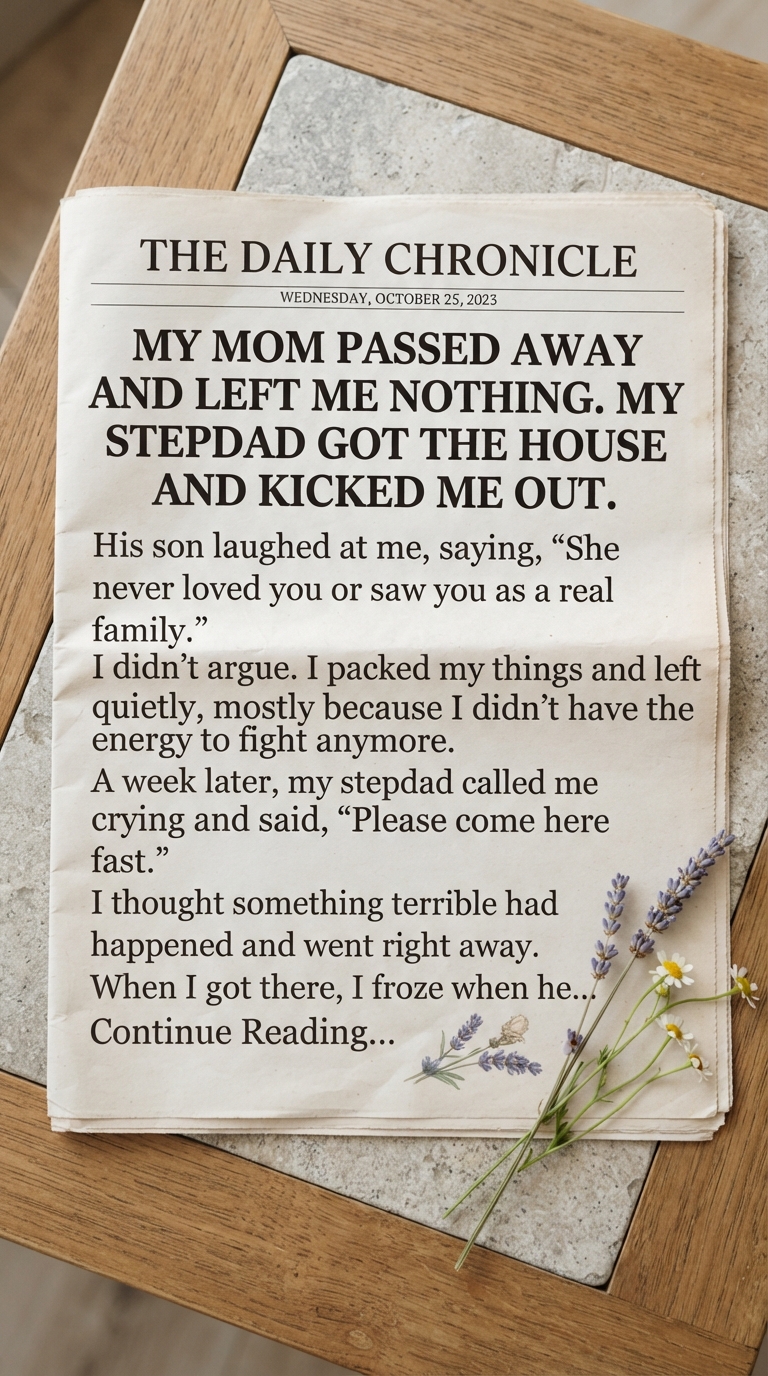
My mom passed away and left me nothing.
At least, that’s what I thought.
My stepdad got the house.
And his son, Derek, made sure I understood exactly what that meant.
He stood in the hallway with his arms crossed while I packed the last of my mother’s things into a cardboard box.
“She never loved you,” he said.
I froze.
Derek smiled.
“That’s why she left the house to Dad.”
I looked at him.
He shrugged.
“She never saw you as real family.”
My stepdad, Robert, didn’t correct him.
He just stood there holding the house keys.
I looked around the place where I had grown up.
The faded family photographs.
The old couch where Mom and I watched movies.
The kitchen where she taught me how to make her famous apple pie.
And the small sunroom where she used to sit every Sunday morning with a cup of coffee.
Now none of it belonged to me.
Or so I thought.
I didn’t argue.
I didn’t scream.
I didn’t demand anything.
I was too tired.
My mother’s illness had taken almost everything out of me.
For two years, I had driven her to appointments.
Sat beside her hospital bed.
Cooked her meals.
Helped her shower.
Held her hand when she was afraid.
And after she died, I didn’t have the strength to fight over furniture or property.
So I packed my clothes.
My childhood photographs.
A few books.
And the sweater Mom had knitted for me.
Then I walked out.
Derek watched me leave.
“Good luck,” he said.
I didn’t answer.
I closed the door behind me.
And I thought that was the end.
It wasn’t.
A week later, my phone rang at 6:14 a.m.
It was Robert.
I almost didn’t answer.
Then I heard his voice.
“Please come here fast.”
He was crying.
My heart stopped.
“What happened?”
“I can’t explain over the phone.”
“Is Derek okay?”
“Yes.”
“Then what is it?”
“Just come.”
I grabbed my coat and drove straight there.
I was expecting the worst.
A medical emergency.
A break-in.
Something terrible.
Instead, when I walked through the front door, I froze.
The house looked completely different.
Boxes covered the dining room.
Documents were spread across the kitchen table.
And Robert was sitting in my mother’s old chair with his head in his hands.
Derek stood beside the fireplace.
His face was pale.
“What happened?” I asked.
Neither of them answered.
Then Robert looked up.
“I was wrong.”
I stared at him.
“About what?”
He picked up a thick envelope.
“About everything.”
He handed it to me.
My name was written across the front.
In my mother’s handwriting.
My hands began shaking.
“What is this?”
“She left it.”
I looked at him.
“To me?”
He nodded.
“But the will said you got the house.”
Robert looked away.
“The will you’re talking about wasn’t the final document.”
My stomach tightened.
“What do you mean?”
He took a breath.
“After your mother died, the attorney contacted me.”
“Why didn’t he contact me?”
Robert looked ashamed.
“Because I told him you were staying away.”
My face went cold.
“You what?”
“I was angry.”
“You were angry, so you lied?”
“I didn’t know what I was doing.”
Derek suddenly spoke.
“Dad didn’t know about the second will.”
Robert turned toward him.
“Neither did you.”
I looked between them.
“Second will?”
Robert nodded.
“Your mother changed everything four months before she died.”
I opened the envelope.
Inside was a letter.
My dearest Emily,
I hadn’t heard my mother call me that in years.
My eyes immediately filled with tears.
If you’re reading this, then I’m gone, and Robert has probably told you that I left the house to him.
I looked up.
Robert closed his eyes.
I kept reading.
That is not the full truth.
My hands trembled.
I know you may believe I chose Robert over you. I need you to know that I did not.
I swallowed hard.
I deliberately made the first version of my will look simple because I was afraid.
Afraid?
I read faster.
Robert has always struggled with Derek’s financial problems. Over the last few years, I discovered that money was disappearing from accounts I had shared with Robert. When I confronted him, he said he was helping his son.
I looked at Robert.
He stared at the floor.
I wanted to help them, but I did not want my daughter sacrificed to their problems.
My throat tightened.
Then I read the next line.
So I made another arrangement.
My mother had secretly created a trust.
The trust contained the house.
Her retirement investments.
A small investment portfolio.
And something even bigger.
A life insurance policy.
The total value was close to $1.2 million.
I stared at the number.
I couldn’t breathe.
Robert covered his face.
“I didn’t know.”
I looked at him.
“You knew about the first will.”
“Yes.”
“But not the trust?”
“No.”
“Then why did you kick me out?”
His eyes filled with tears.
“Because I thought the house was mine.”
Derek muttered:
“I thought so too.”
I looked down at the letter again.
My mother’s final instructions were clear.
I was the primary beneficiary.
Robert was allowed to remain in the house for one year as a life-interest occupant.
But he could not sell it.
Could not transfer it.
And could not remove me from the property or prevent me from accessing the trust.
I reread the paragraph.
Then I looked at Robert.
“You called me and kicked me out of my own house.”
He started crying.
“I didn’t know.”
“You never asked.”
“I should have.”
“Yes.”
He nodded.
“I should have.”
Then I found another document.
It was a handwritten note.
This one was addressed to Robert.
I love you, but loving you does not mean trusting you with everything.
Robert began crying harder.
You have spent years rescuing Derek from consequences. I know you think that is what a good father does. But if you continue, there will be nothing left for either of you.
Then:
Do not punish Emily for being the responsible child.
My heart broke.
That was exactly what had happened.
I had spent my life being the responsible one.
The one who didn’t ask for money.
The one who worked.
The one who stayed beside Mom when she was sick.
And somehow, when she died, I was the one who had been told I didn’t belong.
I looked at Derek.
He was staring at the floor.
Finally, he spoke.
“I didn’t know she wrote that.”
“No,” I said.
“You didn’t know her nearly as well as you thought.”
He nodded.
The attorney arrived an hour later.
He explained everything.
My mother had changed her estate plan after discovering that Derek had accumulated more than $180,000 in debt.
She had also learned that Robert had been considering selling the house to pay some of it.
That’s why she created the trust.
She had protected me without telling me.
Not because she didn’t trust me.
Because she didn’t want me dragged into a fight while she was dying.
The attorney handed me one final document.
“Your mother also left this.”
I opened it.
It was a letter for me.
Emily,
I am sorry I made you carry so much while I was sick.
I know you think I didn’t notice. I noticed everything.
Every appointment you drove me to.
Every night you slept beside my hospital bed.
Every meal you made when you were too tired to eat yourself.
You were never my second choice. You were the person I trusted most.
I pressed the letter against my chest.
Then I read the last paragraph.
If Robert makes you feel like you don’t belong, remember this: family isn’t determined by who gets the keys after someone dies. It is determined by who stayed when life became difficult. You stayed.
I couldn’t hold back the tears.
I cried right there in the kitchen.
Not because of the money.
Because my mother had finally answered the question I had been too afraid to ask.
She had loved me.
She had seen me.
She had known.
Robert eventually stood.
“I owe you an apology.”
I wiped my eyes.
“Yes, you do.”
“I was wrong.”
“You were.”
“I thought Derek and I were entitled to everything.”
“You were wrong about that too.”
He nodded.
“I’m sorry.”
I believed he meant it.
That didn’t erase what he’d done.
But it mattered.
Then Derek stepped forward.
“I said some horrible things.”
I looked at him.
“You did.”
“I shouldn’t have said she didn’t love you.”
“No.”
He swallowed.
“I was angry because Mom left me out.”
“She left you out for a reason.”
He nodded.
“I know.”
For once, there was no argument.
No excuse.
Just the truth.
I didn’t force Robert out of the house.
That surprised everyone.
The attorney reminded me that Mom’s trust gave him one year to remain there.
So I honored it.
But I made one change.
I had the locks changed.
Robert actually smiled when I told him.
“Fair.”
Derek moved out two months later.
He started working with a financial counselor.
Robert began paying down his debts without using my trust.
And the house remained exactly where Mom had intended it to be.
Protected.
Not because I needed a mansion.
Because it was the last place where her fingerprints still existed.
Her recipe cards were still in the kitchen.
Her books were still on the shelf.
Her little plant was still sitting in the sunroom.
I kept the house.
But I didn’t keep it as a monument to grief.
I turned the upstairs bedroom into a small guest room.
I renovated the sunroom.
And every Sunday morning, I sat where she used to sit.
Coffee in my hands.
Her apple pie cooling on the counter.
Sometimes I talked to her.
Sometimes I just listened to the quiet.
A year later, Robert moved into a smaller apartment.
Before he left, he handed me the old house key.
“I guess it’s really yours now.”
I looked at him.
“It was always going to be.”
He smiled sadly.
“I should have known.”
I closed my hand around the key.
“Mom knew.”
That was the difference.
She had known all along.
My mother hadn’t left me nothing.
She had left me something much more important than a house or money.
She had left me the truth.
The truth that I had never been unwanted.
The truth that my quiet years of caring for her had mattered.
And the truth that sometimes the person who says you have nothing is simply the person who never bothered to look at what was already yours.
I walked into the sunroom and opened the curtains.
Sunlight poured across the floor.
For the first time since Mom died, the house didn’t feel empty.
It felt like she had finally finished telling me what she wanted me to know.
And I finally understood.
She hadn’t left me nothing.
She had left me a future.