Nineteen Minutes at 7:15 A.M.
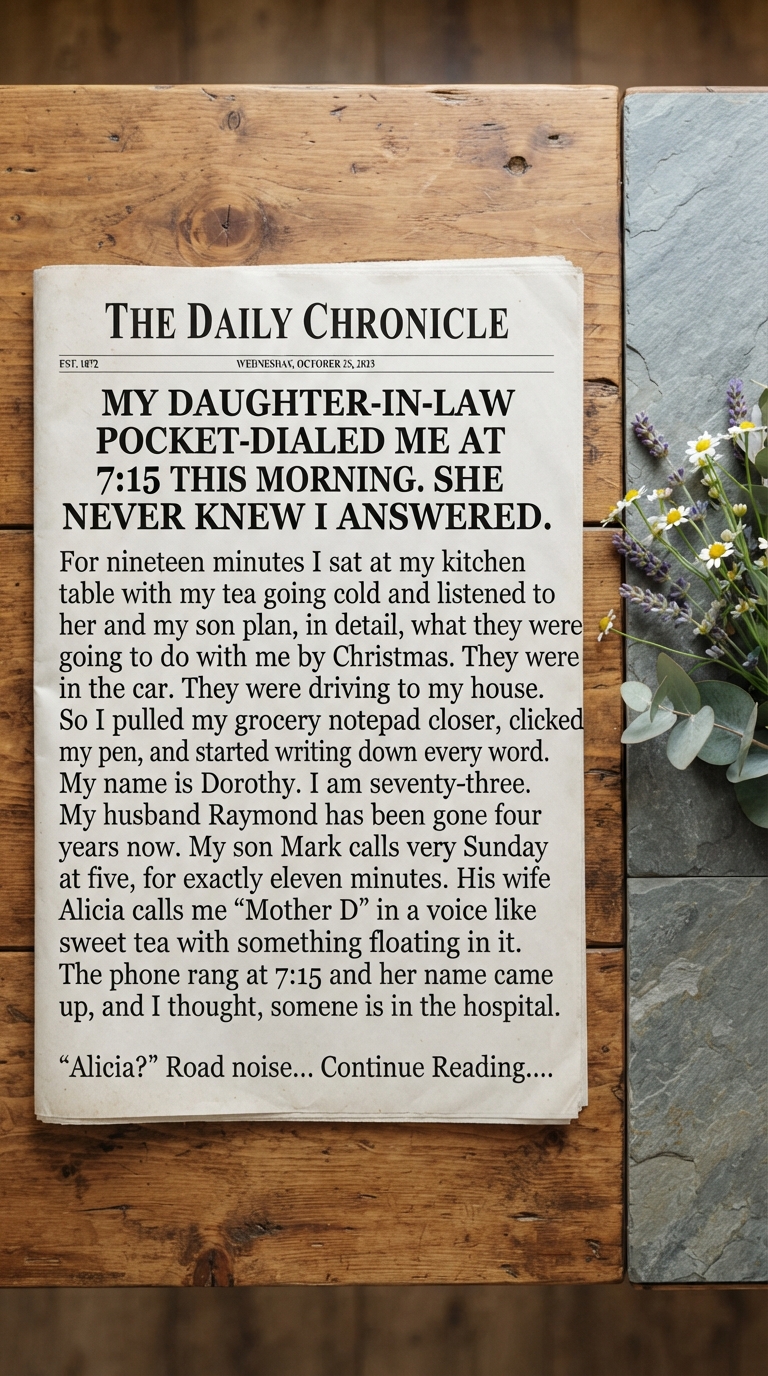
My daughter-in-law pocket-dialed me at 7:15 that morning.
She never knew I answered.
For nineteen minutes, I sat at my kitchen table with my tea going cold and listened to her and my son plan, in detail, what they were going to do with me by Christmas.
They were in the car.
They were driving to my house.
So I pulled my grocery notepad closer, clicked my pen, and started writing down every word.
My name is Dorothy.
I am seventy-three.
My husband, Raymond, has been gone four years now.
My son Mark calls me every Sunday at five, for exactly eleven minutes.
His wife, Alicia, calls me “Mother D” in a voice like sweet tea with something floating in it.
That morning, when my phone rang at 7:15 and her name appeared on the screen, I thought someone was in the hospital.
“Alicia?”
All I heard at first was road noise.
Then her voice.
“Did she answer?”
Mark laughed.
“No. It’s probably in her purse.”
I stopped breathing.
They had no idea I was listening.
Then Alicia said:
“Good. Because I’m done pretending this is temporary.”
I reached for my grocery notepad.
And I began writing.
“She can’t stay there through Christmas,” Alicia said.
Mark answered:
“She won’t.”
“What if she refuses?”
“She won’t.”
“How do you know?”
“Because she’s Mom.”
Alicia laughed.
“You mean because she’ll feel guilty.”
My pen moved across the paper.
7:16 — They believe I will feel guilty.
Then Mark said:
“Once we get her to sign, everything gets easier.”
My hand stopped.
“Sign what?” Alicia asked.
“The paperwork.”
“What paperwork?”
“The power of attorney.”
I stared at the words I’d just written.
POWER OF ATTORNEY.
Alicia lowered her voice.
“And the house?”
Mark was silent for a moment.
“That’s the point.”
My heart began pounding.
Alicia asked:
“Can we sell it before Christmas?”
“If she signs this week, yes.”
“What about the mortgage?”
“Almost paid off.”
“How much do you think we’ll have left?”
“Enough.”
“For what?”
Alicia laughed.
“For all the things we’ve been putting off.”
My fingers tightened around the pen.
I kept listening.
Then Alicia said something that made my blood run cold.
“Have you picked the place?”
Mark replied:
“The one outside town.”
“The senior place?”
“Yeah.”
“Will she like it?”
“She doesn’t have to like it.”
I stared at the clock.
7:21.
They had already chosen where I would live.
They had already discussed selling my house.
They had already planned what to do with the money.
And apparently, my opinion wasn’t part of the discussion.
Alicia said:
“She’ll get used to it.”
Then Mark answered:
“She’ll be better off there anyway.”
I almost laughed.
Because for the last four years, I’d been living completely independently.
I had a garden.
I drove myself everywhere.
I volunteered twice a week.
I paid every bill.
I had never once asked my son to rescue me.
Then Alicia asked:
“What about her things?”
“We’ll sort them.”
“Raymond’s tools?”
“I’ll take those.”
“Her jewelry?”
A pause.
“Mom won’t need most of it.”
I wrote it down.
RAYMOND’S TOOLS. JEWELRY.
Then Alicia asked:
“And the bank account?”
Mark’s voice became quieter.
“We’ll handle that after the house.”
I stopped writing.
The bank account?
My retirement account?
The money Raymond and I had spent decades saving?
They were planning that too.
The phone remained connected.
I could hear traffic.
Turn signals.
Alicia’s occasional laugh.
And Mark’s voice growing more confident.
Then he said:
“She’ll probably cry.”
Alicia replied:
“Let her.”
My pen paused.
Then Mark said:
“She’ll calm down once she realizes we’re doing this for her.”
I looked at the notepad.
At nineteen minutes of handwriting.
And suddenly, I wasn’t hearing my son’s voice anymore.
I was hearing the voice of a stranger wearing my son’s face.
At 7:34, the call ended.
I set my phone down.
My tea was cold.
The house was quiet.
I looked at the photographs on the wall.
Raymond and me on our twenty-fifth anniversary.
Mark at ten years old.
Mark graduating high school.
Mark at his wedding.
Alicia holding a newborn.
My grandson.
I had spent years believing my son was a good man.
Maybe he was.
Maybe he’d simply allowed greed to become louder than love.
Either way, I had heard what I needed to hear.
So I did what Raymond had taught me to do whenever something important happened.
I didn’t panic.
I made a list.
The first call I made was to my attorney.
Helen Mercer had known Raymond for years.
She answered on the second ring.
“Dorothy?”
“I need you to come over.”
“What happened?”
“My son is coming to take my house.”
Silence.
Then:
“Tell me everything.”
I read her my notes.
All nineteen minutes.
When I finished, she asked one question.
“Do you still have the original house documents?”
“Yes.”
“Good.”
“Why?”
“Because Raymond was very careful.”
I frowned.
“What do you mean?”
“Did he ever tell you he created a living trust?”
I stared at the filing cabinet in my study.
“Yes.”
“But he told you it was just estate planning.”
“Yes.”
Helen paused.
“Dorothy, I think it’s time you read the entire trust.”
I pulled the old blue binder from the filing cabinet.
The one Raymond had told me never to throw away.
Inside were tax records.
Insurance policies.
Investment statements.
And the trust.
I had seen it before.
But never read every page.
Helen opened the document on my laptop while we talked.
Then she went quiet.
“Dorothy.”
“What?”
“Your house is not an asset Mark can simply sell.”
“I know it’s mine.”
“No.”
She sounded serious.
“It is protected.”
“Protected how?”
“Raymond made you the lifetime beneficiary and trustee.”
I sat down.
“What does that mean?”
“It means nobody can take control of the property just because they are your child. And the trust specifically says that your principal residence cannot be sold or transferred without your written authorization.”
I stared at my kitchen.
At the windows Raymond had installed himself.
At the garden outside.
I whispered:
“He knew.”
Helen said:
“He suspected someone might eventually try.”
There was more.
The trust contained a separate investment account.
Raymond had funded it over twenty years.
I knew about the account.
I didn’t know the amount.
Helen gave me the balance.
I stared.
$684,000.
“What?”
“He intended this to provide for your care and independence.”
My eyes filled with tears.
“I thought we’d spent more than that.”
“You didn’t.”
“Why didn’t he tell me?”
“Because he knew you’d try to save it for Mark.”
I laughed sadly.
“He knew me.”
“He did.”
Then Helen found another provision.
I read it slowly.
No beneficiary may receive control or distribution from the protected estate while actively attempting to deprive Dorothy of her home, finances, or independent decision-making.
My hand went to my mouth.
Raymond had written it fifteen years earlier.
Before Alicia had even met Mark.
Before anyone knew there would be a problem.
He hadn’t predicted the betrayal.
He had simply protected the woman he knew.
At 9:47, my doorbell rang.
I looked at the security camera.
Mark.
Alicia.
And another man carrying a leather folder.
The same three people I’d heard planning my future less than three hours earlier.
Helen had stayed.
She looked at me.
“Let them in.”
I nodded.
I opened the door.
Alicia smiled brightly.
“Mother D!”
I looked at her.
“Good morning.”
Mark hugged me.
I let him.
“We just wanted to check on you.”
I smiled.
“How thoughtful.”
Alicia glanced around the house.
“You’ve kept everything so nice.”
“I have.”
The man behind them introduced himself.
“I’m Douglas. I’m here to help with the estate paperwork.”
I looked at him.
“What estate paperwork?”
He hesitated.
“Just some documents that will make things easier for everyone.”
I stepped aside.
“Come in.”
We sat around my kitchen table.
Exactly where I’d taken the call.
Exactly where I’d written every word.
Alicia opened her purse.
“We’ve been worried about you.”
Mark nodded.
“You shouldn’t be living alone anymore.”
“I seem to be doing fine.”
Alicia smiled.
“That’s what everyone says before something happens.”
“What do you suggest?”
“A safer environment.”
“Where?”
She mentioned the senior community.
The same place they’d discussed on the phone.
Then she smiled.
“They have a lovely two-bedroom unit.”
Mark added:
“You could sell this place and use the money to pay for everything.”
I looked at him.
“Sell my house?”
“We can help.”
“How generous.”
He smiled.
Then Douglas pushed a folder toward me.
“This is simply a durable power of attorney. It would allow your son to handle financial matters if necessary.”
I opened it.
The first page looked harmless.
The second was more complicated.
The third gave broad authority over property.
The fourth allowed financial transfers.
I looked at Mark.
“You wanted me to sign this?”
“It just makes things easier.”
“For whom?”
Silence.
Alicia answered:
“For everyone.”
I closed the folder.
“No.”
The smile disappeared from Alicia’s face.
“Mother D—”
“No.”
Mark sighed.
“Mom, don’t make this difficult.”
I looked at him.
“I heard you this morning.”
His face went pale.
Alicia froze.
“What?”
I held up the notepad.
“All nineteen minutes.”
Nobody spoke.
Mark stared at the pages.
Then at me.
“You answered?”
“Yes.”
“We thought—”
“I know what you thought.”
Alicia stood.
“You were spying on us?”
“No.”
“You listened to a private conversation.”
“You called me.”
“By accident!”
“Yes.”
“And you recorded us?”
“No.”
I tapped the notepad.
“I wrote it down.”
Mark looked sick.
“You heard everything?”
“Everything.”
I began reading.
“‘She can’t stay there through Christmas.’”
Mark lowered his head.
“‘The senior place.’”
Alicia’s eyes filled with tears.
“‘The house goes on the market.’”
I continued.
“‘Almost seventy-two thousand in credit-card debt.’”
Mark looked at Alicia.
She looked away.
Then I read the worst one.
“‘Take the jewelry. She won’t need it.’”
My voice cracked.
I stopped.
For a few seconds, nobody spoke.
Then Mark said:
“Mom, I can explain.”
I looked at him.
“I don’t want an explanation.”
“Why?”
“Because I already heard the plan.”
I pointed toward the folder.
“And I read the trust.”
His face changed.
“What trust?”
“The one your father created.”
He stared at me.
“What did Dad put in there?”
I smiled sadly.
“Protection.”
Helen opened the blue binder.
She placed the original trust on the table.
“Mr. Mercer was very clear.”
Mark stared at the document.
“That’s Dad’s signature.”
“Yes.”
“What does it say?”
Helen answered.
“Your mother has full control of the residence and protected assets.”
Alicia stepped closer.
“Until when?”
“Until her death, voluntary transfer, or another legally authorized event.”
Mark looked at me.
“So I don’t inherit the house?”
“You may inherit what your father designated eventually.”
“And the $684,000?”
“Protected.”
Alicia shook her head.
“But we’re family.”
Helen looked at her.
“Family status does not create ownership.”
Silence.
Then Mark asked:
“What happens if Mom dies?”
I looked at him.
“That’s the first thing you’ve asked today that doesn’t concern taking something from me.”
He looked ashamed.
I expected to be furious.
Instead, I felt tired.
This was my son.
The boy I had taken to baseball practice.
The teenager who called me from college when his car broke down.
The man whose wedding I had planned with him.
And now he had been sitting across from me with a folder designed to make me sign away my life.
I took a breath.
“Mark.”
He looked up.
“I love you.”
His eyes filled with tears.
“But love doesn’t mean I hand you control.”
He nodded.
“I know.”
“You and Alicia need to leave.”
Alicia started crying.
“But—”
“Please.”
Mark stood.
He looked at the folder.
Then at me.
“I am sorry.”
I nodded.
“I know.”
But I didn’t say I forgave him.
Not yet.
They left.
Helen stayed another hour.
She helped me secure the documents.
We changed passwords.
Updated the trust records.
Not because I expected another attack.
Because I now understood the importance of preparation.
Before Helen left, she hugged me.
“Your husband was a wise man.”
I smiled.
“He was.”
Then she said:
“He also knew his son.”
I closed my eyes.
“That hurts.”
“I know.”
Christmas came.
I stayed home.
I decorated the tree myself.
I hung Raymond’s old ornaments.
I cooked too much food.
Just like he liked.
At 5:00 p.m., my phone rang.
Mark.
I stared at it.
Then answered.
“Hello?”
“Mom?”
“Yes.”
“I wanted to ask something.”
“What?”
“Can I come over?”
I was quiet.
“With Alicia?”
“No.”
“Just you?”
“Yes.”
I thought about it.
“Come tomorrow.”
There was silence.
“Okay.”
Then he said:
“Thank you.”
The next afternoon, Mark arrived alone.
He carried a small box.
“What is that?”
He opened it.
Inside was Raymond’s old watch.
My breath caught.
“Where did you get that?”
“I found it in my house.”
He placed it in my hand.
“I think Dad wanted you to have it.”
I closed my fingers around it.
We sat at the kitchen table.
The same table.
The same two chairs.
But everything felt different.
Mark looked at me.
“I was ashamed after you showed me the trust.”
“Why?”
“Because Dad trusted me to protect you someday.”
He looked down.
“And instead, I planned how to get your house.”
I didn’t interrupt.
“I don’t know how I became that person.”
I answered quietly:
“You became someone who forgot that your mother was a person before she was an inheritance.”
He nodded.
“That will stay with me.”
We did not fix everything that day.
That would have been too easy.
Trust takes time.
But Mark began calling more often.
Not eleven minutes.
Sometimes forty.
Sometimes an hour.
He stopped asking about money.
He stopped asking about the house.
He asked about my garden.
My books.
My health.
My neighbors.
My plans.
He finally started seeing me again.
Not as the woman who would eventually leave him something.
As his mother.
A year later, I was still in my house.
The garden was bigger.
The kitchen smelled like cinnamon.
The Christmas tree stood in the same corner.
And Raymond’s watch was on my wrist.
The grocery notepad was still in my desk drawer.
I kept that page.
Not because I wanted to punish Mark.
Because it reminded me of a lesson I wished I had learned earlier.
People don’t always reveal themselves when you ask them who they are.
Sometimes they reveal themselves when they think you’re not listening.
Alicia’s pocket-dial had lasted nineteen minutes.
Nineteen minutes were enough to expose a plan that had taken months to build.
They had planned where I would live.
What would happen to my house.
What would happen to my belongings.
What they would do with my money.
They had even decided how much guilt they would need to use to make me cooperate.
They thought I was an old woman sitting alone in a quiet house.
They forgot I was still Dorothy.
The woman Raymond trusted.
The woman who had raised their son.
The woman who had spent seventy-three years learning that when someone tries to take away your choices, you don’t surrender them politely.
You protect them.
And sometimes, all it takes is a cold cup of tea, a grocery notepad, and nineteen minutes of accidental honesty.