The Bonus They Thought They Deserved
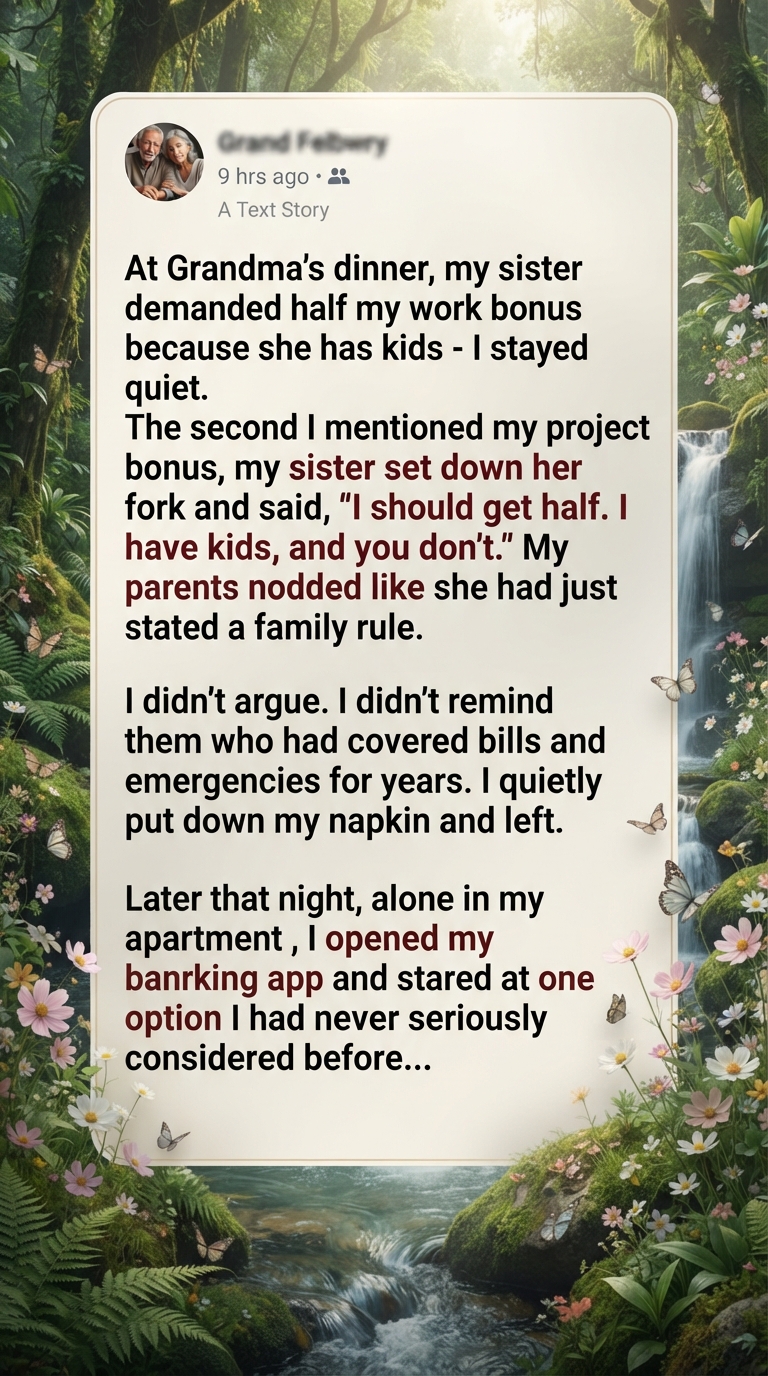
At Grandma’s dinner, my sister demanded half my work bonus because she had kids.
I stayed quiet.
The second I mentioned my project bonus, my sister set down her fork and said, “I should get half. I have kids, and you don’t.”
My parents nodded like she had just stated a family rule.
I didn’t argue.
I didn’t remind them who had covered bills and emergencies for years.
I didn’t list every time I’d transferred money when someone was short on rent, needed a medical procedure, or couldn’t make a car payment.
I simply put down my napkin.
Then I left.
Later that night, alone in my apartment, I opened my banking app and stared at one option I had never seriously considered before.
Stop being the family’s emergency fund.
My name is Natalie.
And that night, I finally decided to find out what would happen if I stopped rescuing everyone.
My family had always had a strange definition of fairness.
If I earned something, it was “our family’s money.”
If my sister earned something, it was “her money.”
My sister, Megan, had three children.
I loved my nieces and nephew.
They weren’t responsible for their mother’s behavior.
But somewhere along the way, Megan’s children became the reason everyone believed I owed my sister whatever she wanted.
When I was twenty-two, I got my first serious job.
I worked hard.
I saved.
I learned how to budget.
I eventually bought a modest apartment.
Megan married young and had her first child shortly afterward.
She struggled financially.
So I helped.
At first, it was small things.
$100 for groceries.
$200 for a utility bill.
A few hundred dollars when her car needed repairs.
Then it became larger.
When her husband lost his job, I covered their rent for two months.
When her youngest needed dental treatment, I paid the bill.
When their refrigerator broke, I bought them a new one.
I never complained.
They were family.
But something changed.
My help stopped being appreciated.
It became expected.
One Thanksgiving, Mom casually asked me:
“Are you still saving so much?”
“Yes.”
“For what?”
“My future.”
She laughed.
“You don’t have children. What future expenses could you possibly have?”
I didn’t answer.
Because I was starting to realize something.
In my family, not having children wasn’t viewed as freedom.
It was viewed as a financial obligation.
Then came the project.
For nearly eleven months, I’d worked on a major corporate contract.
Late nights.
Weekend meetings.
Canceled vacations.
More than once, I ate dinner at my desk.
When the project finally launched successfully, my company gave me a substantial performance bonus.
$48,000.
I stared at the number on my paycheck for a long time.
I’d never received anything like it.
I planned to put most of it toward the down payment on a larger home.
Maybe finally take the vacation I’d postponed for years.
Maybe invest some.
Maybe simply keep a little money for myself.
I mentioned the bonus at Grandma’s birthday dinner.
I wasn’t bragging.
Grandma had asked how work was going.
I told her.
“It’s going really well. We finished the project, and I got a $48,000 bonus.”
Megan immediately put down her fork.
“How much?”
I repeated it.
She stared at me.
Then she said:
“I should get half.”
The room went quiet.
I thought she was joking.
“Half of what?”
“The bonus.”
I laughed nervously.
“You’re serious?”
“Of course.”
“Why?”
She looked at me like the answer was obvious.
“I have kids.”
Mom nodded.
Dad nodded too.
Megan continued.
“You don’t.”
Grandma’s expression changed.
“Megan…”
But Megan wasn’t finished.
“Think about it. I have three children. Clothes, school, food, activities. You have yourself.”
Dad cleared his throat.
“Maybe you could help her a little.”
I looked at him.
“A little?”
Megan crossed her arms.
“I think half is fair.”
I slowly looked around the table.
Nobody told her she was wrong.
Nobody asked why my bonus belonged to her.
Nobody remembered that when her husband had been unemployed, I’d paid their rent.
Nobody mentioned the dental bill.
Nobody mentioned the car.
Nobody mentioned the refrigerator.
Instead, my parents sat there nodding.
As if I had somehow been born with a responsibility to finance my sister’s children.
I reached for my napkin.
Folded it.
Placed it beside my plate.
Then stood.
“Where are you going?” Mom asked.
“Home.”
Megan rolled her eyes.
“Seriously?”
I looked at her.
“Yes.”
She scoffed.
“Typical.”
I almost laughed.
Typical.
Apparently, leaving after someone demanded $24,000 from me was now the rude thing.
I walked out.
That night, I sat alone in my apartment.
I opened my banking app.
My finger hovered over the transfer screen.
Not because I was going to send Megan money.
Because I was considering something else.
I opened my monthly expenses.
Then my transfer history.
For the first time, I added everything I’d given my family over the past five years.
Rent.
Medical bills.
School supplies.
Car repairs.
Groceries.
Emergency transfers.
Birthdays.
Christmas.
Miscellaneous “Can you help me?” payments.
I stared at the final number.
$71,460.
I whispered:
“Seventy-one thousand?”
I checked it again.
$71,460.
Then I opened my savings account.
I suddenly saw my financial life differently.
I’d spent years believing I was helping my family.
But my family had spent years treating my help like an obligation.
And there was something else.
I hadn’t told anyone about it.
For the past year, I’d been secretly paying off my parents’ remaining mortgage.
They thought their monthly payments were coming from a small family investment account.
They weren’t.
I had been making the difference every month.
I hadn’t told them because I didn’t want praise.
I wanted them to have a stable home.
That night, I stopped the automatic transfer.
Then I canceled three other recurring payments.
One for Megan’s phone plan.
One for her children’s extracurricular activities.
One for my parents’ household expenses.
I sat there staring at the screen.
My hands were shaking.
I wasn’t angry.
I was terrified.
What would happen if I stopped?
The answer came the next morning.
My phone rang.
Mom.
“Why didn’t the mortgage payment go through?”
I closed my eyes.
“So you noticed.”
“What does that mean?”
“It means I’m not paying it anymore.”
Silence.
Then:
“Are you punishing us?”
“No.”
“You’re family!”
“I know.”
“Then why would you do this?”
I answered quietly.
“Because family shouldn’t mean one person pays and everyone else decides what they’re entitled to.”
Mom hung up.
Megan called twenty minutes later.
“You canceled the kids’ activity payments?”
“Yes.”
“How could you?”
“They’re your children.”
She gasped.
“You’re really going to say that?”
“I love them.”
“Then help them!”
“I’ve helped them for years.”
She became angry.
“You don’t understand what it’s like to raise three kids.”
“No.”
I paused.
“But you don’t understand what it’s like to build a life while everyone assumes you owe them part of it.”
She hung up.
For the first time in years, I didn’t feel guilty.
I felt free.
Two weeks passed.
Nobody contacted me.
Then Grandma called.
“Natalie, come see me.”
I went.
She was sitting in her kitchen with an old wooden box beside her.
“I heard what happened.”
I sighed.
“I didn’t want you dragged into it.”
“I know.”
She opened the box.
Inside were envelopes.
Old ones.
Very old ones.
She handed me one.
It was addressed to me.
“What is this?”
“Your grandfather wrote it.”
I opened it.
Inside was a letter.
He had written it shortly before he died.
It said:
Natalie,
Your parents will tell you that family means sacrifice. They are right about one thing: family sometimes requires sacrifice. But sacrifice without respect becomes exploitation.
I stopped reading.
Grandma watched me.
“He knew.”
“Knew what?”
“That someday they’d expect you to carry everyone.”
I looked at her.
“How?”
She smiled sadly.
“Because he saw it happening when you were still young.”
Then she handed me another document.
It was a copy of a small trust account my grandfather had established for me.
It had been sitting untouched for years.
Grandma explained that my grandfather had wanted me to have something completely separate from the family.
The account had grown significantly.
I stared at the balance.
It was enough to make a substantial down payment on the home I wanted.
I looked at Grandma.
“Why didn’t you tell me?”
“Because your grandfather made me promise not to.”
“Why?”
“He wanted you to discover something yourself.”
“What?”
She took my hand.
“That you don’t have to earn the right to keep something simply because other people need it.”
I started crying.
A month later, I bought my new home.
It wasn’t enormous.
But it had a small backyard.
A bright kitchen.
A quiet office.
And a room I turned into a library.
I used part of my bonus for the down payment.
I invested another portion.
And I kept the rest.
For me.
Not because I stopped loving my family.
Because I finally learned the difference between helping someone and sacrificing yourself for them.
Megan eventually called.
Her voice was different.
“I need to apologize.”
I didn’t say anything.
“I was wrong about the bonus.”
“Yes.”
She sighed.
“I was embarrassed.”
“About what?”
“About needing help.”
That answer surprised me.
She continued.
“I convinced myself that because you didn’t have kids, your money wasn’t as important as mine.”
I listened.
“I shouldn’t have done that.”
“No.”
“I don’t expect you to give me anything.”
That was the first time I’d heard her say those words.
I believed her.
Eventually, we started rebuilding our relationship.
But things were different.
When she needed help, she asked.
I decided whether I could afford it.
Sometimes I said yes.
Sometimes I said no.
And she learned to accept both.
My parents took longer.
They were angry.
Then embarrassed.
Then distant.
But eventually, Dad admitted something.
“We got used to you fixing things.”
I nodded.
“I know.”
“We shouldn’t have.”
“No.”
He looked down.
“I guess we confused your generosity with responsibility.”
“That was the problem.”
Months later, we gathered at Grandma’s house again.
Same table.
Same plates.
Same family.
But everything felt different.
Megan’s youngest climbed onto my lap.
My mother brought dessert.
Dad asked about my new house.
Nobody mentioned my money.
Nobody asked about my savings.
Nobody suggested that I owed anyone anything.
Grandma watched everyone quietly.
Then she smiled.
“You know what I like about this dinner?”
“What?” I asked.
“Everyone brought something.”
We laughed.
Megan brought dessert.
Dad brought flowers.
Mom brought food.
I brought nothing.
And for once, nobody expected me to.
I looked around the table.
I realized I hadn’t lost my family by setting boundaries.
I’d simply stopped allowing money to be the only reason they knew how to reach me.
My bonus had never been the real issue.
The real issue was whether I believed my life belonged to me.
That night, I finally did.
And when I opened my banking app before bed, I didn’t see a number anymore.
I saw choices.
My choices.
For the first time, the money I’d worked so hard to earn wasn’t a measure of what I could give everyone else.
It was a reminder that I was allowed to build something for myself, too.