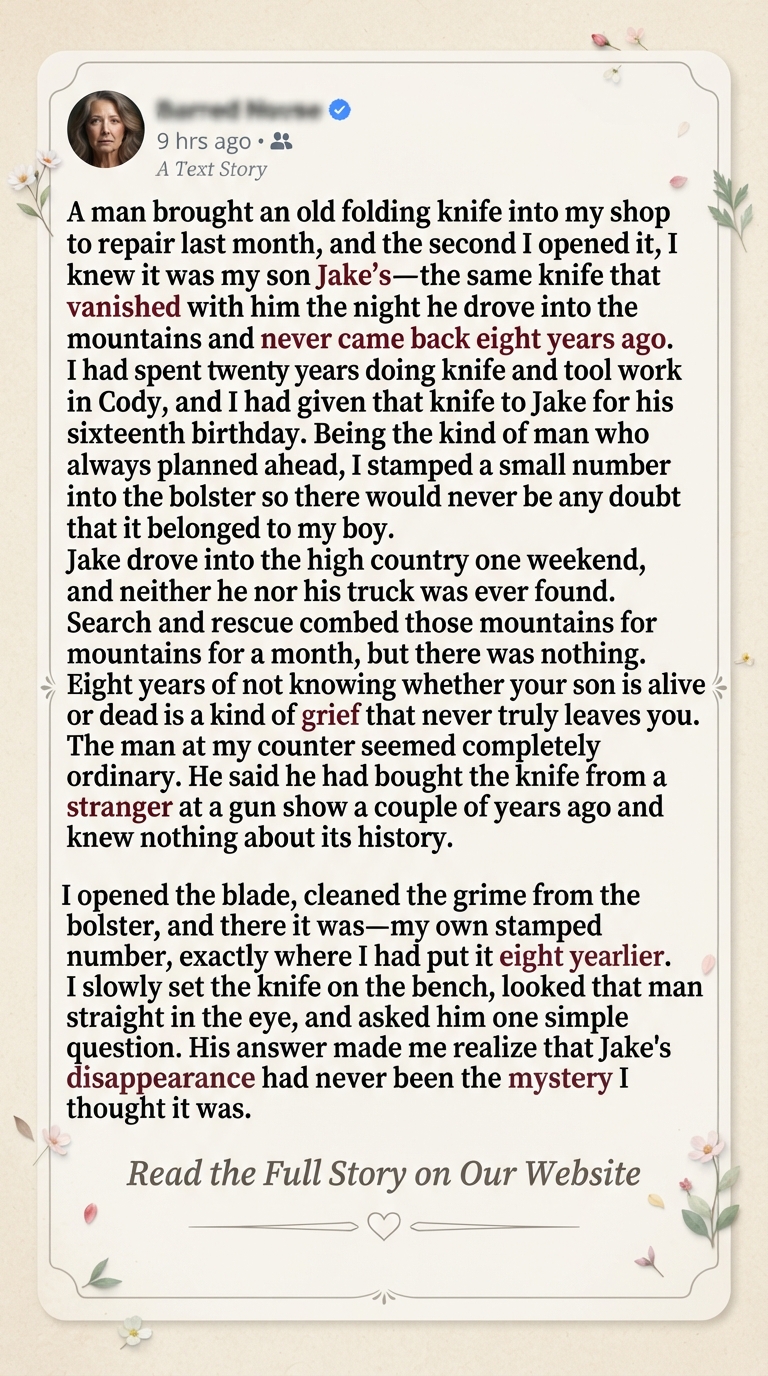
A man brought an old folding knife into my shop last month, and the second I opened it, I knew it was my son Jake’s.
The same knife that vanished with him the night he drove into the mountains and never came back.
I had spent twenty years doing knife and tool work in Cody, Wyoming.
I had repaired hunting knives, sharpened axes, restored antique tools, and fixed just about anything people were willing to carry through my door.
But there was one knife I had never been able to repair.
Jake’s.
I gave it to him for his sixteenth birthday.
He loved it immediately.
It wasn’t expensive.
It wasn’t fancy.
But it was solid.
A simple folding knife with a dark handle and a worn brass bolster.
Being the kind of man who always planned ahead, I stamped a small identification number into the bolster.
Just six digits.
Nothing anyone would notice unless they knew it was there.
I told Jake,
“If you ever lose it, I’ll know it’s yours.”
He laughed.
“Dad, who would steal a knife?”
“Nobody,” I said.
“Still.”
He carried it everywhere.
For years.
Then, eight years ago, Jake drove into the high country one weekend.
He was twenty-four.
He said he wanted to spend a couple of nights camping alone.
He never came home.
His truck was found near a trailhead.
Jake wasn’t.
Search and rescue combed those mountains for nearly a month.
Dogs searched.
Helicopters flew over the valleys.
Volunteers walked miles through rough country.
They found his backpack.
One boot.
A damaged flashlight.
But no Jake.
No body.
No clear trail.
Nothing that told us what happened.
Eight years of not knowing whether your son is alive or dead is a kind of grief that never truly leaves you.
You don’t get closure.
You get questions.
Every birthday becomes a question.
Every unfamiliar vehicle outside your house becomes a question.
Every time the phone rings late at night, part of you still thinks:
Maybe.
Then, last month, a man walked into my shop carrying an old folding knife.
He looked to be in his fifties.
Gray jacket.
Baseball cap.
Nothing unusual.
He placed the knife on my counter.
“Think you can bring this back to life?”
I picked it up.
The handle was scratched.
The blade was dull.
There was dried grime around the hinge.
I opened it.
And everything inside me stopped.
I knew that knife.
Not because of the handle.
Not because of the blade.
Because of the weight.
The way it opened.
The tiny notch near the spine where Jake had dropped it on a rock when he was seventeen.
My hand started shaking.
I turned the knife over.
I grabbed a cloth and carefully wiped the dirt from the brass bolster.
Then I saw it.
Six tiny numbers.
My numbers.
The exact identification number I had stamped into Jake’s knife twenty-four years earlier.
I couldn’t breathe.
I slowly placed the knife on the bench.
The man looked at me.
“Something wrong?”
I stared at him.
“Where did you get this?”
He shrugged.
“I bought it at a gun show.”
“When?”
“About two years ago.”
“From who?”
“Some guy I didn’t know.”
“Do you remember his name?”
“No.”
“Do you remember what he looked like?”
He frowned.
“Why?”
I pointed at the knife.
“That belonged to my son.”
The man’s expression changed.
“What?”
“My son disappeared eight years ago.”
He looked at the knife.
Then back at me.
“I had no idea.”
I believed him.
Or at least, I believed he believed what he was telling me.
But then he said something that made the hair rise on my arms.
“I bought it from an older guy named Ray.”
I stopped.
“Ray what?”
“Collins, I think.”
The shop suddenly felt very quiet.
Ray Collins.
Jake’s best friend.
The last person known to have spoken to him before he disappeared.
Ray had been questioned by search and rescue.
By the sheriff.
By my family.
He told everyone the same thing.
Jake had driven into the mountains alone.
Ray said he hadn’t seen him that weekend.
I had believed him.
For eight years.
I looked at the stranger.
“Do you still have the receipt?”
He nodded.
“I might.”
He searched his phone.
After a minute, he found a photograph of the receipt.
There it was.
Seller: R. Collins.
I stared at the screen.
Then I asked him one simple question.
“Did Ray tell you anything about where he got the knife?”
The man hesitated.
“He said it came from an old friend.”
My heart began pounding.
“Did he say the friend’s name?”
The man looked uncomfortable.
“Jake.”
I sat down.
For eight years, everyone had told me there was no evidence connecting Ray to my son’s disappearance.
Now my son’s knife had surfaced in Ray’s possession.
And Ray had sold it.
I called the sheriff’s office.
The investigator assigned to Jake’s case had retired years earlier, but the department still had the file.
A detective named Miller agreed to meet me.
I brought the knife.
I brought the receipt.
And I brought every photograph I had of Jake carrying it.
Miller examined the bolster.
Then he looked at the old case file.
“You’re certain this is the knife?”
“I made that mark myself.”
He photographed it.
“We’ll need to verify everything.”
“I understand.”
Two days later, detectives contacted Ray Collins.
He initially denied selling the knife.
Then the receipt was shown to him.
His story changed.
He said he had found the knife years ago.
Then he said Jake had given it to him.
Then he said he couldn’t remember.
Every version was different.
Finally, detectives searched his storage unit after obtaining the appropriate legal authorization.
They found something else.
A box.
Inside were several items belonging to Jake.
A jacket.
A camping compass.
Two photographs.
And a notebook.
The notebook was the thing that finally changed the entire case.
It contained handwritten notes about Jake’s final trip.
Not written by Jake.
Written by Ray.
There were dates.
Times.
Locations.
And one sentence underlined twice:
“He knows about the money.”
Detectives began reconstructing what had happened.
Ray had been running a small equipment business that was struggling financially.
Jake had discovered Ray was secretly taking money from the business.
Jake had confronted him.
According to the investigation, Ray had convinced Jake to meet him before Jake left for the mountains.
They argued.
Something happened.
But Ray had not killed him.
At least, there was no evidence proving that.
Instead, the investigation uncovered something none of us had imagined.
Jake had left the meeting alive.
He had driven into the mountains afterward.
And he had deliberately disappeared.
The reason was hidden in another part of the notebook.
Jake had discovered that Ray was involved in a larger financial scheme.
He was afraid.
Not just for himself.
For our family.
Jake had planned to report everything.
But before he could, someone threatened him.
The evidence suggested Jake believed disappearing was the safest way to protect us.
The detective found an old storage locker registered under a name Jake had used.
Inside was a backpack.
A passport.
Cash.
And a letter.
My name was written on the envelope.
I could barely open it.
Inside was a single page.
Dad,
If you’re reading this, I’m sorry.
I know what I’m about to do will hurt you.
But if I stay, people will get hurt.
I found out what Ray has been doing.
I tried to handle it myself.
That was a mistake.
Don’t look for me.
Please don’t.
I need you to believe that I’m alive.
And then there was one final line.
“The knife will come back to you someday. I made sure of that.”
I read that sentence three times.
The detective looked at me.
“We don’t know exactly what happened after Jake left the mountains.”
“But he’s alive?”
“We can’t establish that from this letter alone.”
That wasn’t enough for me.
But it was more than I had had in eight years.
The investigation into Ray continued.
Financial records connected him to multiple fraudulent transactions.
The items found in his storage unit became evidence.
And the knife became the physical link that reopened the investigation into Jake’s disappearance.
Months passed.
Then, one afternoon, I was closing the shop when my phone rang.
Unknown number.
I almost ignored it.
Something made me answer.
“Hello?”
There was silence.
Then a man’s voice.
Older than I remembered.
Quieter.
“Dad?”
My knees nearly gave out.
I grabbed the counter.
“Jake?”
“Yes.”
I couldn’t speak.
He laughed softly.
“I knew you’d recognize my voice.”
I sat down.
“Where are you?”
“Colorado.”
“Are you okay?”
“Yes.”
“Why didn’t you come home?”
There was a long pause.
“Because I was scared.”
He told me he had spent years moving from place to place.
He had watched the news about his disappearance.
He had wanted to call dozens of times.
But every time he thought about coming back, he remembered the threats.
Then he heard that the knife had been found.
He knew the secret was finally coming apart.
“I thought you’d hate me,” he said.
I started crying.
“I spent eight years thinking you were dead.”
“I know.”
“You don’t ever get to apologize for being alive.”
There was silence on the phone.
Then he said,
“Can I come home?”
I closed my eyes.
“Yes.”
Three days later, Jake walked into my shop.
He looked older.
Thinner.
There were gray hairs in his beard.
But I knew him immediately.
A father knows his son’s face.
I walked around the counter.
Neither of us said anything.
We just hugged.
I held him like he was sixteen again.
Like I could somehow make up for eight missing years by refusing to let go.
Eventually, Jake looked at the workbench.
The knife was sitting there.
“You still have it.”
“I fixed it.”
He picked it up.
Opened the blade.
Closed it.
Then smiled.
“You still stamp everything?”
“Only important things.”
He laughed.
For the first time in eight years, I heard my son’s laugh in my shop.
Ray eventually faced charges related to the financial crimes and the evidence uncovered during the investigation. The full circumstances surrounding Jake’s disappearance remained complicated, and not every question received an answer.
But Jake was alive.
That was the answer that mattered most.
I kept the knife.
Not because I needed proof anymore.
Because for eight years, it had been the last piece of my son I had.
Now it was something different.
It was the thing that brought him home.
Sometimes people think miracles arrive loudly.
They don’t.
Sometimes they walk quietly into a little shop in Cody carrying an old folding knife.
Sometimes the thing you thought was evidence of a tragedy turns out to be the first clue that the person you lost was still fighting his way back to you.
And sometimes, after eight years of grief, you get to hear the two words you stopped believing you’d ever hear again.
“Dad, I’m home.”