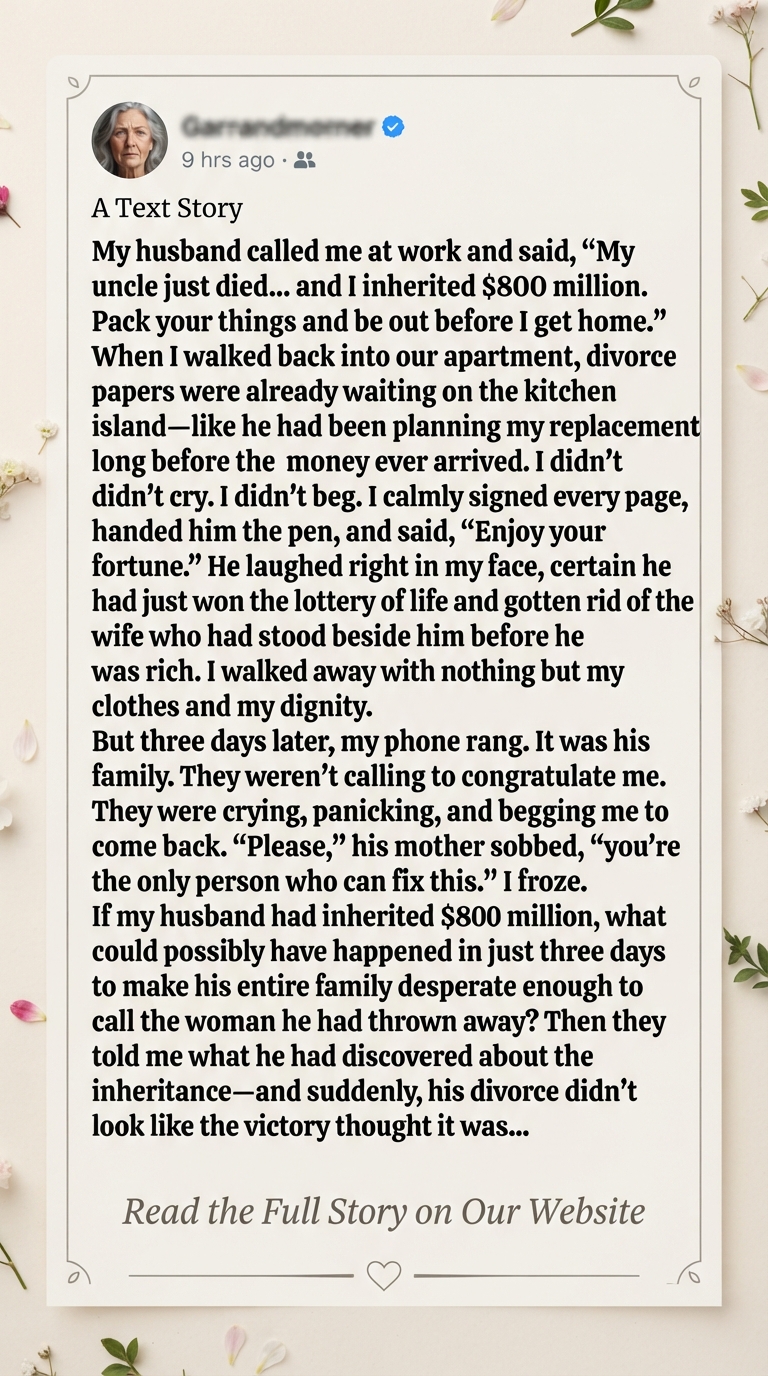
My husband called me at work at 11:17 on a Tuesday morning.
His voice sounded almost cheerful.
“My uncle just died.”
I stopped typing.
“Oh, Trevor. I’m sorry.”
He laughed.
“Don’t be sorry. I inherited $800 million.”
For a moment, I thought I had misheard him.
“What?”
“You heard me. Eight hundred million dollars.”
I stared at my computer screen.
Then he said the words that changed everything.
“Pack your things and be out before I get home.”
I was silent.
He continued.
“I’m serious. I don’t want to spend the rest of my life dragging you around while I finally get to enjoy what I deserve.”
“What about us?”
“There is no ‘us’ anymore.”
Then he hung up.
I sat there for nearly a minute, staring at my phone.
For twelve years, I had stood beside that man.
When Trevor lost his job, I paid the rent.
When he started his first business, I worked evenings to help cover the bills.
When his mother needed surgery, I drove her to every appointment.
When he said he wanted to build a better life, I believed him.
Apparently, I had only been useful while he was poor.
Now he had $800 million.
And I had become disposable.
I went home that afternoon.
The divorce papers were waiting on the kitchen island.
A folder.
A pen.
And a sticky note in Trevor’s handwriting.
“Sign everything. Let’s make this easy.”
I read every page.
Then I signed.
Every single one.
When Trevor arrived, he found me placing the pen on top of the completed papers.
He looked surprised.
“That was easy.”
I nodded.
“Enjoy your fortune.”
He laughed.
“You really think you’re going to walk away like this?”
“I already did.”
He smiled.
For the first time in twelve years, I realized how little I recognized the man standing in front of me.
I took two suitcases.
My clothes.
My laptop.
A few photographs.
Nothing else.
Then I left.
I didn’t ask for money.
I didn’t ask for the apartment.
I didn’t ask for a share of the inheritance.
I simply walked away.
Three days later, my phone rang.
It was Trevor’s mother.
I almost didn’t answer.
When I did, I heard her crying.
“Please come back.”
I frowned.
“What happened?”
“Everything is falling apart.”
“What do you mean?”
“He needs you.”
I almost laughed.
“Your son told me he didn’t need me anymore.”
“He was wrong.”
“Where is Trevor?”
She started sobbing.
“Please. Just come here.”
I almost hung up.
Then she said:
“You’re the only person who can fix this.”
That sentence stopped me.
“Why?”
Silence.
Then she whispered:
“Because the inheritance isn’t what Trevor thought it was.”
I drove to the family lawyer’s office that afternoon.
Trevor was already there.
He looked completely different.
Three days earlier, he had been smiling like a man who had conquered the world.
Now his shirt was wrinkled.
His eyes were bloodshot.
His hands wouldn’t stop shaking.
His mother sat beside him.
Across the table was an elderly attorney named Mr. Harrison.
He had represented Trevor’s uncle for more than twenty years.
He opened a thick folder.
“Your husband’s uncle did leave an estate valued at approximately $800 million.”
I looked at Trevor.
He swallowed.
“But there is a condition.”
I leaned forward.
“What condition?”
Mr. Harrison looked directly at Trevor.
“Your uncle did not leave the fortune to you outright.”
Trevor’s face tightened.
“He left it to the family trust.”
“And?”
“The trust has a beneficiary structure.”
He opened another document.
“The assets remain protected until certain conditions are satisfied.”
Trevor slammed his hand on the table.
“You never told me that!”
“I attempted to explain it to you.”
“You told me I was the beneficiary!”
“You are.”
Trevor looked at me.
“So what’s the problem?”
Mr. Harrison turned another page.
“The primary condition is that the beneficiary must remain married to the spouse identified in the original estate documents for twelve months after receiving notice of the inheritance.”
The room went completely silent.
I stared at him.
“Excuse me?”
Mr. Harrison nodded.
“Your uncle amended the trust seven years ago.”
Trevor’s face went pale.
“He couldn’t have done that.”
“He did.”
“Why?”
Mr. Harrison looked at me.
“Because he believed money had destroyed his own family.”
Then he explained.
Trevor’s uncle had watched his siblings fight over money.
He had watched marriages collapse after inheritances.
He didn’t want Trevor to receive his fortune until he proved that he could put family loyalty ahead of wealth.
So the trust contained one unusual provision.
Trevor had to remain legally married to me for twelve months after receiving the inheritance.
If he divorced me during that period, the $800 million would pass to a charitable foundation.
Not Trevor.
Not his mother.
Not another relative.
Charity.
Trevor had unknowingly destroyed his inheritance three days after receiving it.
I looked at him.
“You divorced me for money.”
He said nothing.
“And the money required you not to divorce me.”
Still nothing.
His mother began crying again.
“That’s why we called you.”
I stood.
“So you want me to remarry him?”
“No,” Mr. Harrison said.
Everyone looked at him.
“The divorce decree has already been filed.”
Trevor’s eyes widened.
“What?”
Mr. Harrison closed the folder.
“And there is another problem.”
“What?”
“The trust doesn’t simply require the marriage to continue.”
He looked at me.
“It requires the beneficiary to demonstrate that the marriage existed in good faith.”
Trevor stared at him.
“What does that mean?”
“It means your uncle anticipated exactly what you tried to do.”
Mr. Harrison slid another envelope across the table.
“This was delivered yesterday.”
It was addressed to me.
I opened it.
Inside was a handwritten letter.
The first line read:
“If you’re reading this, Trevor probably made the mistake I feared he would.”
I looked up.
My hands were trembling.
The letter explained that Trevor’s uncle had met me several times over the years.
He remembered when Trevor was struggling.
He remembered me working two jobs.
He remembered me paying his mother’s medical bills.
And he remembered something Trevor had apparently forgotten.
Years earlier, Trevor’s uncle had asked him:
“If you became wealthy tomorrow, would you still choose your wife?”
Trevor had answered yes.
His uncle didn’t believe him.
So he built the trust around that question.
At the bottom of the letter was one final paragraph.
“If Trevor ever chooses money over the woman who stood beside him when he had nothing, don’t rescue him from the consequences. Let him learn what his decision cost.”
I folded the letter.
Then I looked at Trevor.
His eyes were wet.
“I was wrong,” he whispered.
“Yes.”
“I didn’t think…”
“I know.”
“I thought you would come crawling back.”
I shook my head.
“You didn’t lose $800 million because of the divorce.”
He looked at me.
“You lost it because you believed $800 million made you better than the person who loved you before you had it.”
No one spoke.
I walked out of the office.
I never remarried Trevor.
The divorce remained final.
The $800 million passed into the charitable foundation exactly as his uncle’s trust required.
Trevor spent months trying to challenge the trust.
He failed.
His family blamed him.
His business partners disappeared.
And eventually, he had to sell the house he had once bragged would become his “mansion.”
I didn’t receive a penny of the inheritance.
And strangely enough, I didn’t regret it.
A year later, I opened my own consulting business.
It was small.
Just three employees at first.
But it was mine.
I built it slowly.
Honestly.
The way I had always wanted to build a life.
One evening, I received an email from Mr. Harrison.
Attached was a copy of another letter from Trevor’s uncle.
It contained one sentence addressed to me:
“You were never the woman who lost $800 million. You were the woman who discovered what money could never buy.”
I saved the letter.
Then I closed my laptop.
I had walked away from Trevor with nothing but my clothes and my dignity.
Three days later, his family begged me to return because they finally understood the truth.
The inheritance wasn’t a gift.
It was a test.
And Trevor had answered it before he even realized he was taking it.
He thought divorcing his wife was the first thing he could afford with $800 million.
Instead, it became the reason he never received the fortune at all.