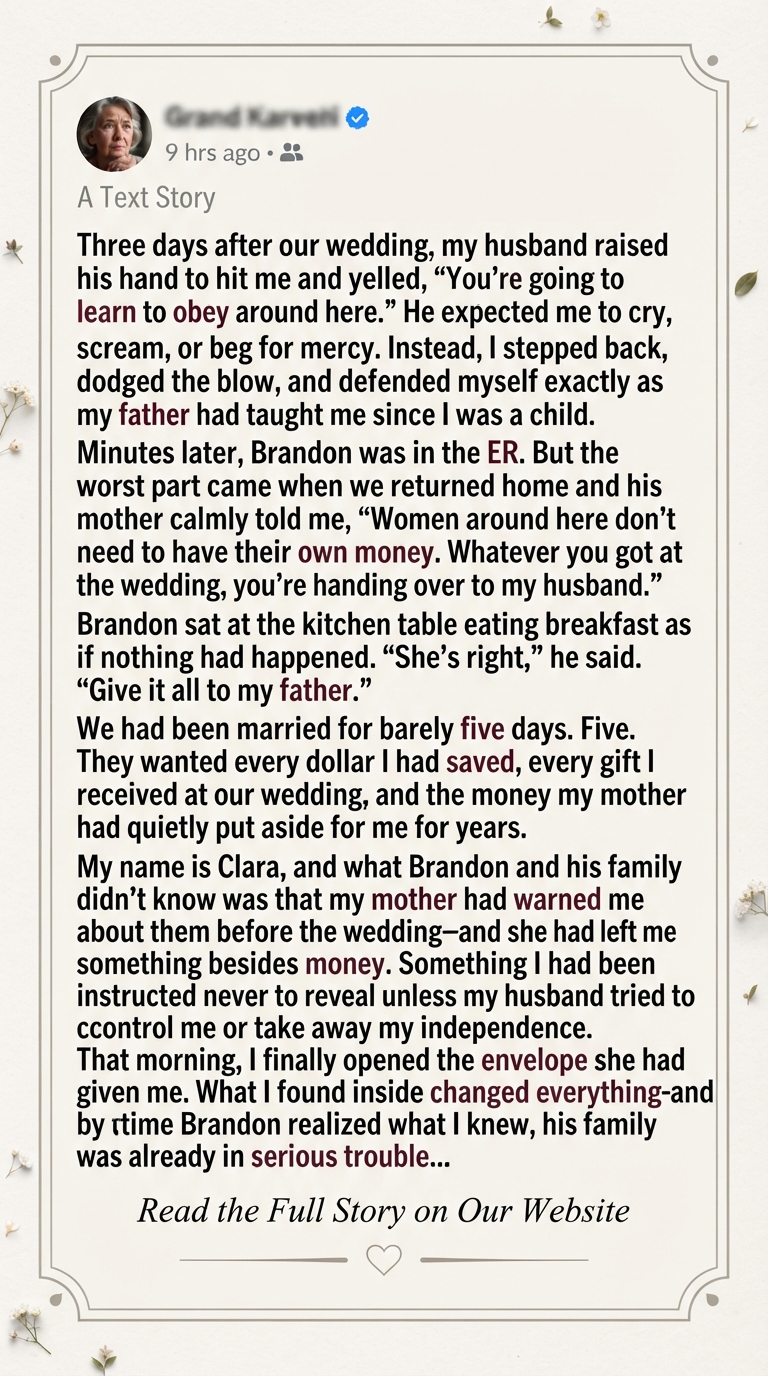
Three days after our wedding, my husband raised his hand to hit me.
“You’re going to learn to obey around here.”
His palm came toward my face.
I stepped back.
I dodged the blow.
And when he grabbed for me again, I defended myself exactly as my father had taught me since I was a child.
Minutes later, Brandon was sitting in an emergency room with a badly injured wrist and a doctor asking him how the injury had happened.
He didn’t tell the truth.
He said he’d fallen.
I said nothing.
I thought the worst was over.
I was wrong.
When we returned home, Brandon’s mother, Evelyn, was already waiting in the kitchen.
She looked at her son.
Then at me.
Then she calmly said:
“Women around here don’t need to have their own money.”
I stared at her.
She continued.
“Whatever you received at the wedding, you’re handing over to my husband.”
Brandon sat at the kitchen table eating breakfast as if nothing had happened.
“She’s right,” he said.
“Give it all to my father.”
We had been married for five days.
Five.
They wanted every dollar I had saved.
Every wedding gift.
And the money my mother had quietly put aside for me over the years.
I looked at Brandon.
Then at his mother.
And for the first time, I wasn’t afraid.
Because they didn’t know about the envelope.
The envelope my mother had given me two days before my wedding.
She had held my hands and said:
“Clara, I hope you never need to open this.”
“What is it?”
“You’ll know.”
She paused.
“But if your husband ever tries to control your money, your movements, or your safety, open it immediately.”
I had laughed nervously.
“Mom, Brandon isn’t like that.”
She looked at me for several seconds.
“I hope you’re right.”
That morning, sitting across from my new husband and his mother, I finally understood why she had looked so worried.
I went upstairs.
I opened the envelope.
And my entire understanding of my marriage changed.
Inside was a handwritten letter.
A small USB drive.
And a copy of an old financial document.
The letter began:
“Clara, if you’re reading this, something happened that I hoped never would.”
I sat on the edge of the bed.
My hands trembled.
My mother explained that several years earlier, she had met Brandon’s father, Richard, through a local business association.
At the time, Richard had approached her about investing in a small construction company.
She had almost done it.
Then her accountant discovered something strange.
The company had repeatedly moved money between related businesses.
Several loans had been made to relatives.
Some had never been repaid.
And multiple investors had complained about missing records.
My mother walked away.
But she didn’t forget.
Years later, when Brandon and I started dating, she recognized Richard’s name.
She quietly began investigating.
The USB contained copies of public business records, contracts, emails, and financial statements.
I opened the first file.
Then another.
Then another.
My stomach tightened.
Richard’s company wasn’t simply struggling.
It had been using new investors’ money to cover old obligations.
And there was something even worse.
Brandon was listed as a beneficiary of one of the companies.
Not an employee.
Not merely a relative.
A beneficiary.
My mother had discovered that Richard had been preparing to move certain assets into accounts controlled by family members.
And my wedding was apparently part of that plan.
The money I had brought into the marriage wasn’t just money to them.
It was an opportunity.
I kept reading.
Then I found a document that made my blood run cold.
A draft agreement.
It had my name on it.
The document described a proposed transfer of my personal savings into an account controlled by Richard.
I had never seen it.
I had never signed it.
But there was a line at the bottom indicating that Brandon intended to have me sign it after the wedding.
My mother had known.
She had been protecting me.
And then I found the final file.
A recorded conversation.
My mother’s voice.
And Richard’s.
He was telling her that Brandon had become “difficult to control” since meeting me.
Then he said something that made my hands go cold.
“If Clara puts her money into the family structure, we’ll finally have enough liquidity to clean everything up.”
My mother asked:
“And if she refuses?”
Richard laughed.
“Brandon will handle it.”
I stopped the recording.
I sat there in silence.
The man I had married hadn’t simply demanded my money that morning.
He had been preparing to take it.
I didn’t confront them immediately.
Instead, I called my mother’s attorney.
He listened carefully while I explained everything.
Then he said:
“Clara, do not sign anything.”
“I won’t.”
“And don’t tell them what you found.”
“Why?”
“Because if these documents are authentic, you need to preserve the evidence before they know you have it.”
He helped me make copies.
The originals stayed exactly where I had found them.
Then I called my father’s old friend, a retired investigator named Thomas.
I gave him permission to review the documents.
Two days later, he called.
“Clara, your mother was right to be cautious.”
“What did you find?”
“The company has been under financial pressure for years.”
“How bad?”
“Bad enough that several transactions deserve investigation.”
Then he said:
“There is something else.”
“What?”
“Your husband’s father has been trying to transfer ownership of certain properties before creditors can reach them.”
I closed my eyes.
“So they needed my money.”
“Yes.”
“And Brandon knew?”
“We don’t know how much he knew yet.”
I did.
He knew enough.
Three days later, Brandon came home furious.
“You embarrassed me.”
I looked at him.
“By refusing to give your father my money?”
“You’re my wife.”
“And that doesn’t make my money yours.”
He stepped toward me.
“You’re going to learn how this family works.”
I didn’t move.
“No, Brandon.”
He stopped.
“I already learned.”
His face changed.
“What does that mean?”
“It means I know about your father’s companies.”
Silence.
I watched the color leave his face.
“What are you talking about?”
“The transfers.”
His mouth opened.
Nothing came out.
“The related companies.”
He stepped backward.
“The property transfers.”
His eyes widened.
“And the money your father expected me to hand over.”
Brandon sat down.
“You don’t understand.”
“I understand enough.”
He reached for his phone.
I continued.
“My mother knew about your father before we got married.”
His hand stopped.
“She left me evidence.”
Brandon stared at me.
“What evidence?”
I smiled.
“The kind you should have worried about before you raised your hand at me.”
The following morning, investigators arrived at Richard’s office.
The documents my mother had preserved were turned over to the appropriate authorities.
The financial records were examined.
Several questionable transactions were identified.
Richard’s company was placed under investigation.
Brandon wasn’t immediately charged with anything.
But investigators discovered that he had signed documents connected to several transactions.
His claim that he knew nothing became much harder to maintain.
And then they found the draft agreement with my name on it.
The one I had never signed.
That document became one of the clearest indications that someone had intended to obtain control of my personal funds without my informed consent.
Brandon’s mother stopped calling me.
His father hired attorneys.
And Brandon suddenly wanted to talk.
Not about love.
Not about our marriage.
About the evidence.
“I never wanted you hurt,” he said.
I looked at him.
“You raised your hand at me three days after our wedding.”
“I was angry.”
“You demanded my money.”
“I was under pressure.”
“You planned to give it to your father.”
“I thought I was helping my family.”
I shook my head.
“You weren’t protecting your family.”
I stood.
“You were protecting a system that was already collapsing.”
Our marriage ended less than two months later.
I kept my personal savings.
My wedding gifts remained mine.
The money my mother had saved for me stayed exactly where it belonged.
With me.
The investigation into Richard’s business continued for months.
Some allegations were substantiated.
Others remained disputed or unresolved.
But the financial records were enough to force a complete restructuring of the company, and several transactions were referred for further legal review.
As for Brandon, he eventually moved away.
I never saw him again.
A year later, I visited my mother’s house.
She was sitting on the porch drinking tea.
I placed the envelope on the table.
“You knew.”
She looked at it.
“I suspected.”
“You knew enough to protect me.”
She reached across the table and took my hand.
“I couldn’t choose your husband for you, Clara.”
She paused.
“But I could make sure you never lost the ability to choose your own life.”
I started crying.
Not because I was broken.
Because I finally understood what she had given me.
It wasn’t the money.
It wasn’t the documents.
It wasn’t even the evidence.
It was independence.
My mother had spent years teaching me that love should never require surrendering your ability to protect yourself.
Brandon thought marriage meant ownership.
His family thought my money became theirs the moment I became their daughter-in-law.
They were wrong.
I had entered that marriage believing I was becoming part of a family.
Instead, I discovered a family trying to make me part of a financial scheme.
And the envelope my mother gave me didn’t destroy my marriage.
It revealed what the marriage had really been.
Five days after my wedding, they tried to take away my money.
They never realized that the one thing they could never take from me was the truth.