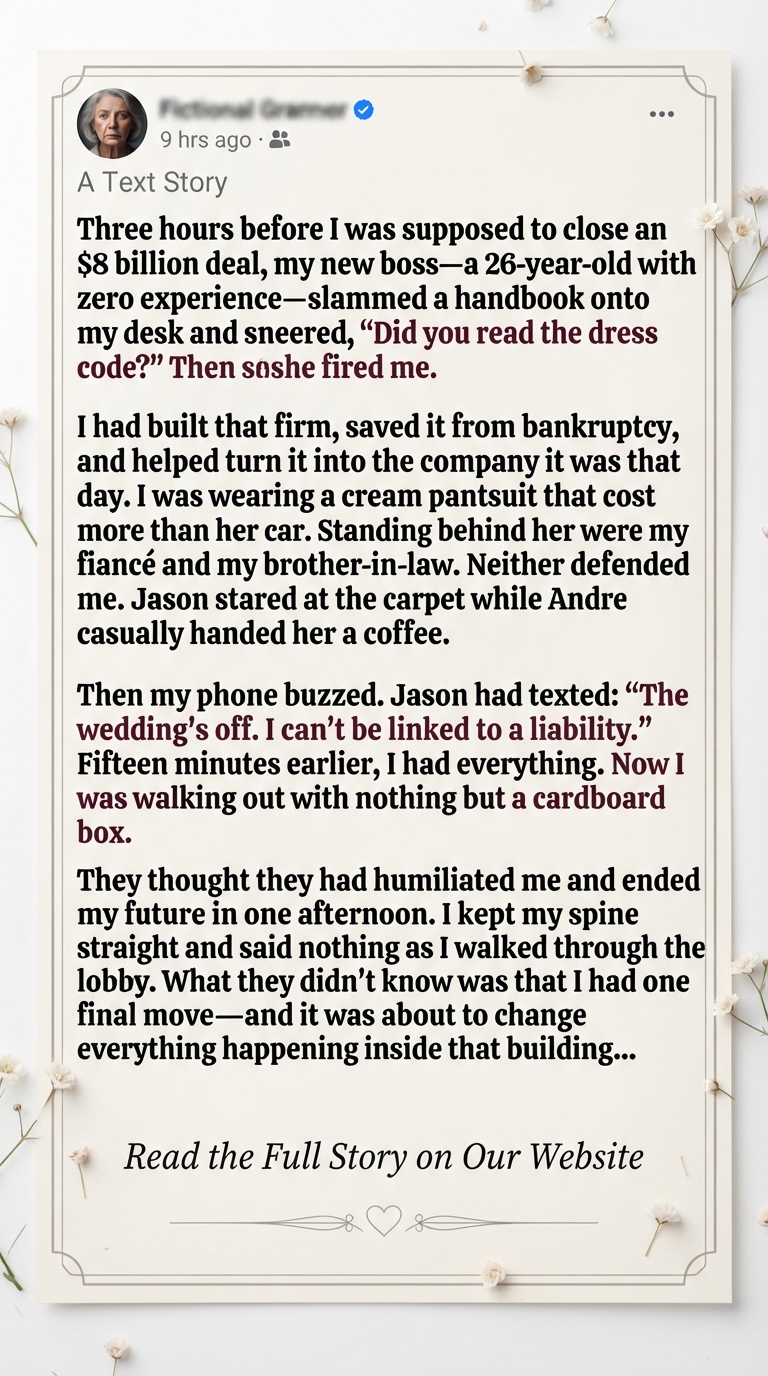
Three hours before I was supposed to close an $8 billion deal, my new boss—a 26-year-old with zero experience—slammed a handbook onto my desk.
“Did you read the dress code?”
I looked at the handbook.
Then at her.
“I’ve been wearing this company badge for twenty-three years.”
She smiled coldly.
“And now you’re wearing the wrong clothes.”
I looked down at my cream pantsuit.
It was tailored.
Professional.
Conservative.
It had cost more than her car.
But the clothes weren’t the real issue.
She had been looking for an excuse.
Everyone in the building knew it.
She was Victoria Hale, the founder’s granddaughter.
Twenty-six years old.
Fresh out of business school.
Three months into the company.
And somehow, overnight, she had become my boss.
I had built that firm.
I had joined when we had forty employees.
I helped rescue it from bankruptcy.
I negotiated our first international contracts.
I spent years working weekends and sleeping in conference rooms.
And that morning, we were three hours away from closing the largest acquisition in the company’s history.
An $8 billion deal.
A deal I had negotiated for fourteen months.
Victoria slammed the handbook onto my desk again.
“You’re fired.”
The room went silent.
Behind her stood my fiancé, Jason.
And my brother-in-law, Andre.
Neither defended me.
Jason stared at the carpet.
Andre casually handed Victoria a coffee.
I looked at Jason.
He wouldn’t meet my eyes.
Then my phone buzzed.
A text.
From him.
The wedding’s off. I can’t be linked to a liability.
I read it twice.
Fifteen minutes earlier, I had everything.
My career.
My wedding.
My future.
Now I was walking out with a cardboard box.
I kept my spine straight.
I didn’t argue.
I didn’t cry.
I didn’t tell them what I knew.
Because they had made one enormous mistake.
They thought I was the person who needed the company.
They had forgotten who actually owned the foundation of the deal they were about to close.
At the elevator, Victoria called after me.
“Don’t bother coming back.”
I turned.
“I wasn’t planning to.”
She smiled.
“You should be grateful we don’t report you for misconduct.”
I nodded.
“Of course.”
Then I walked away.
Outside the building, I placed the cardboard box in my car.
I sat behind the wheel.
And finally allowed myself to breathe.
My phone rang.
It was my attorney.
“Did it happen?”
“Yes.”
“Exactly as you expected?”
“Almost.”
He was silent.
“Are you ready?”
I looked back at the glass tower where I had spent most of my adult life.
“Yes.”
“Then send the notice.”
I opened my laptop.
One document.
One signature.
One email.
And the entire $8 billion transaction changed direction.
What Victoria didn’t know was that the company wasn’t technically the owner of the technology being acquired in the deal.
Four years earlier, when the firm nearly collapsed, I had created a separate intellectual-property holding company.
I did it because the company’s lenders were preparing to seize our most valuable assets.
I transferred the core patents into the holding company under a licensing agreement.
The firm could use them.
But it didn’t own them outright.
I did.
Or, more precisely, a trust I controlled did.
At the time, the board approved the arrangement because it saved the company.
They knew.
The attorneys knew.
The investors knew.
And Jason knew.
At least, he used to.
But after Victoria arrived, things changed.
She wanted control.
Andre wanted a promotion.
Jason wanted a wealthy bride.
And all three believed my loyalty to the company would keep me quiet.
They were wrong.
The $8 billion acquisition depended on the buyer receiving rights to the intellectual property.
Those rights couldn’t be transferred without authorization from the holding company.
And that authorization required my signature.
The signature they had just made impossible to obtain by firing me.
At 11:42 A.M., the buyer’s legal team arrived.
Victoria was waiting in the conference room.
She looked confident.
Andre sat beside her.
Jason was there too.
Victoria opened the meeting.
“We’re ready to finalize.”
The buyer’s lead attorney smiled.
“Excellent.”
He opened his folder.
Then stopped.
“Where is Ms. Carter?”
Victoria frowned.
“She no longer works here.”
The attorney looked confused.
“That’s a problem.”
Victoria laughed.
“No. She was an employee.”
He shook his head.
“She is the authorized representative of the IP holding company.”
Silence.
Victoria looked at Andre.
Andre looked at Jason.
Jason’s face went pale.
“What holding company?” Victoria asked.
The attorney turned a document toward her.
“The one that owns the patents necessary for this transaction.”
Victoria stared at the page.
Then she saw my name.
Her face changed.
“You’re telling me she owns the technology?”
“Not personally,” the attorney said. “Her family trust does.”
Victoria stood.
“That can’t be right.”
The attorney looked at her.
“It is.”
She grabbed her phone.
“Call her.”
Andre shook his head.
“She won’t answer.”
Jason already knew.
He looked down at the carpet again.
The same carpet he’d stared at when they fired me.
The buyer’s attorney closed the folder.
“Until the ownership issue is resolved, we’re suspending today’s closing.”
Victoria’s voice cracked.
“But we’ve announced this deal.”
“That is not our problem.”
The meeting ended.
The $8 billion deal was frozen.
At 1:15 P.M., my phone rang.
Victoria.
I let it ring.
Then Jason.
I let it ring.
Then Andre.
I let it ring.
Finally, my attorney called.
“They’re panicking.”
“I assumed they would.”
“Victoria wants you back.”
I laughed quietly.
“Does she?”
“She says she’ll reinstate you immediately.”
“No.”
“She offered you your old position.”
“No.”
“She offered you the executive role.”
I paused.
“What about the people she fired last month?”
“They’ll be reinstated.”
“And the employees she humiliated?”
“They’ll receive written apologies.”
I shook my head.
“Still no.”
My attorney smiled.
“I thought you’d say that.”
At 4:30 P.M., I returned to the building.
Not as an employee.
As the representative of the entity that controlled the intellectual property.
The lobby went silent when I walked through the doors.
I wore the same cream pantsuit.
The same one Victoria had mocked that morning.
My assistant from twenty years ago was waiting for me.
She smiled.
“I knew you’d come back.”
“I’m not coming back.”
She looked confused.
“Then why are you here?”
“To finish the deal.”
The conference room doors opened.
Victoria stood immediately.
“You can’t do this.”
I placed a folder on the table.
“I already did.”
She opened it.
Inside was a formal notice suspending the company’s license to use the patents pending a review of its compliance with the original licensing agreement.
Her hands began shaking.
“You’re destroying the company.”
“No.”
I looked directly at her.
“I’m preventing you from selling something you don’t own.”
Andre stood.
“You can’t just take the technology away.”
“I didn’t take anything.”
I pointed to the agreement.
“You violated the terms.”
Jason finally spoke.
“Please.”
I looked at him.
“Please what?”
He swallowed.
“I made a mistake.”
“You ended our wedding.”
“I was scared.”
“You called me a liability.”
“I didn’t mean it.”
“Yes, you did.”
He lowered his head.
I felt strangely calm.
The heartbreak was still there.
But it no longer controlled me.
The board launched an emergency investigation.
Within days, they discovered that Victoria had been appointed without the required governance approvals.
They also found that Andre had concealed several conflicts of interest.
Jason had been communicating privately with investors about replacing me months before the firing.
None of them had expected the documents to exist.
But they did.
Because I had kept records.
Every contract.
Every board resolution.
Every licensing agreement.
Every email.
For twenty-three years, I had built the company.
And for twenty-three years, I had kept copies of everything important.
The board eventually removed Victoria from executive leadership.
Andre resigned before the investigation concluded.
Jason disappeared from my life completely.
The $8 billion deal was renegotiated several months later under new leadership.
I wasn’t an employee anymore.
I didn’t need to be.
I negotiated a new licensing arrangement through my holding company.
And this time, I wasn’t sitting behind anyone else’s desk.
I was sitting across the table.
As the owner of the rights everyone had once assumed they controlled.
Six months later, I received an envelope.
Inside was my old company ID.
The one Victoria had taken from me the day she fired me.
There was a handwritten note from the board chairman.
“We owe you an apology.”
I placed the badge in a drawer.
I didn’t need it anymore.
That evening, I walked into my new office.
It was smaller than the tower downtown.
But every decision made inside it belonged to me.
My assistant handed me a cup of coffee.
“Your 3 P.M. meeting is ready.”
I smiled.
“Send them in.”
She closed the door.
I looked through the window at the city.
Three hours before the biggest deal of my career, my new boss thought a dress code could erase twenty-three years of work.
My fiancé thought calling me a liability would make him safer.
My brother-in-law thought silence would protect him.
And Victoria thought firing me meant taking control.
They were all wrong.
The company had never been the only thing I built.
I had built the contracts.
The relationships.
The intellectual property.
The records.
And most importantly, I had built something they couldn’t fire me from.
My own future.
The day they walked me out with a cardboard box, they thought they had taken everything.
They didn’t realize I had already taken the one thing they needed most.
The right to use what they thought belonged to them.