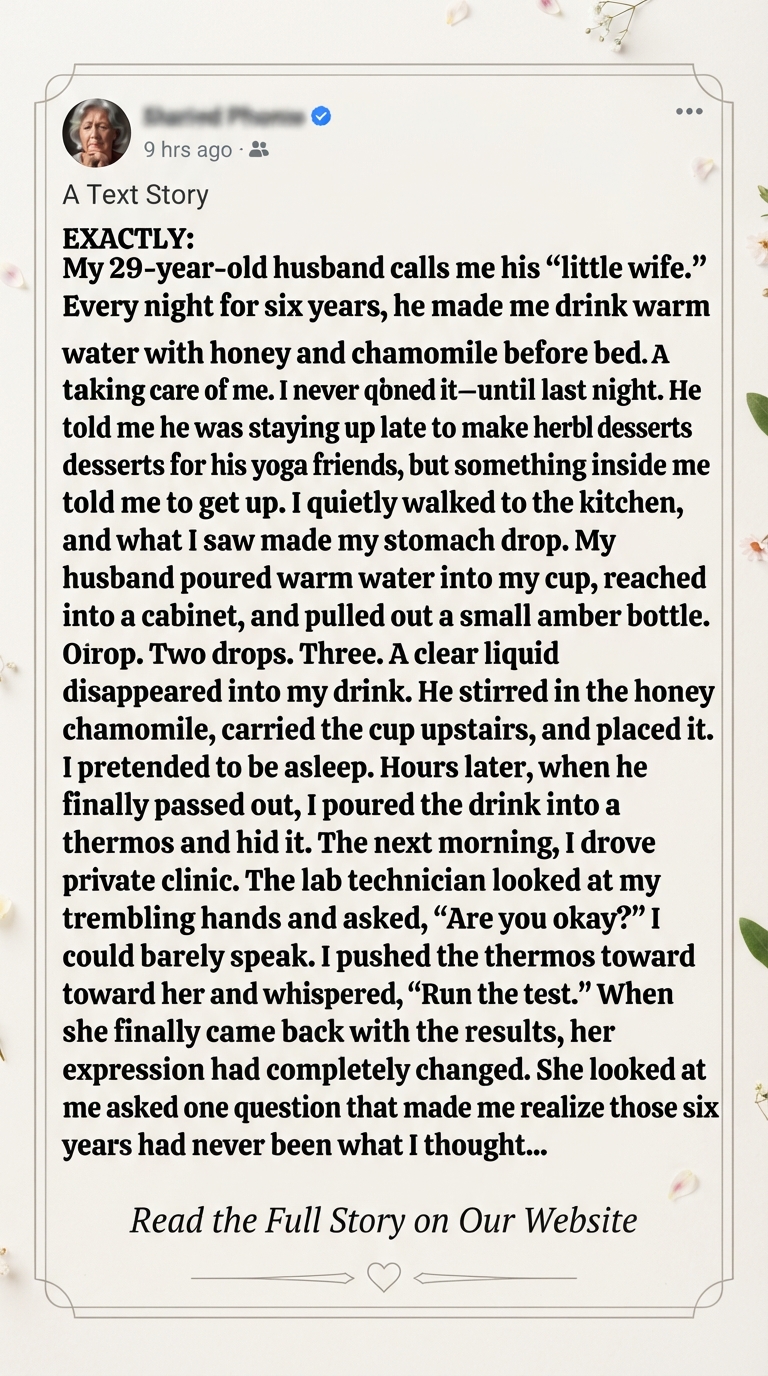
My 29-year-old husband called me his “little wife.”
He said it affectionately.
At least, that’s what I thought.
Every night for six years, he made me the same drink before bed.
Warm water.
Honey.
Chamomile.
Sometimes a little lemon.
“You need your rest, little wife,” he would say, kissing my forehead.
I thought it was sweet.
I thought I had married a man who cared about the small things.
I never questioned it.
Until last night.
Richard told me he was staying up late because he was making herbal desserts for some friends from his yoga studio.
I smiled, kissed him goodnight, and went upstairs.
But something didn’t feel right.
I couldn’t explain it.
Maybe it was the way he’d closed the kitchen door.
Maybe it was the strange look on his face when I asked what he was making.
Or maybe, after six years, some part of me had finally learned to listen to the feeling I always ignored.
I got out of bed.
Quietly.
I walked downstairs.
The kitchen light was on.
I stopped before the doorway.
Richard stood at the counter.
He wasn’t making desserts.
He was making my drink.
He poured warm water into my favorite cup.
Then he opened a cabinet.
He looked around.
He reached behind several jars.
And pulled out a tiny amber bottle.
My heart started pounding.
He twisted off the cap.
One drop.
Two.
Three.
A clear liquid disappeared into the water.
Then he added honey.
Then chamomile.
He stirred it slowly.
I stood frozen in the hallway.
Richard picked up the cup.
He walked upstairs.
I rushed back into bed and closed my eyes.
A moment later, the bedroom door opened.
He placed the cup on my nightstand.
“Goodnight, little wife.”
I didn’t move.
He waited.
Then he kissed my forehead.
I heard him leave.
I stayed perfectly still.
For nearly an hour.
Eventually, I heard his breathing become deep and steady.
I opened my eyes.
I poured the drink into an empty thermos.
Then I hid it beneath a stack of towels in the bathroom cabinet.
The next morning, I told Richard I had errands to run.
He kissed me goodbye.
“Don’t forget your tea tonight.”
I smiled.
“Of course.”
Then I drove straight to a private clinic.
I walked into the laboratory with the thermos in both hands.
The technician looked at me.
“Are you okay?”
I could barely answer.
“Run the test.”
She looked at the thermos.
“What are you testing for?”
“I don’t know.”
My voice shook.
“That’s why I’m here.”
She took the sample.
Then she told me it might take several hours.
I sat in the waiting room.
I didn’t call Richard.
I didn’t text him.
I just stared at the floor and tried to remember six years of my life.
Every bedtime.
Every cup.
Every time he told me I needed to relax.
Every morning I woke up groggy.
Every time I complained that I couldn’t remember falling asleep.
I had blamed stress.
Work.
Age.
Anxiety.
Anything except him.
Finally, the technician came back.
She wasn’t smiling.
She sat across from me.
Then she placed the report on the table.
“There is a sedative compound in this.”
My stomach dropped.
“What kind?”
She told me.
I stared at her.
“Is it dangerous?”
“At this concentration, it could cause significant drowsiness, impaired memory, and dependence if taken repeatedly.”
I couldn’t breathe.
“How long?”
She looked at the paperwork.
“If this has been happening regularly…”
She stopped.
“Six years,” I whispered.
Her expression changed.
She looked at me carefully.
Then she asked the question that made my entire body go cold.
“Why would your husband need you unconscious every night?”
I stared at her.
“I don’t know.”
But deep down, I already knew something was terribly wrong.
I drove home.
Richard wasn’t there.
I went straight to his office.
For the first time in six years, I opened the drawers he always kept locked.
Inside, I found something I never expected.
Not another bottle.
Not money.
Not photographs of another woman.
A file.
My name was on it.
I opened it.
Inside were medical reports.
My medical reports.
Blood tests.
Sleep studies.
Psychological evaluations.
Dates.
Notes.
And pages of handwritten observations.
Subject remains unaware.
Memory impairment continues.
Nighttime compliance remains high.
My hands started shaking.
Then I found photographs.
Pictures of me asleep.
Different rooms.
Different nights.
Different years.
I dropped them.
My knees nearly gave out.
Then I found the document underneath them.
A life-insurance policy.
My name was the insured.
Richard was the beneficiary.
The policy had been increased twice during our marriage.
I felt sick.
But then I noticed something.
The dates.
The latest increase had happened three months ago.
I kept searching.
And that’s when I found the final folder.
It contained copies of emails between Richard and an attorney.
I read the first one.
Then the second.
Then the third.
My hands went numb.
Richard wasn’t planning to kill me.
He was planning to convince everyone that I was mentally deteriorating.
For six years, he had been keeping records of every forgotten conversation, every missed appointment, every morning I couldn’t remember how I had fallen asleep.
He had even encouraged me to see a therapist.
He wanted a paper trail.
A diagnosis.
A story.
And I suddenly understood why.
Three weeks earlier, Richard had asked me to sign documents giving him control over our finances “in case my memory problems got worse.”
I had refused.
He had smiled.
“You don’t trust me?”
I had felt guilty.
Now I understood.
He wasn’t preparing to care for me.
He was preparing to make me disappear while I was still alive.
But there was something else in the file.
A letter from an insurance investigator.
Richard had previously attempted something similar with his first wife.
I read the sentence three times.
His first wife hadn’t died from an accident.
She had survived.
And she had eventually left him.
The investigator had suspected that Richard had been drugging her as well.
But she had been too frightened to testify.
I sat on the floor of his office.
For six years, I had believed I was the lucky woman who had married a man who cared enough to make her a bedtime drink every night.
The truth was much darker.
He wasn’t calling me “little wife” because I was precious to him.
He used the name because it reminded him that he thought he had made me small.
Dependent.
Forgetful.
Easy to control.
That afternoon, I copied everything.
The medical records.
The photographs.
The emails.
The insurance documents.
And the laboratory report.
Then I called an attorney.
The next evening, I came home before Richard expected me.
He was already in the kitchen.
Making my drink.
He smiled.
“There’s my little wife.”
I looked at the amber bottle sitting beside him.
Then I smiled back.
“I’m not your little wife anymore.”
His face changed.
He froze.
I placed the laboratory report on the counter.
Then the photographs.
Then the insurance documents.
He stared at them.
“You went through my office.”
“No.”
I looked directly into his eyes.
“I went through your lies.”
He didn’t speak.
“You’ve been drugging me for six years.”
His mouth opened.
Nothing came out.
“You photographed me while I slept.”
Silence.
“You built a medical history to make me look mentally incompetent.”
He finally whispered, “You don’t understand.”
“I understand everything.”
Then I placed one final document on the counter.
A copy of the report concerning his first wife.
Richard’s face went white.
“You had no right—”
“You were never taking care of me.”
I stepped closer.
“You were studying me.”
That was when he finally broke.
Not because he was sorry.
Because he realized I had evidence.
Police arrived less than an hour later.
The investigation uncovered years of financial records, prescription purchases, falsified notes, and communications with the attorney.
The case eventually went to court.
Richard was convicted of multiple offenses related to the drugging, financial fraud, and abuse.
And I left that house with one thing I hadn’t had in six years.
A clear mind.
Months later, I returned to the clinic.
The technician who had tested the drink recognized me.
She smiled.
“How are you doing?”
I smiled back.
“I’m sleeping better.”
She laughed softly.
“That’s good.”
I looked through the clinic window at the morning sunlight.
For years, I had thought sleep was something my husband gave me.
I finally understood.
It was something he had taken from me.
My memories.
My confidence.
My independence.
My ability to trust my own mind.
But he couldn’t take my instincts.
That tiny voice inside me had survived all six years.
And one night, it finally told me to get out of bed.
That was the night everything changed.
The amber bottle hadn’t revealed what kind of husband Richard was.
It revealed what kind of prisoner he had been trying to make me.
And the woman he called his “little wife” became the woman who finally walked away from him with her life, her memory, and her freedom intact.