Twenty-nine years.
That was how long I had worked the counter at the Gas-N-Go on 26th.
Twenty-nine years of opening the doors before sunrise.
Twenty-nine winters of scraping ice from the windshield while snow piled against the pumps.
Twenty-nine summers of selling cold drinks to construction crews and handing out free cups of ice water to anyone who looked overheated.
I knew which truckers took their coffee black.
I knew which teachers stopped in every morning at 6:15.
I knew which kids came in after school with exactly enough change for a candy bar.
And I knew when someone needed more than coffee.
Sometimes, they needed someone to listen.
Then the new owner arrived.
His name was Derek Hale.
He was thirty-two, wore expensive watches, and talked constantly about “modernizing the customer experience.”
On his second week, he told me the store needed a younger image.
I laughed.
I thought he was joking.
He wasn’t.
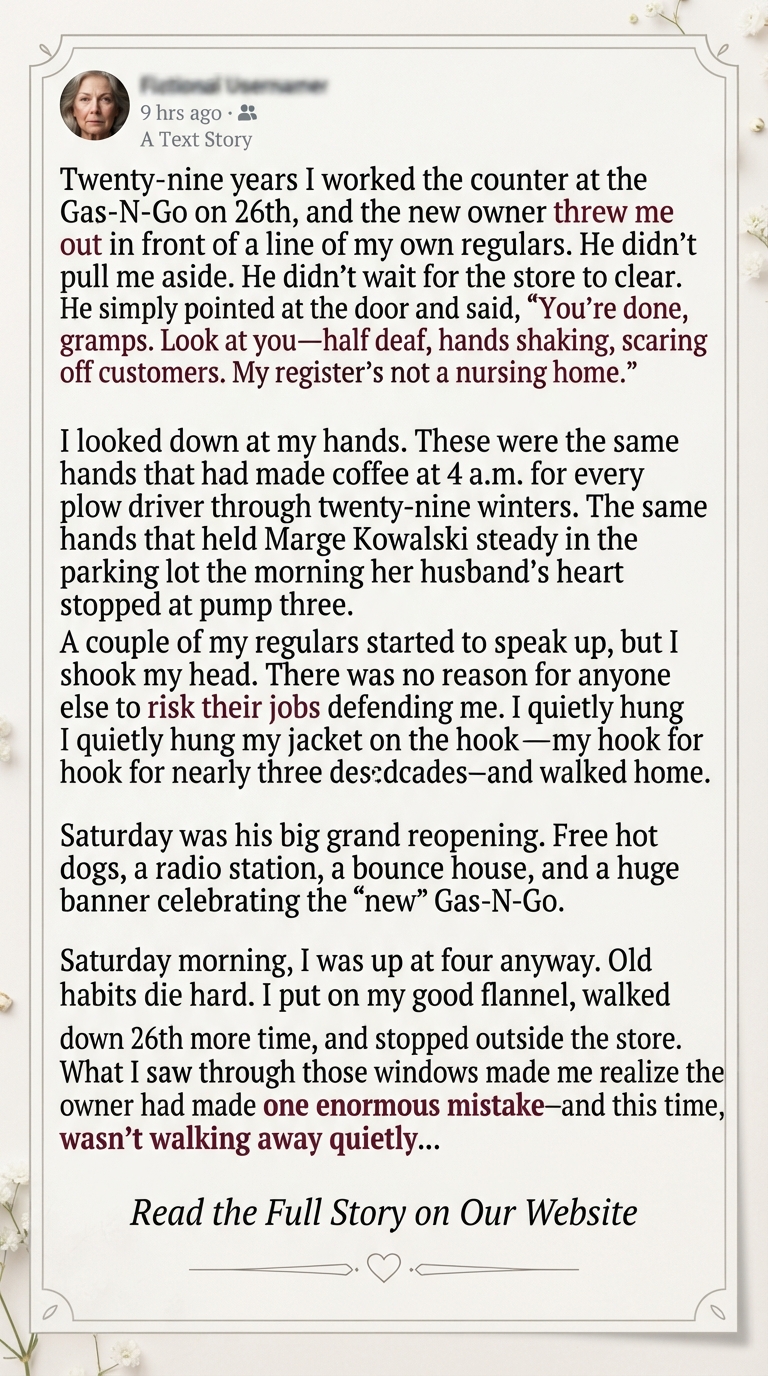
One Tuesday morning, with a line of customers behind me, Derek pointed toward the door.
“You’re done, gramps.”
The store went silent.
He folded his arms.
“Look at you. Half deaf. Hands shaking. Scaring off customers. My register’s not a nursing home.”
I looked down at my hands.
They were shaking.
He was right about that.
But he didn’t know why.
Those hands had made coffee at four in the morning for twenty-nine winters.
Those hands had carried boxes for elderly customers who couldn’t lift them.
Those hands had held Marge Kowalski steady in the parking lot the morning her husband collapsed beside pump three.
Those hands had signed emergency forms for a teenager whose mother couldn’t get there.
And those hands had held my wife’s hand through twelve years of doctor’s appointments before she passed away.
I looked around the store.
Several regulars were staring at Derek.
One opened his mouth to speak.
I shook my head.
Don’t.
There was no reason for anyone else to risk their job defending me.
I took off my jacket.
I hung it on the hook beside the cooler.
My hook.
The same hook I’d used for nearly three decades.
Then I walked out.
I didn’t slam the door.
I didn’t curse.
I didn’t threaten him.
I just went home.
For the first time since 1997, I didn’t have to set an alarm.
But Saturday morning, I woke up at four anyway.
Old habits die hard.
I made coffee.
Put on my good flannel.
And walked down 26th Street.
That was the day of Derek’s grand reopening.
There were balloons everywhere.
A radio station van sat outside.
A bounce house occupied half the parking lot.
A huge banner stretched across the building:
WELCOME TO THE NEW GAS-N-GO!
I stopped across the street.
Then I looked through the windows.
And my stomach dropped.
The store was nearly empty.
Not empty of people.
Empty of the people who mattered.
I recognized every face outside.
Marge Kowalski was standing near the curb.
So was Frank, the retired mail carrier.
Mrs. Alvarez, who bought the same newspaper every morning.
The snowplow drivers.
The teachers.
The construction workers.
Even the teenagers who had grown up and now brought their own children.
They weren’t there for the grand reopening.
They were there for me.
Marge saw me first.
She crossed the street.
“Tom.”
I smiled.
“What are you all doing here?”
She looked at the store.
“Waiting.”
“For what?”
She handed me an envelope.
“You need to open this.”
I looked at the front.
It had my name on it.
Inside was a petition.
Three hundred and eighteen signatures.
Every signature belonged to someone who had worked, shopped, lived, or driven through that neighborhood.
At the top was one sentence:
BRING TOM BACK.
I swallowed hard.
“Marge…”
She shook her head.
“No. Read the last page.”
I turned to the back.
There was a letter.
It wasn’t from a customer.
It was from the previous owner of Gas-N-Go.
Mr. Harold Bennett.
I hadn’t seen him in almost two years.
The letter said:
Tom, if you’re reading this, Derek has probably done exactly what I feared he would.
I looked up.
“What?”
Marge pointed at the store.
“Keep reading.”
I continued.
When I sold Gas-N-Go, I didn’t just sell the building. I sold the business under one condition. The new owner had to preserve the community agreement that had been in place for decades.
My hands began to tremble.
Not from age.
From realization.
The agreement required the store to maintain certain community services.
Free coffee for overnight emergency workers.
A local bulletin board.
Support for neighborhood fundraisers.
And most importantly, an employee protection clause for workers with more than twenty years of service.
I read the next line twice.
Tom, you were the reason I included that clause.
I stared at the paper.
Derek hadn’t just fired me.
He had violated the purchase agreement.
And there was more.
The final page contained an attorney’s letter.
The sale agreement gave me the right to buy the business back if Derek violated the community provisions.
At a predetermined price.
A price negotiated before the neighborhood had exploded in value.
A price that was less than half of what the property was now worth.
I looked at Marge.
“You knew?”
She smiled.
“Harold called me the day before you were fired.”
“Why didn’t you tell me?”
“Because he wanted you to decide for yourself.”
Then a black SUV pulled up.
Harold Bennett stepped out.
He was eighty-one and walked with a cane.
I hadn’t seen him since his retirement.
He smiled.
“You still walking the same route?”
I laughed.
“Every morning.”
He looked toward the Gas-N-Go.
“Then I suppose it’s time you walked through those doors again.”
Derek suddenly came outside.
He looked irritated.
“What is this?”
Harold held up the agreement.
“You fired Tom.”
Derek scoffed.
“He’s an old man who can’t keep up.”
Harold’s expression hardened.
“You didn’t fire an employee.”
He pointed toward the building.
“You violated the contract that allowed you to own this place.”
Derek’s face changed.
“What are you talking about?”
“My attorney already sent the notice.”
Derek looked at me.
“You can’t buy this place.”
I smiled.
“I don’t need to.”
He looked confused.
“Because according to your contract…”
I held up the final page.
“…you already agreed to sell it back to me.”
The crowd went silent.
Derek’s face turned pale.
“You don’t have that kind of money.”
I looked at the people standing behind me.
Then I smiled.
“I don’t need it.”
Marge stepped forward.
Then Frank.
Then Mrs. Alvarez.
Then the plow drivers.
Then dozens more.
Because they had already raised the money.
Not to make me rich.
To give me back the place that had become part of their lives.
But there was one more surprise.
Harold pulled a set of keys from his pocket.
“I’ll cover the remaining amount.”
I stared at him.
“You can’t do that.”
He smiled.
“You spent twenty-nine years taking care of everyone else.”
He put the keys in my hand.
“Let somebody take care of you for once.”
I couldn’t speak.
Derek eventually signed the papers.
His grand reopening lasted less than three hours.
The radio station packed up.
The bounce house disappeared.
The balloons were gone by noon.
By Monday morning, the sign outside had changed.
It no longer said:
THE NEW GAS-N-GO.
It simply said:
GAS-N-GO — SERVING 26TH STREET SINCE 1987.
I reopened the doors at 4:30 a.m.
The first customer was a snowplow driver.
He walked in, took off his hat, and smiled.
“Morning, Tom.”
I poured his coffee.
“Black?”
He laughed.
“Like always.”
Then Marge walked in.
She hugged me.
Frank brought a box of donuts.
Mrs. Alvarez took her usual seat by the window.
And one by one, the neighborhood came back.
A few months later, I hired two teenagers from the neighborhood.
I taught them everything I knew.
Not just how to run a register.
How to remember people’s names.
How to notice when someone needed help.
How a gas station could become more than a place to buy gasoline.
It could become a place where people knew they weren’t invisible.
One morning, one of the teenagers looked at my shaking hands while I poured coffee.
“Mr. Tom?”
“Yeah?”
“Doesn’t it bother you that your hands shake?”
I looked at them.
Then I smiled.
“No.”
“Why not?”
I placed the coffee on the counter.
“Because these hands have done a lot of good things.”
He looked at me.
“Like what?”
I glanced around the store.
“At least one.”
He smiled.
“What’s that?”
I pointed toward the coffee machine.
“They’re still making your coffee.”
And every morning after that, when the doors opened at 4:30, my old hook was still there beside the cooler.
But now there was a small brass plaque beneath it.
It read:
TOM’S HOOK
And underneath, someone had added six words:
Twenty-nine years. Never forgotten. Never replaced.